Brian Lane Herder, The United States Navy 1914-18 (Osprey, 2025)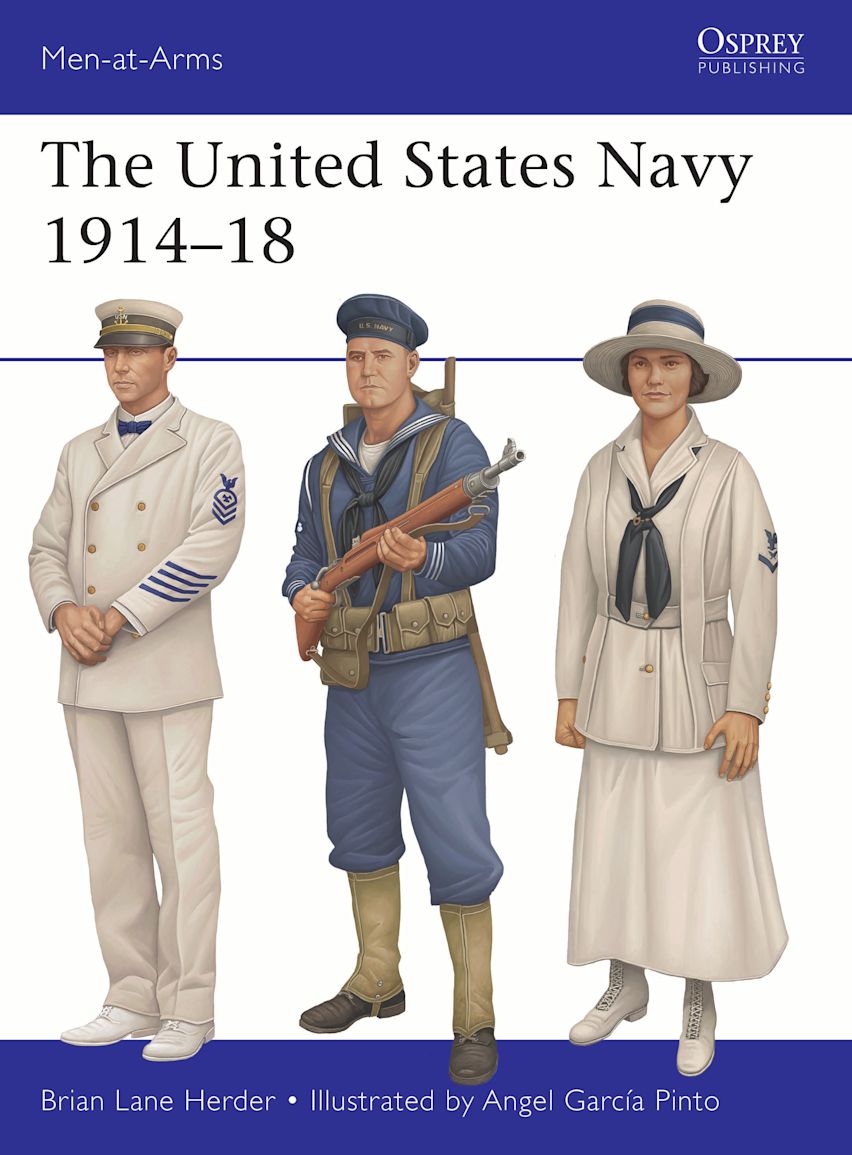
It might come as a surprise to find out that the United States Navy in 1914 was the third largest in the world. When the European war broke out, the US could call on 33 battleships, including 10 dreadnoughts, and that was before a massive construction programme ordered in 1915 by President Wilson. They also had suitable war plans, Black and Orange, for the Pacific and Atlantic fleets. In this book on the US Navy by Brian Lane Herder, he notes that despite such lofty ambitions, the Navy’s wartime action in the Great War was mostly spent on convoy protection and transport duties, and the major ships planned for fleet battles were never completed.
Herder provides a description of the fleet, beginning with its command structure, including the auxiliaries, the Marine Corps, and the Coast Guard. Fleet organization follows and the yards and bases employed by the Navy. Herder also surveys the ships, from the mighty battleships down to gunboats and submarine chasers. The US Navy, in keeping with the other major powers, developed a rudimentary airpower, first dabbling in balloons and then fixed-wing aircraft. The US Navy was not completely idle during the War, involving itself in operations in Mexico, Haiti, and the Dominican Republic, then into the North Atlantic in 1917, where Herder delves into their transport and supply actions and the war on U-boats. Perhaps incongruously, the US Navy operated railway artillery on the Western Front in 1918. Herder leaves his consideration of naval personnel until last, with an overview of recruitment, training, pay, nursing, the Yeomanettes, and the use of landing parties. After the War, he notes, the US Navy suffered a crisis of purpose that stretched into the inter-war years.
This is a slim volume in Osprey Publishing’s Men-at-Arms series, but a useful one. The US Navy has a proud tradition, though its reputation as a potent fighting force on the world stage is relatively recent, dating to World War II. Herder’s survey highlights an important step along that road to power, even if the US’s naval ambition was not realised in the Great War: there is also an interesting ‘what if?’ just below the surface in Herder’s book. The colour plates of service people don’t quite match the text, which is mostly about the ships and aircraft, but figure modellers will appreciate them, and they are of the usual high quality. The photographs and illustrations sprinkled throughout the book are more on point and add to what is an entertaining and informative read.