by RNS | Nov 29, 2025 | Beating Tsundoku
Angus Konstam, Royal Navy Monitors of World War II (Osprey, 2025)
One of the most unusual warships of World War II was the Royal Navy’s monitor. The design was simple: a battleship gun turret with a ship built around it. It’s sole purpose was to bombard enemy positions on land in support of Allied operations. The prolific Angus Konstam describes these warships and how they went about their business.
Konstam points out that the Royal Navy had 15 capital ships at the outbreak of World War II, but they were employed with the two main battle fleets. That left a requirement for shore bombardment operations. The answer, at least partially, was the monitors. Konstam traces the origin of the monitors to the Great War, when the RN had forty of them of various sizes, but almost all of them were scrapped by the opening of World War II. Konstam notes that Winston Churchill championed the production of new monitors equipped with two 15-inch guns. These were designed to fit the necessary parameters for modern combat, updating the Great War models. Four 15-inch monitors took to the high seas in World War II, but only two or three at a time. Smaller monitors stayed on harbour duties. Konstam takes us through their operational history, beginning with HMS Erebus then HMS Terror, HMS Roberts, HMS Abercrombie, and the harbour monitors. From there, Konstam focuses on the purpose of the monitors, namely naval gunfire support. He works through the process of identifying and hitting targets, often using aerial reconnaissance. Konstam also examines how the big guns functioned, looking at process and personnel. The operations where the big guns made a difference follow, including Operation Neptune, the naval part of the D-Day landings. Konstam closes with some specifications and modifications of the monitors.
Royal Navy Monitors of World War II is another solid Osprey book from Angus Konstam. He deftly narrates the development of these unusual warships, digs into the nuts and bolts of how they operated, and narrates the ships in action. Konstam is aided by excellent graphic illustrations, ship’s diagrams, and photographs, which should keep modellers happy. Anyone who reads World War II naval history, particularly when it comes to the more obscure warships, will enjoy this book.

by RNS | Nov 25, 2025 | Beating Tsundoku
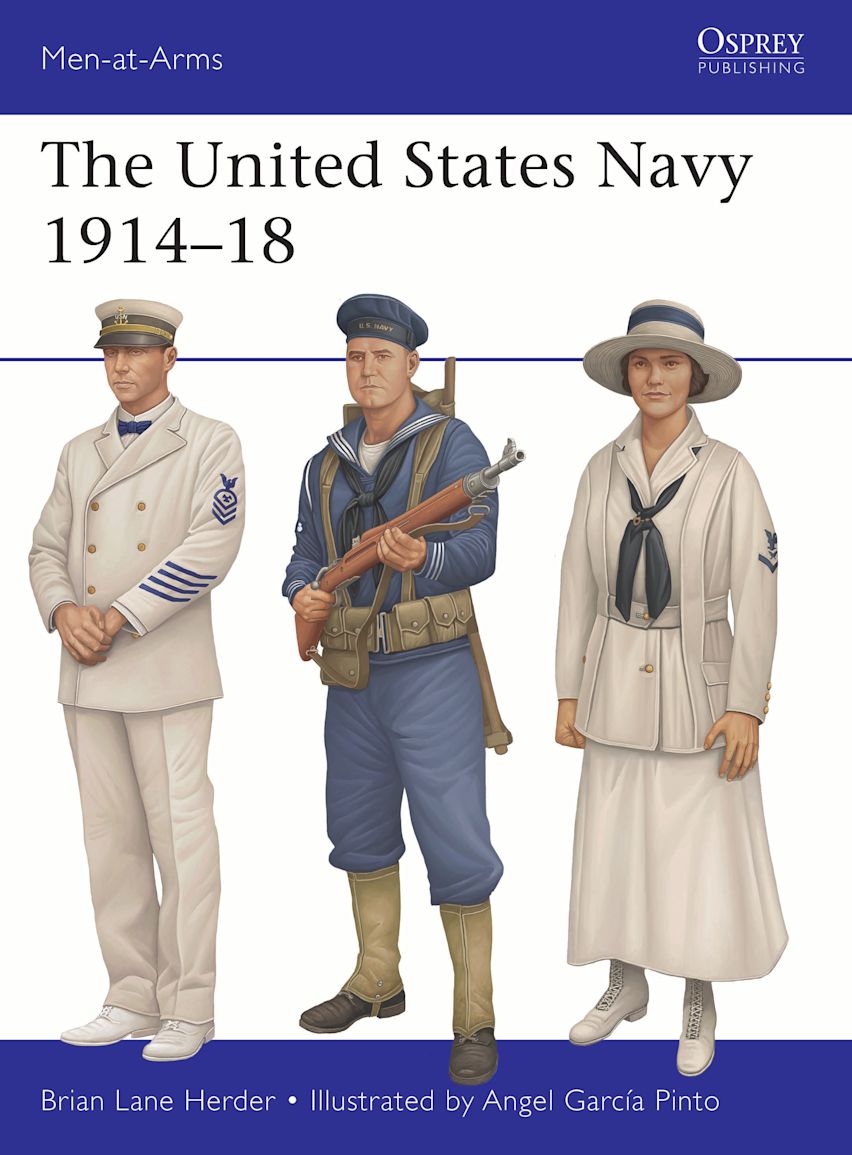
Brian Lane Herder, The United States Navy 1914-18 (Osprey, 2025)
It might come as a surprise to find out that the United States Navy in 1914 was the third largest in the world. When the European war broke out, the US could call on 33 battleships, including 10 dreadnoughts, and that was before a massive construction programme ordered in 1915 by President Wilson. They also had suitable war plans, Black and Orange, for the Pacific and Atlantic fleets. In this book on the US Navy by Brian Lane Herder, he notes that despite such lofty ambitions, the Navy’s wartime action in the Great War was mostly spent on convoy protection and transport duties, and the major ships planned for fleet battles were never completed.
Herder provides a description of the fleet, beginning with its command structure, including the auxiliaries, the Marine Corps, and the Coast Guard. Fleet organization follows and the yards and bases employed by the Navy. Herder also surveys the ships, from the mighty battleships down to gunboats and submarine chasers. The US Navy, in keeping with the other major powers, developed a rudimentary airpower, first dabbling in balloons and then fixed-wing aircraft. The US Navy was not completely idle during the War, involving itself in operations in Mexico, Haiti, and the Dominican Republic, then into the North Atlantic in 1917, where Herder delves into their transport and supply actions and the war on U-boats. Perhaps incongruously, the US Navy operated railway artillery on the Western Front in 1918. Herder leaves his consideration of naval personnel until last, with an overview of recruitment, training, pay, nursing, the Yeomanettes, and the use of landing parties. After the War, he notes, the US Navy suffered a crisis of purpose that stretched into the inter-war years.
This is a slim volume in Osprey Publishing’s Men-at-Arms series, but a useful one. The US Navy has a proud tradition, though its reputation as a potent fighting force on the world stage is relatively recent, dating to World War II. Herder’s survey highlights an important step along that road to power, even if the US’s naval ambition was not realised in the Great War: there is also an interesting ‘what if?’ just below the surface in Herder’s book. The colour plates of service people don’t quite match the text, which is mostly about the ships and aircraft, but figure modellers will appreciate them, and they are of the usual high quality. The photographs and illustrations sprinkled throughout the book are more on point and add to what is an entertaining and informative read.

by RNS | Nov 20, 2025 | Beating Tsundoku
Dickon Whitewood, Stoke Field 1487 (Osprey, 2025)
There is a common misconception that the Battle of Bosworth, in 1485, ended the Wars of the Roses. After all, at Bosworth, the armies of a king and his usurper met in combat to decide the throne for the final time, right? Except it wasn’t. Henry Tudor defeated Richard III and seized the throne. But the issue was far from settled, and it would take another battle, at Stoke Field in 1487 to finally close the book on the Wars of the Roses. In this new book in Osprey Publishing’s Campaign series, Dickon Whitewood tells that story.
Whitewood explains why things were not quite settled after Bosworth and support for Henry was not guaranteed. Early in his reign, Henry faced down two misfiring rebellions, then came the curious case of the ‘imposter’ Lambert Simnel that initially led to some confusion followed by a purge of Henry’s enemies that did little to settle matters. Whitewood leaves his narrative to discuss the opposing commanders. Here, Whitewood retells the story of Henry’s upbringing and rise to power, and he offers brief biographies of Henry’s commanders. John de la Pole, Earl of Lincoln, led the rebel army. He was aided by, among others Thomas Fitzgerald of Laccagh and the Swiss mercenary captain Martin Schwarz. The armies they commanded are Whitewood’s next stop. He examines the problems of recruitment, with Henry recruiting in the usual monarchical fashion, while the rebels had some feudal support but had to raise mercenary forces to supplement their army. The thorny historical problem of numbers at the battle also receives Whitewood’s attention. The plans of the opposing sides and their strategic pre-battle manoeuvring comes next. This was a campaign with only one destination for both commanders, the throne of England, while the path to get there was as complex as most other Wars of the Roses campaigns. That journey ran via Stoke Field, near Nottingham.
To set up his narrative of the battle, Whitewood surveys the battlefield, which, for once, we know where it was. There is some confusion, Whitewood notes, over the rebel battlefield command structure and deployment. It would appear, though, that all the factors were stacked against them. The battle began without most of the Royal army present when the outnumbered vanguard, under Oxford, almost immediately closed to contact. The rebels advanced under a hail of arrows, and the two sides clashed in ferocious combat. The Royalists held then counter-attacked, killing many of the rebel commanders and ultimately scattering their army. Henry’s hold on the crown was all but assured. Whitewood notes the rewards and punishments that followed Henry’s victory and some subsequent plots against him that came to nothing. Whitewood concludes with a short section on the battlefield today.
This book is an excellent introduction to the Battle of Stoke Field. Whitewood walks us through the main issues in play and how they came about, not the easiest feat when it comes to the often complicated Wars of the Roses. We also get a good sense of the commanders and their armies before Whitewood embarks on his narrative of the battle, which he tells succinctly and clearly. He is helped by Osprey’s usual impeccable graphic artwork, both in illustrations and maps. Readers of late medieval military history and the Wars of the Roses will enjoy Whitewood’s efforts.

by RNS | Nov 10, 2025 | Beating Tsundoku
Mark Edward Lender & James Kirby Martin, War Without Mercy (Osprey, 2025)
The myth of the American Revolution as an honourably conducted war has been under attack by some military historians for a while now. What was once seen as a war fought under a shared set of rules and standards of behaviour, with a few isolated exceptions, is no longer tenable. Yet the myth still exists, particularly in the political arena, and particularly on the Patriot side. In War Without Mercy, Mark Edward Lender and James Kirby Martin explode that perception and dig into the root causes of what was often a vicious existential war especially on the margins: ‘Liberty or Death’ was not so much a mere slogan but a statement of intent.
In this analysis of the Revolution’s military conduct away from the major armies, Lender and Martin highlight the local nature of the vast majority of military action with no constraining power to regulate engagements. In such circumstances, grievances and retaliations went unchecked, resulting in extreme violence. Such violence, the authors note, was nothing new on the frontiers against and between the Indians or internally against enslaved Black people. Acts of rebellion in the colonial period were also dealt with harshly, and that attitude continued into the revolutionary era. Lender and Martin add the impact of political ideology into the mix, which often led to terrorist actions, chiefly against Loyalists with the attendant retaliations that followed. The authors also consider the shock and then fury amongst Loyalists in their reactions to what was a profoundly shocking revolution. Once such a melting pot of preconditions for violence spilled over into a myriad of violent actions in the early stages of the Revolution, the momentum for further violence became self-justifying. And the authors detect this across all the colonies and communities involved in the Revolution from New Jersey down through the Carolinas and westward into the frontier regions and out to sea, noting that the further away from the main armies or centres of power, the more unrestrained the violence became. They conclude that this was indeed an existential war and fought without mercy.
War Without Mercy is an excellent study of the extreme violence that consumed the American Revolution. Lender and Martin set out their stall admirably and support their arguments with a plethora of grim and gruesome examples drawn from all across the colonies; some of which might be expected, such as the vicious frontier fighting, but others perhaps less so, especially in the northern colonies. Readers of military history, particularly those that study the subject at ground level, might be less surprised at the conclusions drawn by Lender and Martin, and those that already accept the Revolution as predominantly a civil war will expect the atrocities that so often accompany internal strife. For others, still labouring under the delusion of a clean overthrow of British rule, Lender and Martin’s findings might come as a profound shock. Whatever the case, in this fascinating analysis, Ender and Martin have demonstrated that any understanding of the American Revolution must take into account the existential nature of the conflict.

by RNS | Nov 2, 2025 | Beating Tsundoku
Brian Lane Herder, Manila Bay 1898 (Osprey, 2025)
Most students of US history know the importance of the Spanish-American War, particularly with regard to the nascent American imperialism of the late 19th Century. The shattering of the Spanish fleet at Manila Bay in May 1898 played a significant role in fostering US control over the Pacific. In this book in Osprey’s Campaign series, Brian Lane Herder examines the actions that led to the fall of Manila and its place in the broader flow of events.
Herder places the battles at Manila Bay in their strategic context, setting them against the declining Spanish empire and a rising United States, which was stretching its wings across the seas after consolidating its internal land ‘frontiers’. In the Pacific Ocean, the US dominated Hawaii with a view to annexation. Then came the Filipino Revolution of 1896 and, in 1898, the Cuban Crisis and the ‘Maine Incident’, prompting a US ultimatum for the Spanish to evacuate the island. That led directly to war in April 1898.
Of the commanders at Manila Bay, Herder finds that the Spanish were ‘gloomy, fatalistic’ generals under threat of execution if they did not defend at all costs. For the Americans, Commodore George Dewey stands out as the leading commander. For the Filipinos, Herder highlights Generalissimo Emilio Aguialdo y Famy and General Mariano Noriel as inspirational revolutionary leaders. Herder considers the forces involved in the fighting, including the Spanish defences at Manila Bay, which looked better on paper than in practice. Herder also covers the main naval squadrons and the army, commanded by an obsolete officer class. The US navy was greatly underestimated although it had reinvented itself in the late 19th Century to become a modern, powerful fleet. The US army had also expanded and modernised by 1898. The Filipino insurgency also fielded an ‘effective and disciplined’ but logistically limited army. Herder argues that the Spanish knew they would lose the war, but that they must do so with honour. Defending the Philippines, however, offered their best chance of success. The Americans adopted a strategic approach, part of which was to attack the Spanish fleet in Manila Bay. The Filipinos wanted revolution, and supporting the US was their best shot at that, although they operated in an atmosphere of mutual distrust.
Moving on to the campaign, Herder describes the extensive US preparations for war and their resolve to attack the Spanish in the Philippines. The US fleet in the region, under Dewey, inspected an empty Subic Bay, which meant the Spanish were in Manila Bay. The firing began with the shore batteries, but the US fleet ploughed on. They found the Spanish fleet off the Cavite Peninsula and opened fire. Herder narrates the action in what was a decidedly one-sided affair. With the Spanish fleet defeated, the Americans blockaded Manila. European ships soon arrived to observe, including the belligerent Germans who seemed to side with the Spanish for reasons still unknown. On land, the insurgents placed Manila under siege. Other insurgent operations led to the declaration of independence on 12 June. It took a while to organise the US land force for a Philippines expedition, and they didn’t sail until June, though they seized Guam along the way. Meanwhile, a powerful Spanish fleet that had sailed for the Philippines had to return to Spain to prevent a feared US naval assault. Back in Manila, the US expeditionary force had arrived. After a precarious start, the Americans built their strength to the point where the Spanish agreed to surrender the city but only after a fake battle to save their honour, which turned into the real thing. Spanish surrender was inevitable, however, and came on 13 August. The Filipinos were all but shut out of the city, but they would go on later to fight the Americans in a bloody war that lasted until 1901. The Philippines would not gain independence until 1946.
The Spanish-American War still causes controversy amongst historians, and Herder does well to include those issues within a tightly written narrative of events. Clearly, there is much more to all this, particularly on the political side, but Herder does enough to set the action at Manila Bay into its strategic context. This brief survey, therefore, scratches an itch while leaving the door open to further reading for those so inclined. As is customary, Osprey’s production values shine through with some excellent illustrations and graphics and a useful collection of photographs, especially of the various ships involved. Manila Bay 1898 is an interesting and entertaining read for anyone interested in US military and imperial history.