by RNS | May 26, 2026 | Beating Tsundoku
John Jordan, ed., Warship 2026 (Osprey, 2026)
Warship is an annual wide-ranging collection of articles written by notable experts in the field of maritime history. In this year’s edition, the subjects covered are an eclectic group: Russian Novik class destroyers; battle damage on RN fleet carriers during WWII; the inter-wars Imperial Japanese fleet; Imperial German torpedo boats; Allied escort forces in World War II; French 450-tonne destroyers; Royal Danish minesweepers; the capture of World War I German codebooks; Royal Navy training ships; the story of the Italian aircraft carrier Falco; and there is a useful and sometimes robust review section of the past year’s naval history books.
All of the articles take deep dives into their topics, making this a book primarily for the committed naval military history reader. However, they are well written and supplemented with a cornucopia of photographs, ship diagrams, and technical tables. The diversity of articles makes some more interesting than others, but there is something for everyone interested in this field. Warship is not an easy read, but it is a worthwhile one.
by RNS | May 20, 2026 | Beating Tsundoku
Angus Konstam, Warships at Dunkirk 1940 (Osprey, 2026)
The myth of the fleet of wee boats that saved an army at Dunkirk in May 1940 has lingered in certain quarters. In this book in Osprey’s New Vanguard series, the prolific Angus Konstam does not denigrate the efforts of those boats but places the proper emphasis on the Royal Navy and French Navy in the evacuation labelled as Operation Dynamo.
Konstam begins with the narrative of events that created the Dunkirk pocket and the efforts to extract the troops. Gathering a suitable fleet was a remarkable achievement in itself, sending them across the English Channel into the teeth of a luftwaffe storm of bullets and bombs even more so. Such was the relentlessness of the German air assault, supported by MTBs, submarines, and mines, that daylight operations gave way to nighttime actions. Nevertheless, the Allied navies rescued nearly 400,000 soldiers, though not without some tragic losses at sea. Konstam adds some hair-raising accounts from those who sailed along with the specifications of the various ships involved. There are also many photographs and illustrations that illuminate the text.
This is a solid, though slim, survey of the ships involved in Operation Dynamo. Konstam does a creditable job in boiling down a lot of information from a complex operation into a tidy narrative and useful sections on the ships and their specifications. His inclusion of survivor accounts adds an interesting human touch. Military and naval history students will appreciate Konstam’s book.
by RNS | May 14, 2026 | Beating Tsundoku
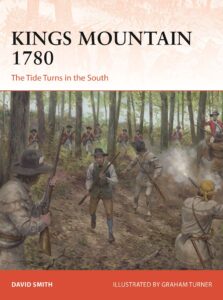
David Smith, Kings Mountain 1780 (Osprey, 2026)
In 1780, at the height of the American War of Independence, the British secured Charleston and the Carolinas coast, which just left the backcountry to establish control over. A force of locally recruited Loyalists could do that job, reasoned the British command, while a significant part of the main army could head north for the real fight. They were wrong. All they did was poke the Patriot bear in the form of thousands of militiamen. An over-confident Scottish officer, Patrick Ferguson, commanded the Loyalists, and they would meet their fate on an isolated hilltop at Kings Mountain, North Carolina, in October that year.
Smith provides brief biographies of the commanders on both sides before considering the forces they commanded. As with most irregular warfare, there was a distinctly ad-hoc feel to these backcountry militiamen, on both sides, with sometimes merely a nod to traditional military discipline. The overall British commander, Lord Cornwallis, notes Smith, opted to advance into North Carolina with Ferguson’s Loyalists on his flank. The Patriots only had to disrupt the British, and if they could defeat Ferguson then all the better for them. The campaign initially went Cornwallis’s way but not without setbacks. In August, the British won a major battle at Camden, but the see-saw of victories and defeats for the Loyalist militia continued. Smith follows the action to Mackay’s trading Post, where the Patriots were forced to retreat and Ferguson pursued. It was a miscalculation that would cost him his life.
Ferguson’s pursuit went well at first, despite his small command, but he underestimated the Patriots who were organising to deal with his incursion into the North Carolina backcountry. The hunter had become the hunted. Too late, Ferguson realised the danger, but he was determined to stand his ground if it came to a fight even as he retreated towards Cornwallis’s army. He arrived at a ridge known as Kings Mountain, threw up earthworks, and awaited the Patriot attack. The Patriots surrounded the ridge but began their assault before that was fully accomplished. At first, the intensifying battle seemed to be going the Loyalists’ way, but the Patriots squeezed the Loyalist position, which began to break down. Then came the fateful moment; Ferguson was shot out of his saddle, and the Loyalist resistance collapsed. The Patriots had won a stunning victory. Smith notes that this was a significant turning point, loosening the British grip in the South.
This is the book I wish I’d had when I visited Kings Mountain – Smith offers a brief description of the battlefield as an epilogue for future visitors. Smith surveys the principal actors at the tactical and strategic levels then follows them in a clear narrative along their routes to the battle. His account of the fighting is also lucid, clarifying what was a confusing action for all involved. Smith illuminates his story with quotes from men who fought, and he is helped by maps, artwork, illustrations, and modern photographs. Readers of the American Revolution already know how complex the fighting was in the backcountry; for others, Smith lays the groundwork for a better understanding at the broader level in this entertaining and informative read.