by RNS | Aug 28, 2026 | Beating Tsundoku
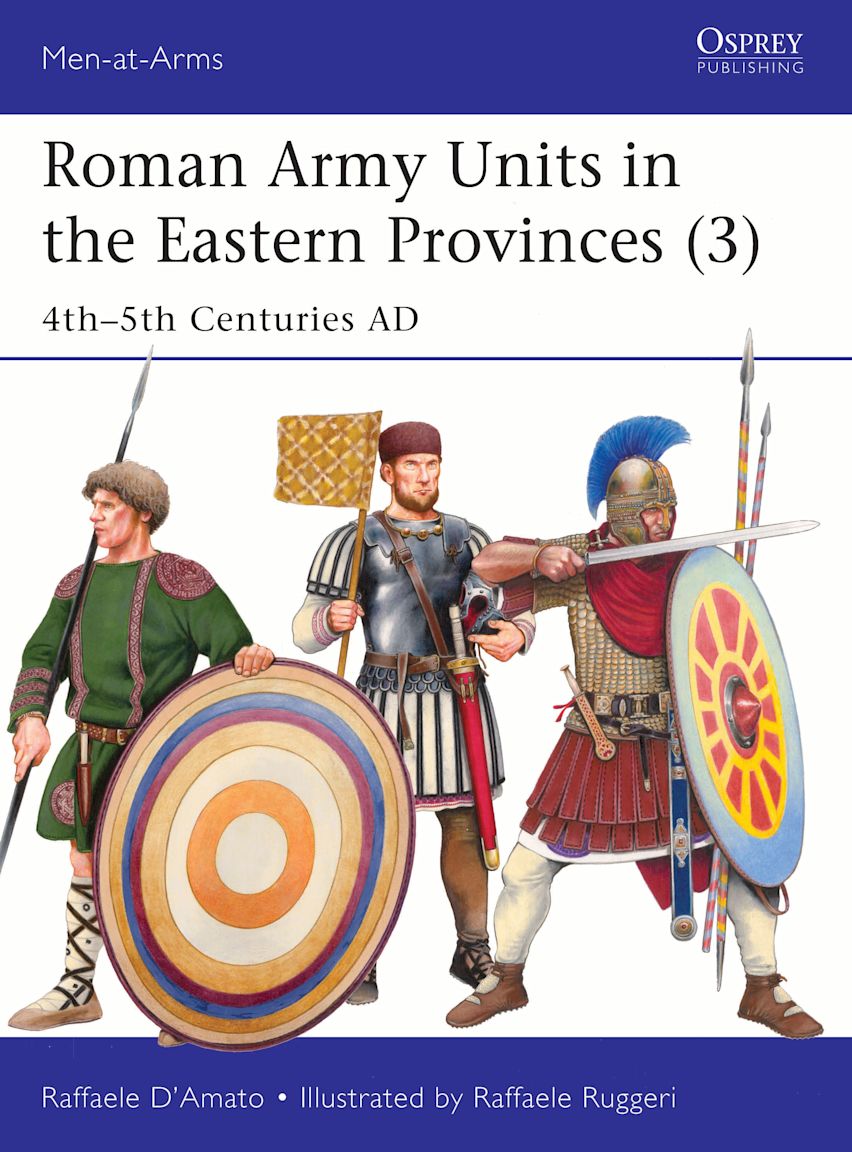
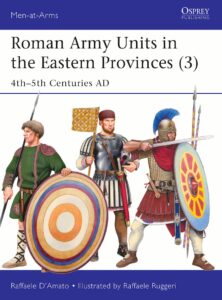
Raffaele D’Amato, Roman Army Units in the Eastern Provinces (3), (Osprey, 2026)
There is little doubt that the massive Roman Empire came under severe external military pressure in the 4th and 5th centuries CE. That had forced a split, with Constantinople becoming the capital of the Eastern Empire, requiring two different Roman armies and strategies. In this Osprey Men-at-Arms series book, Raffaele D’Amato surveys the Roman army in the East during this period.
D’Amato begins with Constantine I’s reorganisation of the Roman Army to perform border protection and provincial control backed by field armies located in strategic positions. D’Amato outlines the composition of the army in the East, including a detailed listing of unit distribution. The multiplicity of peoples incorporated into the Eastern Roman army was reflected in their weaponry, equipment, and uniforms. D’Amato takes us on a tour of the provinces, examining those variations. He covers Dacia, Macedonia, Thracia, Pontus, Asia, Oriens, and Aegyptus. The accompanying artwork adds the garrison of Constantinople to the list.
This is a brief but useful survey of the Roman army in the Eastern provinces, with a bibliography added for those who want to delve further. D’Amato’s informative text is neatly arranged and ably supported by artistic renditions of the soldiers and many photographs of archaeological artefacts. Readers with more than a passing interest in the period will enjoy this book, though general readers might need a wee bit of background knowledge to get the benefits of D’Amato’s work.
by RNS | Aug 25, 2026 | Beating Tsundoku
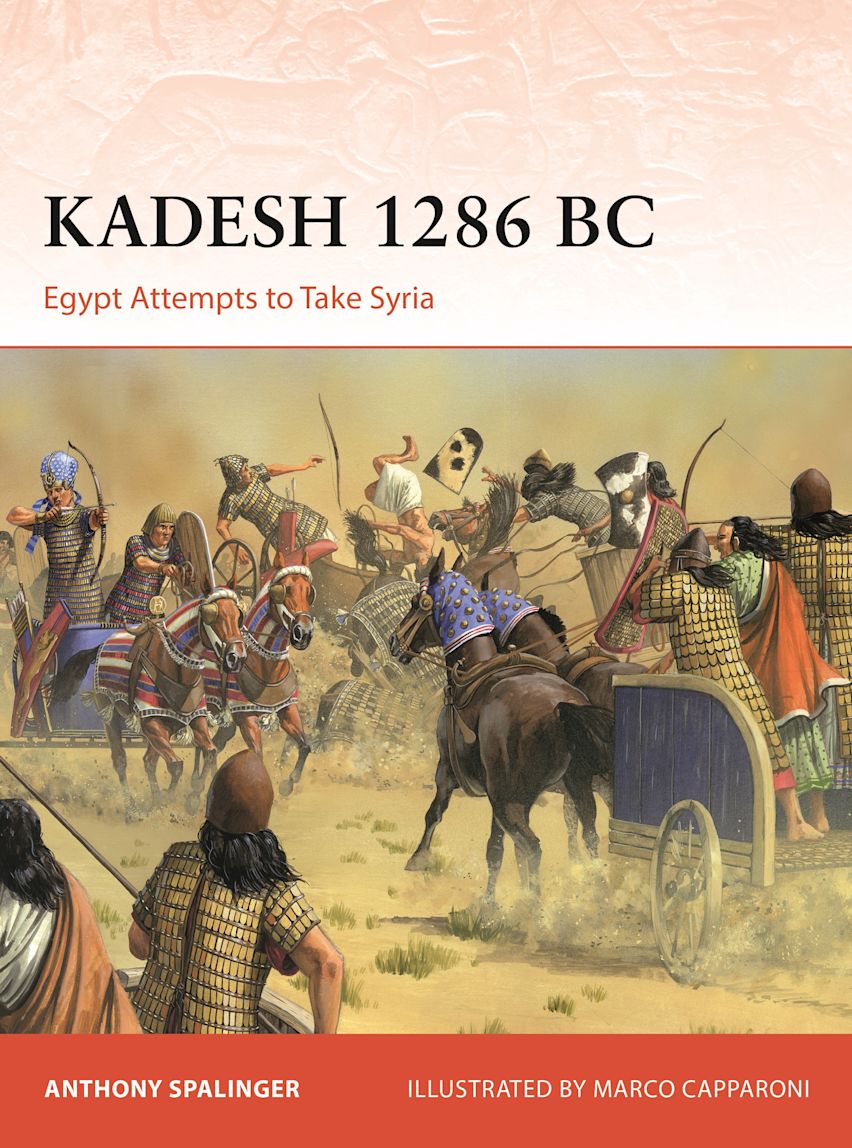
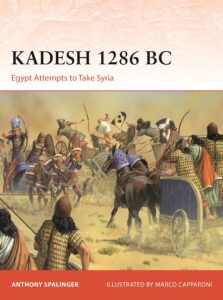
Anthony Spalinger, Kadesh 1286 BC (Osprey, 2026)
Imagine over ten-thousand chariots racing into combat on a flat plain, dust clouds flowing behind wheels, sheets of arrows raining down on horses and men, and warriors stabbing and hacking at each other while chariot drivers desperately tried to control their horses. That is what happened at history’s first recorded major organised battle between the Hittites and Egyptians at Kadesh in the 13th Century BCE. In this Osprey Campaign series book, Anthony Spalinger analyses the action.
Spalinger opens by narrating the contextual situation in southern Syria that provided the flashpoint between the Hittites and Egyptians. Controlling Kadesh, Spalinger notes, would allow that power to control the region. After skipping through very brief biographies of the opposing commanders, Spalinger delves into analysing the main primary sources. Readers need to pay attention to this because the rest of Spalinger’s study of the battle can only be understood properly through following Spalinger’s assessment. Spalinger breaks down the opposing forces, though he mixes that with some narrative elements of the campaign. He then goes into more details of the campaign, beginning with the Egyptians arriving at Kadesh where the forewarned Hittites eagerly awaited to ambush them. They attacked with only two Egyptian divisions capable of fighting back. But Rameses II led a counter-attack, driving the Hittites back across the Orontes river. Then a second Hittite attack was repulsed, leaving the sides glowering over the river at each other before, after some performative action and talks, the Egyptians withdrew. Spalinger intersperses that relatively straightforward narrative with analysis and conclusions drawn from the sources, making the action difficult to follow at times. He concludes that this was a ‘momentous and decisive’ battle because it ended Egyptian imperialism, though Spalinger concedes that the battle did not end the war between the two powers.
It is important to note that this account of Kadesh is not a survey, but a stripped-down study written by an academic historian. To that end, much of the narrative flow is lost in analytical breakdowns as Spalinger weaves his way through the sources. There is a lack of clarity at times as a result. Despite Spalinger’s simplifying of his technical notes, this did not quite work in this format, and a reader encountering Kadesh for the first time might need a basic narrative outline of the battle before attempting this book. Fortunately, Osprey covered the battle a bit more loosely, and a bit livelier, in Qadesh 1300 BC (Campaign #22), written by Mark Healy. My recommendation is to read Healy first then Spalinger. Then dive into Spalinger’s excellent bibliography for further reading. Readers that enjoy a more academic approach to their battles will get the most out of Spalinger’s book, but any reader of ancient warfare will enjoy this too.
by RNS | Aug 18, 2026 | Beating Tsundoku
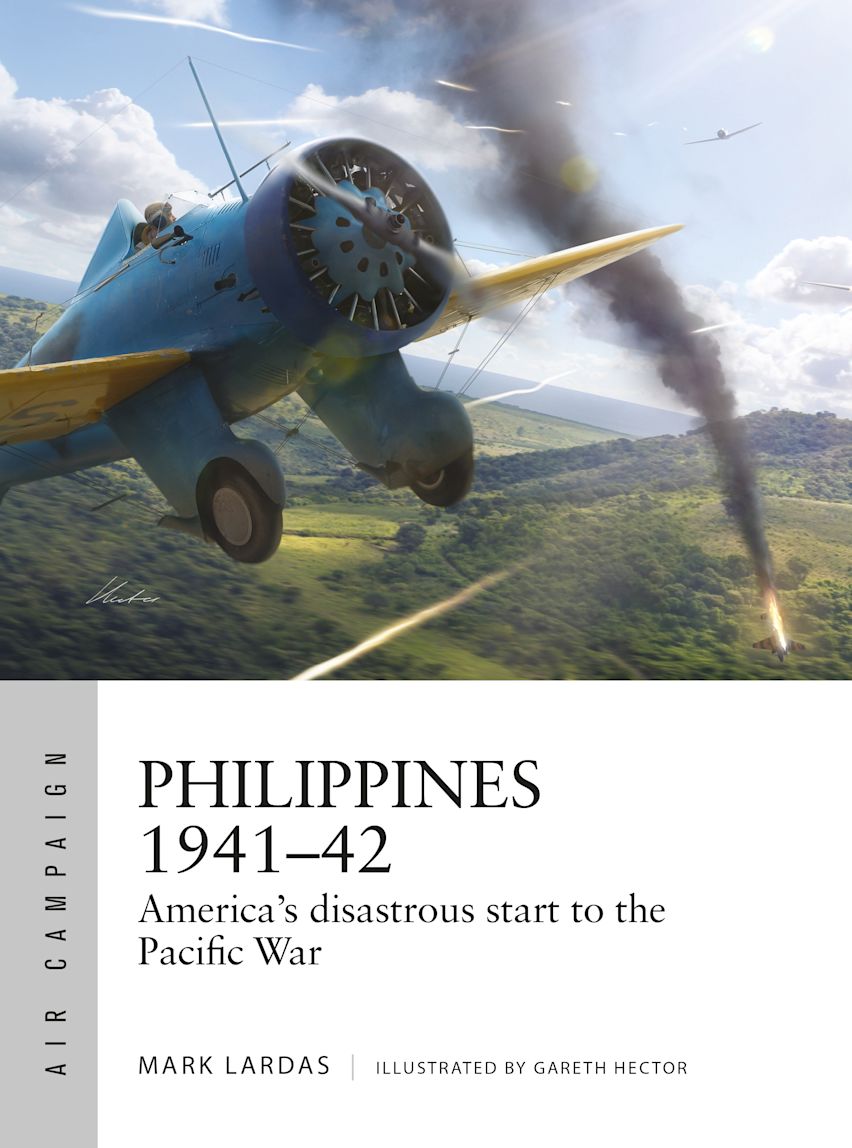
Mark Lardas, Philippines 1941-42 (Osprey, 2026)
Picture the scene: Clark airfield in the Philippines on 8 December 1941. The news arrives of the attack on Pearl Harbor, but the Americans at Clark airfield have no idea what’s about to hit them. The disaster that follows sets off a desperate rearguard action by the Americans, but one that is ultimately doomed. In this Osprey Air Campaign volume, Mark Lardas describes the men, their machines, and the action that set the tone for the Pacific air war.
Lardas begins with the attack on Clark airfield to set the scene before surveying the Japanese aircraft, their facilities, and their weapons and tactics honed on fighting in Chinese skies. In response, argues Lardas, the US had many aircraft and facilities, but the planes were obsolete and the infrastructure inadequate. They would pay a high price for that. As for the campaign objectives, Japanese expansion began in China in the 1930s and spread, but the Philippines stood in the way of their full imperialist ambitions. To capture the Philippines would require amphibious landings supported by air power. The US was a somewhat reluctant defender of the Philippines, Lardas contends, but they could not let the Japanese stroll in to seize power. They thought they had the resources and correct strategy, in accordance with local forces, but they had badly miscalculated.
The campaign narrative Lardas embarks upon delves into the preparations and build-up of forces, leading into the attack on Clark airfield. The Japanese quickly secured an airfield in the Philippines, but the major initial attacks came from Formosa. In what Lardas describes as a ‘cascade of failure’, Clark airfield succumbed to a surprise raid that destroyed many US aircraft. Despite that, the Americans could still put serviceable aircraft into the air to attack Japanese landings and supply ships. Nevertheless, the Japanese attacks on US airfields intensified until, within a few days, the air campaign over the Philippines heavily favoured Japan. As the Japanese invasion progressed, US supplies were lost in addition to more aircraft, and the remainder were withdrawn. But, Lardas notes, the US still launched limited counter-strikes until the Philippines finally fell on 1 May 1942. Lardas assesses the competing campaigns as one of tight tactical Japanese doctrine against the unfocused US effort.
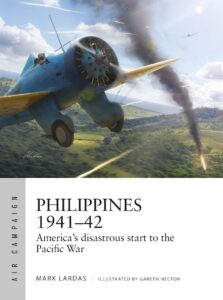
The front cover of this book tells you all that you need to know about what happened in the Philippines. It depicts an obsolete US warplane under intense fire from a Japanese fighter. This singular exercise in futility is reflected across the campaign, and Mark Lardas’s survey captures that very well, highlighting the progressive collapse of the US air effort in conjunction with events on the ground. He assesses the competing forces and finds that the outcome could have perhaps been different if the US had adopted an alternative strategy, although that dips into the realms of ‘what-if’ history a bit too far. Lardas is ably supported by Osprey’s usual high quality graphics and maps. Overall, this is an excellent addition to the Air Campaign series, and one that will appeal to military history readers in general and those interested in the Pacific Theatre in particular.
by RNS | Aug 11, 2026 | Beating Tsundoku
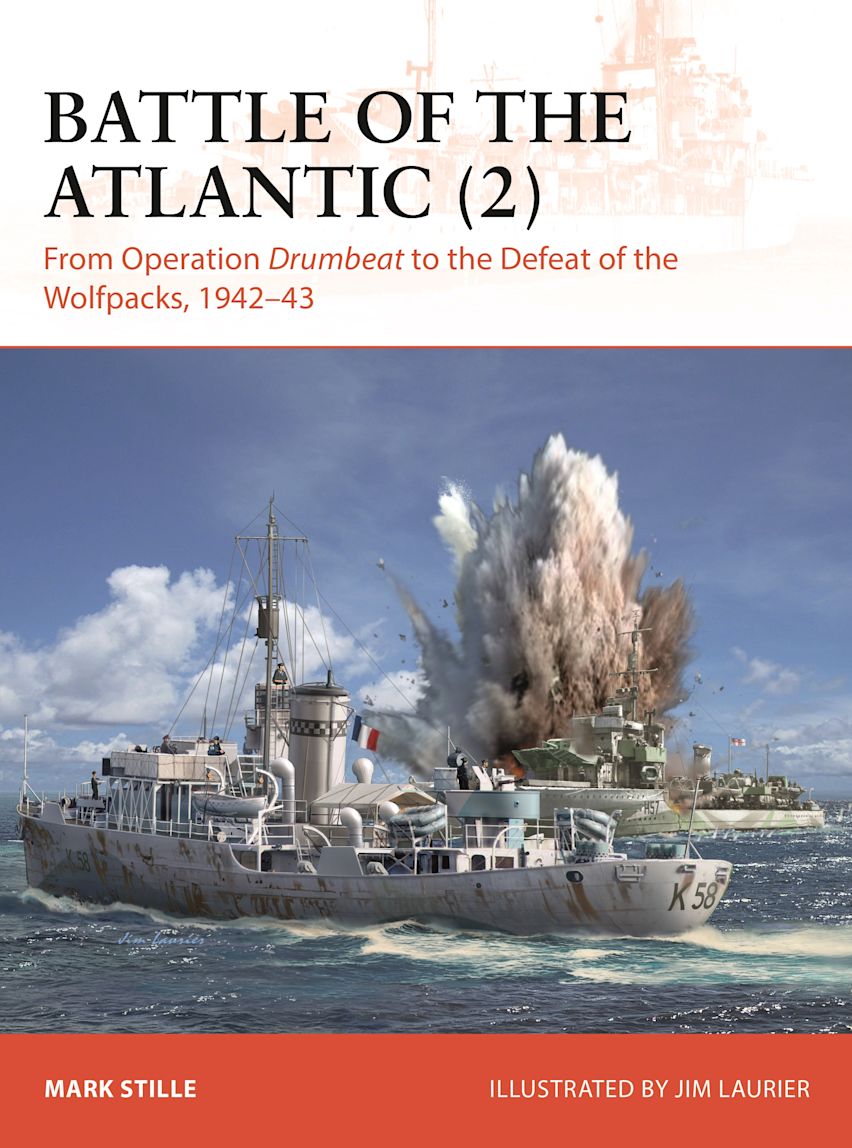
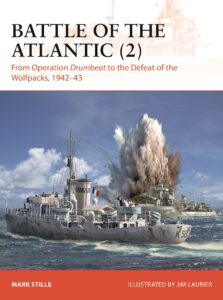
Mark Stille, Battle of the Atlantic (2) (Osprey, 2026)
Despite some successes before 1942, German U-boats were ineffectual in preventing supplies reaching Britain across the Atlantic. But increased production allowed for massed submarine assaults that the Germans hoped would give them the stranglehold they needed. The British too were confident, having established a network of defences in conjunction with Canada and the USA. However, the US entry into the war also made them a target, and they were not prepared for it. In this book, Mark Stille narrates this vitally important struggle at the height of the Second World War.
Osprey’s Campaign books begin with a chronological outline that provides a useful framework for the text that follows. Stille then briefly introduces the main commanders on both sides, including Karl Dönitz, who would implement a strategy of attrition to bring Britain to its knees, or so he hoped. That strategy was simple: sink more tonnage of supplies than the Allies could replace. All the Allies had to do was get their ships safely to harbour, but as Stille highlights, each convoy crossing the Atlantic required a complex multi-force operation to succeed. He surveys the ships and aircraft involved but a huge factor for the Allies, he argues, was breaking the U-boat codes, allowing the services to do their work. The German effort focused on building and protecting U-boats. Stille traces their technical and tactical development. He also considers the failure of German airpower and the surprising successes of German naval intelligence.
Stille compares the Allied and German plans for competing in the Atlantic shipping lanes. This amounted to evolving Allied convoy systems and the German adoption of wolfpack tactics and exposing weaknesses in Allied convoy coverage. Dönitz deployed only a few U-boats in January 1942, but that was enough to exploit US unpreparedness along its eastern seaboard. This proved calamitous for Allied shipping, with many merchant ships lost. It would take months for the Americans to institute a working convoy system, but then Dönitz switched to the North Atlantic. Cat-and-mouse warfare followed, with both sides causing damage to the other, before Allied airpower began to turn the tide. Stille describes the infamous Laconia incident off the coast of Africa then returns to the North Atlantic in October 1942 where the mixed results continued. In November, the U-boats proved ineffective in preventing Operation Torch, but by the end of 1942, Dönitz could deploy 212 U-boats for the coming year. March 1943 became a crisis for the Allies, according to Stille, who narrates the major actions. April saw the turning point in German fortunes, however, and May proved a dark month for them with significant U-boat losses. The subsequent switch to operations in the Bay of Biscay did not help the Germans. Stille concludes that despite some assertions to the contrary, Britain was never in real danger of being cut off from its supplies. The Allied technological and tactical advantages also multiplied through this period while the Germans never quite had the numbers or wherewithal to win the battle.
Mark Stille has written an action-packed survey of the battle to cut Britain’s supply lines at a crucial phase in the War. There is not much room in this format to develop the picture beyond the main themes, but Stille lays those out clearly. He covers what happened, how it happened, and why it happened in a well-written description and narrative. There is nothing particularly new in this volume, and there does not need to be, but Stille bursts the bubble somewhat of those who argue for a U-boat supremacy that the Allies were lucky to escape. Stille’s text is accompanied by Osprey’s usual excellent graphics and photograph selection. Naval history readers, in particular, will appreciate this book, as will any student of World War II.
by RNS | Aug 3, 2026 | Beating Tsundoku
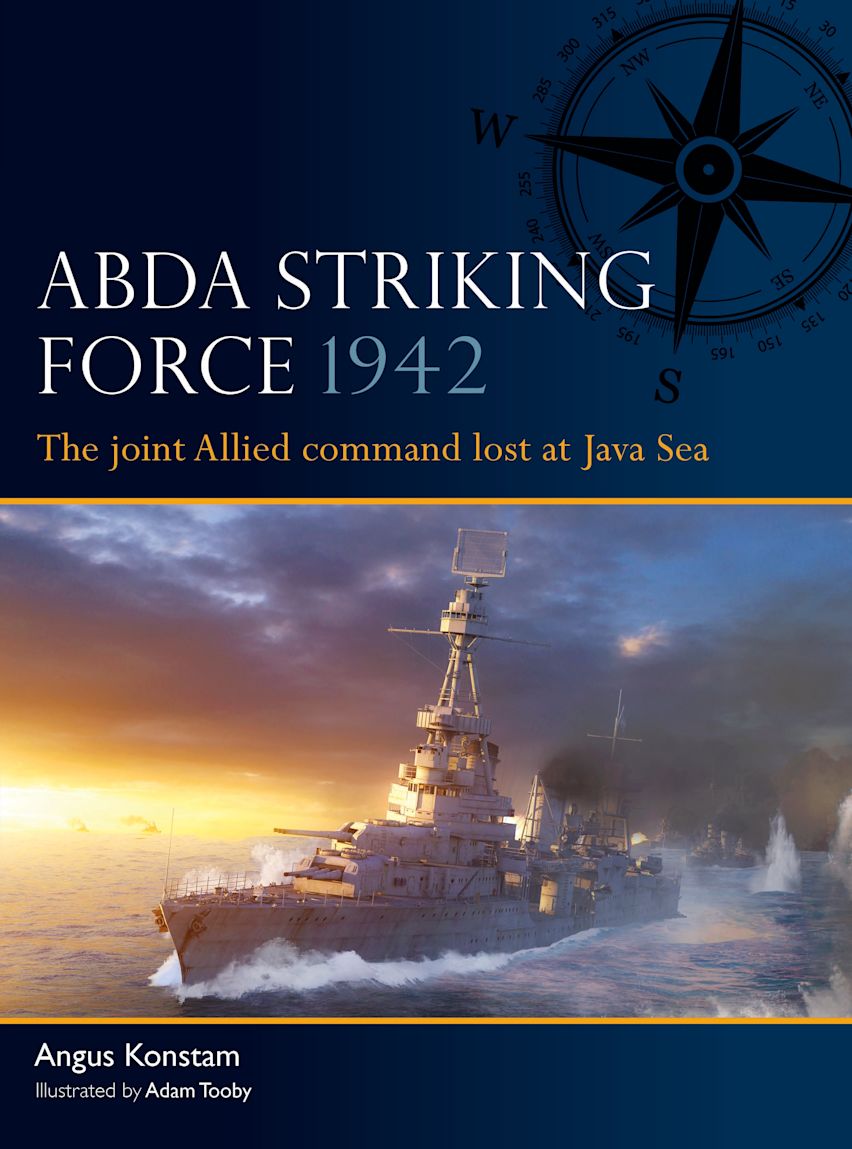
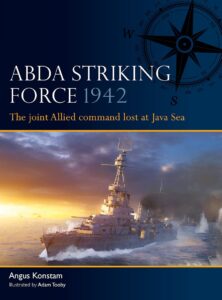
Angus Konstam, ABDA Striking Force 1942 (Osprey, 2026)
The American, British, Dutch, and Australian naval task force (ABDA) was formed on 1 January 1942 to combat overwhelming Japanese forces in defence of the Malay Barrier. Any advantages the Allies had could be measured in days as the Japanese swept all before them, but they fought anyway. In this latest volume of Osprey’s Fleet series, Angus Konstam calls the Allied effort a ‘forlorn attempt’, but one incorporating heroism and sacrifice.
Konstam notes that all the Allied fleets in the Far East were woefully unprepared for the Japanese onslaught, with just a few cruisers backed by some destroyers and submarines. The Royal Navy had had two battleships in the region, but they didn’t last long, and their fate symbolised the change from battleship supremacy to air warfare. The Americans had a couple of useful cruisers and submarines in an otherwise obsolete fleet, while the Dutch looked good on paper but lacked support from their defeated homeland. The Japanese deployed a modern fleet that included aircraft carriers and battleships, and Konstam notes, they possessed the lethal Type 93 torpedo. Overall, he concludes, the Allies were outnumbered and outgunned, but they would just have to make do. In his survey of weaponry available to both sides, Konstam highlights the lack of practical air support for the Allies. The sense of the Allies being late to the show is reflected in their failure to adopt a joint command in time to properly prepare for the enemy coming for them – which the Allies knew about from solid intelligence work, though their communications proved somewhat dysfunctional. They also lacked effective logistical support.
Combat operations began well enough for ABDA, with a successful attack on Japanese transport ships at Balikpapan in January 1942, but the ABDA fleet came under sustained aerial attack in the Flores Sea in February, and more losses came off the coast of Banka that same month. Konstam notes that the fall of Singapore in February 1942 marked the end of ABDA’s attempts to hold the Malay barrier. They would now have to try and protect Java and the Dutch East Indies. But Java came under sustained attack, also in February, and ABDA became involved in a confused, losing fight in the Badung Strait. More serious losses for ABDA came off Java in the last week of February, and then the Japanese sunk the last remaining cruisers of ABDA in the Sundai Strait and off Borneo. Only a few destroyers escaped from Java. In his analysis, Konstam reiterates the disadvantages that ABDA operated under in its futile attempt to hold back the Japanese tide.
Konstam provides a useful survey of the doomed ABDA fleet. His narrative of operations is well-handled though tough reading in parts, because despite what Hollywood writers might like, there is very little glory in doomed enterprises such as that of ABDA. Konstam’s survey is well-supported by many photographs and Osprey’s usual evocative artwork. World War II naval history readers, in particular, will enjoy reading this book.