Anthony Spalinger, Kadesh 1286 BC (Osprey, 2026)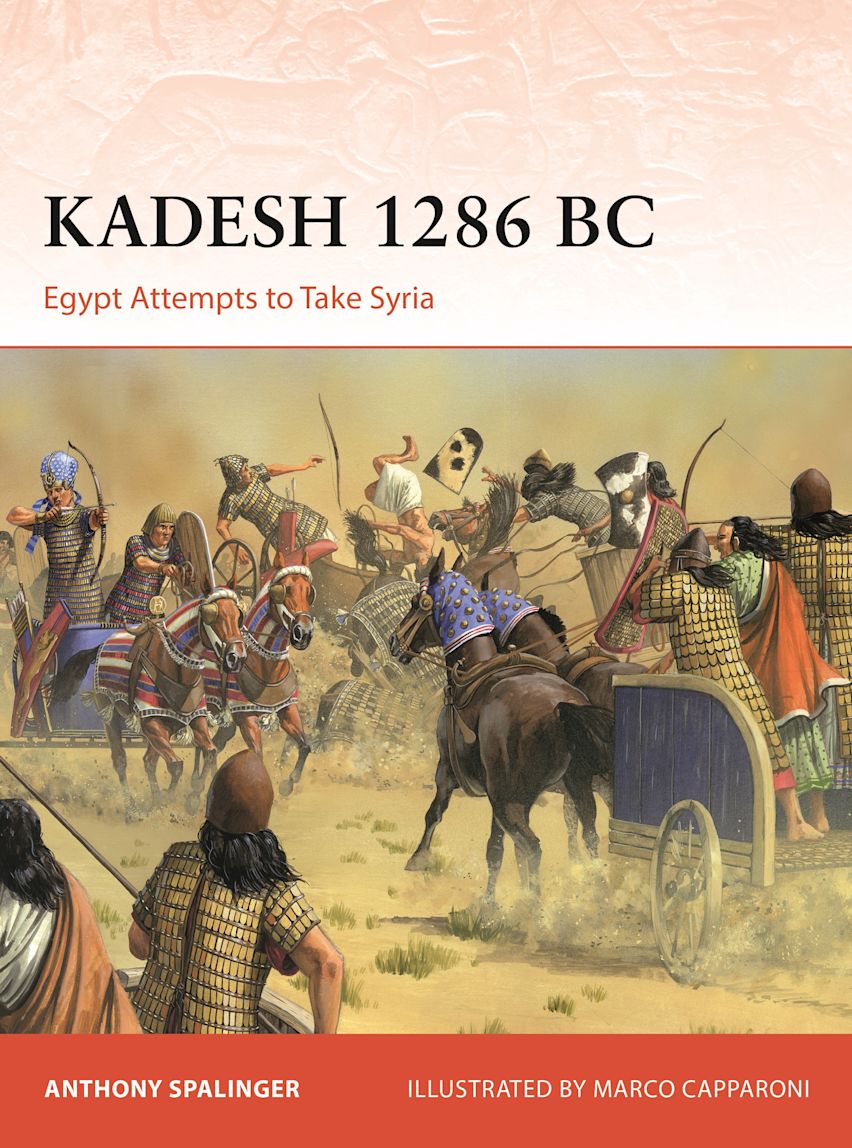
Imagine over ten-thousand chariots racing into combat on a flat plain, dust clouds flowing behind wheels, sheets of arrows raining down on horses and men, and warriors stabbing and hacking at each other while chariot drivers desperately tried to control their horses. That is what happened at history’s first recorded major organised battle between the Hittites and Egyptians at Kadesh in the 13th Century BCE. In this Osprey Campaign series book, Anthony Spalinger analyses the action.
Spalinger opens by narrating the contextual situation in southern Syria that provided the flashpoint between the Hittites and Egyptians. Controlling Kadesh, Spalinger notes, would allow that power to control the region. After skipping through very brief biographies of the opposing commanders, Spalinger delves into analysing the main primary sources. Readers need to pay attention to this because the rest of Spalinger’s study of the battle can only be understood properly through following Spalinger’s assessment. Spalinger breaks down the opposing forces, though he mixes that with some narrative elements of the campaign. He then goes into more details of the campaign, beginning with the Egyptians arriving at Kadesh where the forewarned Hittites eagerly awaited to ambush them. They attacked with only two Egyptian divisions capable of fighting back. But Rameses II led a counter-attack, driving the Hittites back across the Orontes river. Then a second Hittite attack was repulsed, leaving the sides glowering over the river at each other before, after some performative action and talks, the Egyptians withdrew. Spalinger intersperses that relatively straightforward narrative with analysis and conclusions drawn from the sources, making the action difficult to follow at times. He concludes that this was a ‘momentous and decisive’ battle because it ended Egyptian imperialism, though Spalinger concedes that the battle did not end the war between the two powers.
It is important to note that this account of Kadesh is not a survey, but a stripped-down study written by an academic historian. To that end, much of the narrative flow is lost in analytical breakdowns as Spalinger weaves his way through the sources. There is a lack of clarity at times as a result. Despite Spalinger’s simplifying of his technical notes, this did not quite work in this format, and a reader encountering Kadesh for the first time might need a basic narrative outline of the battle before attempting this book. Fortunately, Osprey covered the battle a bit more loosely, and a bit livelier, in Qadesh 1300 BC (Campaign #22), written by Mark Healy. My recommendation is to read Healy first then Spalinger. Then dive into Spalinger’s excellent bibliography for further reading. Readers that enjoy a more academic approach to their battles will get the most out of Spalinger’s book, but any reader of ancient warfare will enjoy this too.