David Greentree, Murmansk 1941 (Osprey, 2026)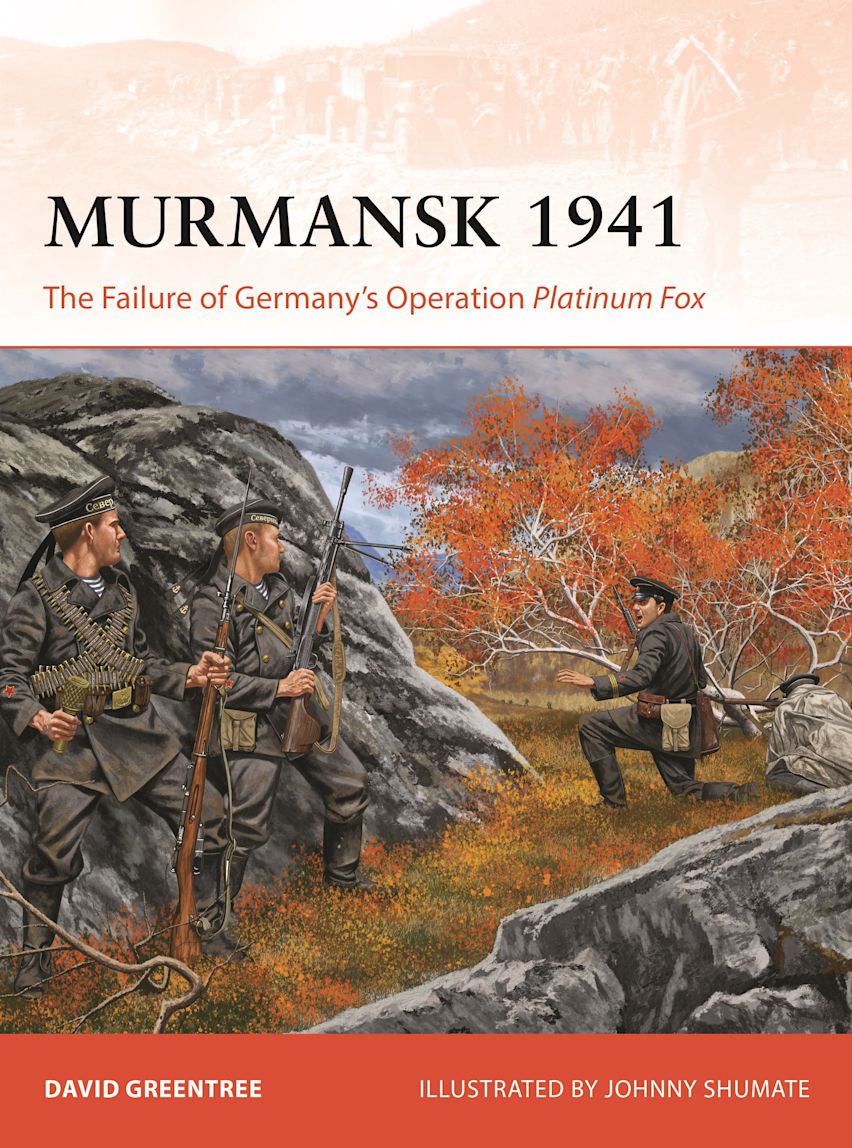
The Eastern Front in World War II conjures images of mass warfare, incorporating thousands of tanks and warplanes, sweeping across the wide-open steppes. In the far north, however, the Russians, Germans, and Finns fought a different campaign along a rugged coastline and tundra inland, all for control of the Russian town of Murmansk. In this Osprey Campaign series book, David Greentree takes readers into an unforgiving war in an unforgiving environment.
Germany had concerns over vital Finnish nickel supplies in the event of war with the Soviet Union. Capturing Murmansk on the Barents Sea and its associated railway would be a big part of the protection they needed. The problems for developing a workable plan, however, were manifold. Greentree sets the scene, comparing the respective commanders and their available forces. Returning to the battlefield, we find the Russians digging in and the Germans preparing to attack across mostly unknown terrain against an opposition they knew little about. Greentree moves on to discussing the opposing plans. The German Generalleutnant Eduard Dietl fretted about the size of his command, the intended approaches, and events elsewhere that might impact his campaign. The Russians did not fully believe that Germany would attack but prepared defensive positions anyway. Then came 22 June 1941 and Operation Barbarossa.
The German advance begins Greentree’s narrative of the campaign. The Germans rolled forward while building their logistics, while the Russians held as best they could. The grind would continue for months. What is striking throughout this narrative is the lack of effective communications and the broken terrain that benefitted the defender. That worked both ways, affecting the Russians just as badly when they counter-attacked, though wasteful frontal assaults did not help them. An attempt to flank German positions north of Litza Bay also came unstuck. Greentree also describes the action at sea, with the Royal Navy aiding the Russians in limiting German convoys creeping along the coast. On land, attrition took its toll on men and morale, including, perhaps surprisingly, German SS units. By September, the Germans had lost momentum and supplies had dwindled. Their offensive had been stopped in its tracks. Greentree concludes that the Germans had deployed insufficient forces in the wrong places and did not support them. The Russians played their part, of course, in wearing down and defeating the Germans.
This is an interesting survey of a smaller campaign within the massive Operation Barbarossa. David Greentree just about manages to contain all the twists and turns of a wide-ranging series of combats on land and sea. There are moments where the details swamp the narrative flow, but that is probably unavoidable in this format. Nevertheless, Greentree successfully outlines who did the fighting and how that unfolded. He is ably supported by excellent maps and illustrations and some fascinating photographs. Readers interested in an off-beat campaign from the Eastern Front will enjoy Greentree’s efforts.