Mark Stille, Battle of the Atlantic (2) (Osprey, 2026)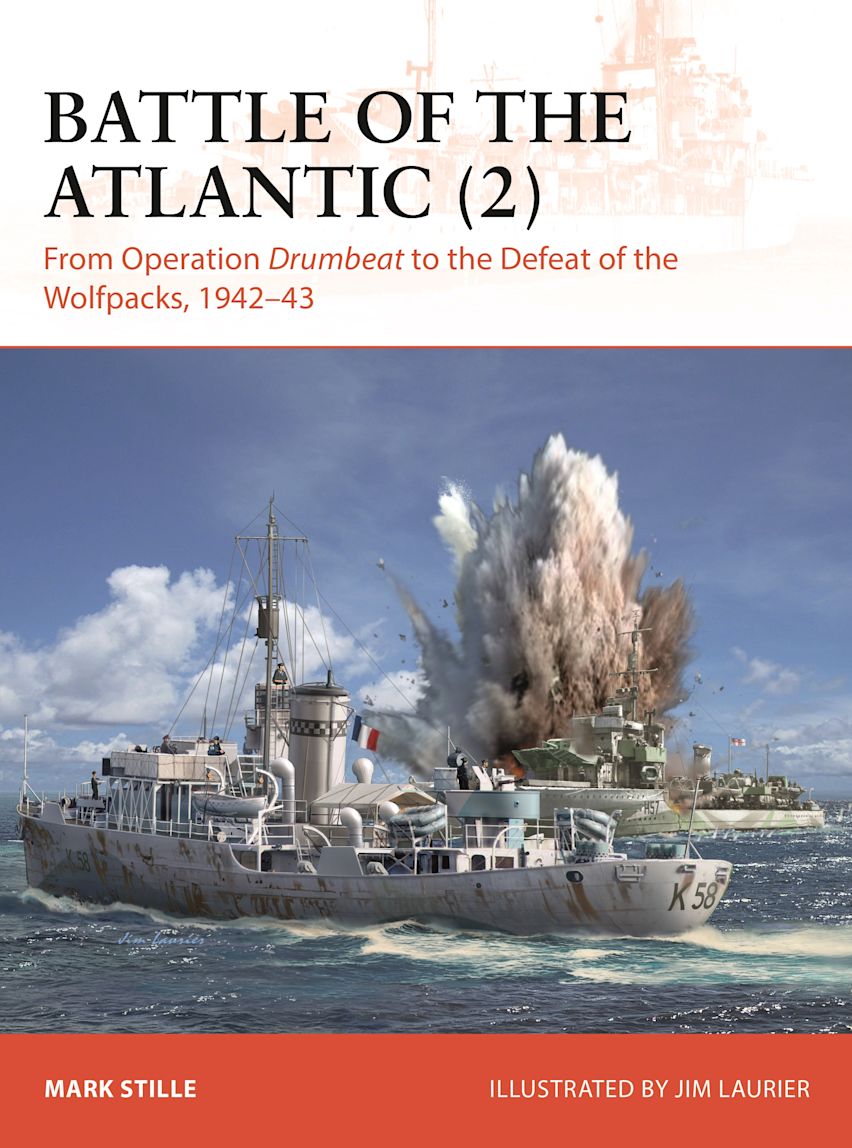
Despite some successes before 1942, German U-boats were ineffectual in preventing supplies reaching Britain across the Atlantic. But increased production allowed for massed submarine assaults that the Germans hoped would give them the stranglehold they needed. The British too were confident, having established a network of defences in conjunction with Canada and the USA. However, the US entry into the war also made them a target, and they were not prepared for it. In this book, Mark Stille narrates this vitally important struggle at the height of the Second World War.
Osprey’s Campaign books begin with a chronological outline that provides a useful framework for the text that follows. Stille then briefly introduces the main commanders on both sides, including Karl Dönitz, who would implement a strategy of attrition to bring Britain to its knees, or so he hoped. That strategy was simple: sink more tonnage of supplies than the Allies could replace. All the Allies had to do was get their ships safely to harbour, but as Stille highlights, each convoy crossing the Atlantic required a complex multi-force operation to succeed. He surveys the ships and aircraft involved but a huge factor for the Allies, he argues, was breaking the U-boat codes, allowing the services to do their work. The German effort focused on building and protecting U-boats. Stille traces their technical and tactical development. He also considers the failure of German airpower and the surprising successes of German naval intelligence.
Stille compares the Allied and German plans for competing in the Atlantic shipping lanes. This amounted to evolving Allied convoy systems and the German adoption of wolfpack tactics and exposing weaknesses in Allied convoy coverage. Dönitz deployed only a few U-boats in January 1942, but that was enough to exploit US unpreparedness along its eastern seaboard. This proved calamitous for Allied shipping, with many merchant ships lost. It would take months for the Americans to institute a working convoy system, but then Dönitz switched to the North Atlantic. Cat-and-mouse warfare followed, with both sides causing damage to the other, before Allied airpower began to turn the tide. Stille describes the infamous Laconia incident off the coast of Africa then returns to the North Atlantic in October 1942 where the mixed results continued. In November, the U-boats proved ineffective in preventing Operation Torch, but by the end of 1942, Dönitz could deploy 212 U-boats for the coming year. March 1943 became a crisis for the Allies, according to Stille, who narrates the major actions. April saw the turning point in German fortunes, however, and May proved a dark month for them with significant U-boat losses. The subsequent switch to operations in the Bay of Biscay did not help the Germans. Stille concludes that despite some assertions to the contrary, Britain was never in real danger of being cut off from its supplies. The Allied technological and tactical advantages also multiplied through this period while the Germans never quite had the numbers or wherewithal to win the battle.
Mark Stille has written an action-packed survey of the battle to cut Britain’s supply lines at a crucial phase in the War. There is not much room in this format to develop the picture beyond the main themes, but Stille lays those out clearly. He covers what happened, how it happened, and why it happened in a well-written description and narrative. There is nothing particularly new in this volume, and there does not need to be, but Stille bursts the bubble somewhat of those who argue for a U-boat supremacy that the Allies were lucky to escape. Stille’s text is accompanied by Osprey’s usual excellent graphics and photograph selection. Naval history readers, in particular, will appreciate this book, as will any student of World War II.