by RNS | Jan 12, 2026 | Beating Tsundoku
Enrico Cernushi, Italian Adriatic Fleet 1915-18 (Osprey, 2026)
Italy was late to World War I. For about eight months, the Italian navy, the Regia Marina (RM), kicked its heels in port while the great powers contested the seas around the peninsula. Once they became involved, the RM sailed to war, with a primary objective of controlling the Adriatic Sea. The Adriatic is narrow, only 120 miles wide and shallower in the north than in the south. Despite a waterway full of mines, there were 48 engagements featuring the Italian navy in the three years they participated in World War I. Enrico Cernushi describes the Regia Marina and the action.
Cernushi opens with the development of fleets in the Mediterranean and demonstrates that the competition for naval supremacy was heated in the run-up to World War I. On the outbreak of war, the RM in the Adriatic would not fight just yet while Italy remained neutral. Cernushi moves forward to May 1915, and Italy’s introduction into the war, to cover the fighting capability of the RM, which was considerable both in ships and weapons. He also covers how the fleet was commanded, and hampered by problems with political interference, and the role of intelligence. Despite struggling with importing raw materials and coal at times, the Italians out-manufactured Austria-Hungary, Cernushi notes. With all the background established, Cernushi moves on to the Italian fleet in combat.
The narrative is separated by year and split into northern and southern Adriatic sections. Each section is opened with a chronological chart of events, including the ships involved and the targets. Cernushi supplements his charts with narrative, commentary, and box-outs of particular engagements. At the end of the war, confusion reigned over which country would receive which Austro-Hungarian ships amidst high level political machinations. Cernushi concludes that the RM picked its battles over the doctrine of action-at-any-cost and used the blockade strategy effectively. He notes also that after the War the Italian navy had to rebuild yet again in the face of emerging technologies.
This latest volume in Osprey’s excellent Fleet series is informative and introduces readers to a fleet that will be new to many of them. Cernushi does well when outlining and narrating the action, though he tends to skip around with the chronology in his opening chapter on naval development, making it hard to follow at times. Nevertheless, he provides all the information we need to form an understanding of the Adriatic fleet, how it worked, and what it did. This is a book that naval history students, especially readers of World War I, will want to read.

by RNS | Jan 5, 2026 | Beating Tsundoku
Steven J. Zaloga, Gulf War 1990-91 (Osprey, 2026)
In February 1991, after an intensive month long aerial bombing campaign, a coalition of UN backed forces attacked the Iraqi occupying forces in Kuwait. The offensive lasted just 100 hours, ending in total defeat for the Iraqis. In this Osprey Campaign series volume, Steven Zaloga tells us how that victory happened.
After narrating a brief chronology of events, Zaloga turns to the opposing commanders. That pitched a delusional Saddam Hussein against highly experienced western commanders from the Unites States of America, Saudi Arabia, and the United Kingdom. On paper at least, the Iraqi ground forces presented a formidable obstacle: 45 divisions of infantry backed by tanks and artillery. But, Zaloga points out, this was a ‘hollow force’ encumbered by a weak centralised command, too much variety of weapons, many of them obsolete, and poor artillery fire control. They had useful missile systems and a large intelligence network, but that was not going to help them when the Coalition forces arrived. The latter possessed everything Iraq did not, including better tanks, helicopters, artillery, intelligence, and logistics, much of which is surveyed by Zaloga.
It might have helped the Iraqis if they could have developed a viable operational plan, but Zaloga argues, they underestimated their enemy. The Iraqis set up to defend five possible approaches and mined them accordingly. The coalition had to defend Saudi Arabia and expel the Iraqis from Kuwait, with the US in the vanguard and other nations’ forces fitting in where required. Zaloga then embarks on his narrative of the campaigns, beginning with Iraq’s invasion of Kuwait in August 1990. The Iraqis then bolstered their defences against the expected assault, but they miscalculated the intensity of the air campaign that descended on them in January 1991. Zaloga highlights how drastically that impacted Iraqi logistics and reduced their defences. Morale plummeted and desertions were widespread. Zaloga turns to the missile war, with the Iraqis launching SCUD missiles at targets in Israel and Saudi Arabia and Coalition special forces conducting ‘SCUD hunts’ against missile launchers. Zaloga also describes the Iraqi raid on the Saudi Arabian town of Khafji on 31 January, which was defeated, boosting Coalition morale. Then came the Coalition ground offensive on 24 February. That involved a direct assault, which was met by ineffective Iraqi counter-attacks, and a massive wheeling manoeuvre into Iraq. On 25 February, Saddam ordered the withdrawal of the Iraqi army from Kuwait City, which was a confused affair that led to the ‘Highway of Death’ as the Coalition pummelled the fleeing Iraqis. The much vaunted Republican Guard tried to cover the retreat, but they too were thrashed in intense tank battles, helicopter attacks, and infantry assaults. Kuwait city fell on 27 February. With that the war was all over bar the shouting. Zaloga concludes with a brief analysis of a war that probably ended too soon because of political considerations.
Zaloga’s brief but illuminating survey of the Gulf War covers all the bases and offers a cogent explanation of how and why the Coalition army was able to destroy what they thought might be a battle-hardened and potent Iraqi army with considerable ease. Zaloga assesses the armies, their command and control, and their plans then deftly narrates the campaign. There is no in-depth coverage of the rank-and-file on either side, but Zaloga did not have the room for that or the air war, which is reasonable but leaves a wee hole in his account. Nevertheless, this is an informative book that captures a war of greater scale than the history books might imply. Zaloga is also well-supported by Osprey’s usual high quality photographs, illustrations, maps, and artwork. Readers of modern warfare will enjoy reading this book as will anyone interested in the events surrounding a war the consequences of which still reverberate.

by RNS | Jan 3, 2026 | Beating Tsundoku
Gordon Richard, In Custer’s Boots (Casemate, 2026)
There can be few more enigmatic and polarising figures in US history than George Armstrong Custer who commanded the 7th Cavalry in its disastrous engagement with multiple Indian tribes on 25 June 1876 at the Battle of the Little Bighorn. Custer lost the battle, most of his regiment, and his life, and his actions that day have split historical opinion ever since. The weight of modern opinion leans heavily against Custer, who is often depicted as a vainglorious and insubordinate commander whose hubris and lust for glory caused a massacre of American cavalrymen that shocked the United States to its core. Gordon Richard is having none of it. In this volume of collected essays, Richard not only exonerates Custer but goes on the offensive against those who see it otherwise. It is a compelling read.
BUY NOW
Richard’s opening chapter is a reconstruction of the battle told in chronological segments as he follows the different companies of the 7th Cavalry to their doom. That is one of the few times that Richard spends on the battle, however, because most of the controversies he pursues examine the strategic whirlwind of movements leading to the battle by the columns of cavalry that most argue were supposed to converge on the Indian camp and either defeat the Indians in battle or shepherd them back onto their reservations. Thus, Richard fights back against those who claim that Custer defied his orders to launch his attack, digging into the source material to do so. He lambasts those who contend that Custer did not conduct adequate reconnaissance or maintain contact with the other columns and the Army commander, Brigadier-General Alfred H. Terry. Richard has few kind words for Custer’s subordinate commanders, Reno and Benteen, who the author views as self-serving along with Terry, all of whom heaped the blame for the disaster on the one man who could not contradict them: Custer. Richard includes essays on the activities of the main Indian protagonists during the battle, the awful plight of Custer’s terrified horses at the battle, how Custer is memorialised on the internet, and the curious case of the Culbertson Guidon.
Running through this book is Richard’s central argument that to understand what happened at the Little Bighorn requires the researcher to step into Custer’s boots and examine his choices in real time within his contemporary cultural context. Richard’s arguments are stridently promoted, but he uses a rapier rather than an axe to dismantle many of the myths and legends that have emerged since the battle. He digs into the primary sources to resolve issues, and he shows no fear in taking on respected historians, army officers past and present, and internet commentators alike. Richard also uses a variety of historical techniques in his arguments, with, perhaps inevitably, some arguments from omission and assumptions exposing some weaknesses in his conclusions. However, there are very few of those in what is a strong refutation of many long-held opinions on what happened at the Little Bighorn and why – I couldn’t help thinking that Libbie Custer would be proud of Gordon Richard’s stout defence of her husband. This is an essential book for anyone researching Custer and the Bighorn campaign and a thoroughly informative and enjoyable read.

by RNS | Dec 30, 2025 | Beating Tsundoku
Mark Lardas, U-Boat vs Royal Navy Capital Ship (Osprey, 2026)
In World War II, German U-boats sank two Royal Navy battleships and three fleet carriers. They also damaged battleships in twenty-four different engagements. They did all that for the loss of only two submarines. Mark Lardas thinks that is a story worth telling, and he is right, but there was more to this startling statistic than meets the eye.
Lardas draws his readers into his story with the dramatic sinking of HMS Barham in November 1941. After that tease, he provides a strategic overview of the post-WWI naval competition between Germany and Britain when the British allowed the Germans to keep their U-boats, believing they were obsolete. They were correct in the long term, notes Lardas, but not initially because when the war broke out, the British were not ready. Fortunately for them, neither were the Germans. Lardas expands on that, examining the design and development of the U-boats, battleships, and carriers that would play out this cat-and-mouse warfare from Norway to the Mediterranean. Lardas also surveys the technical aspects of the boats and ships, including weaponry and detection methods. He then compares the respective crews, including box-out texts on tragic heroes Günther Prien and William Tofield Makeig-Jones, both of whom went down with their ships.
With the scene set, Lardas moves on to narrate the fleeting but momentous encounters between U-boats and their intended Royal Navy targets. That follows a chronological format, tracing U-boat attacks through the war. They include the attempt on HMS Ark Royal in September 1939 and the sinking of HMS Courageous three days later. Then came the infamous sinking of HMS Royal Oak at ‘safe’ anchor in Scapa Flow. April 1940 operations around Narvik, in Norway, proved frustrating for the U-boats despite their best efforts to hit RN capital ships. Lardas follows the action into the Atlantic from June 1940 to October 1941, then we move into the Mediterranean and the losses of HMS Ark Royal and HMS Eagle. The final attack on a capital ship came in November 1942. Lardas attributes that to improved anti-submarine warfare tactics, Allied control over the North African coast, and the reduced Allied emphasis on naval warfare. The attacks, he concludes, ‘simply stopped’. Lardas closes with statistics and analysis of the various encounters between U-boats and RN capital ships.
Despite its unsexy title, U-Boat vs Royal Navy Capital Ship is an interesting delve into a combat scenario that wasn’t meant to happen: capital ships were supposed to be shielded from U-boats, but when that failed, the results could be spectacular. Mark Lardas’s book explains how that happened, tracing the roots of maritime disaster back to the pre-war period and flawed designs and planning. He could have devoted more space to the combat narratives, but that may be unfair given the format restrictions. Lardas’s engaging text is well supported by Osprey’s excellent illustrations, graphic artwork, and selection of photographs. World War II naval enthusiasts will enjoy this book, but it will appeal to any military history student.

by RNS | Dec 27, 2025 | Beating Tsundoku
Michael O. Fallon, Hill 119 (Casemate, 2025)
Hill 119 was a barren rise on a finger of terrain, lying south of Danang in South Vietnam, with a 360 degree view of so-called ‘Indian Country’. Delta Company, 1st Recon Battalion, 1st Marine Division manned an Observation Post (OP) on the hill for 600 consecutive days in 1969 and 1970. They also took part in up to week-long recon patrols; while on the hill, they called in artillery and air-strikes on enemy movements. The enemy was the Viet Cong and the North Vietnamese Army, and particular, 2nd NVA Division’s T89 Sapper Battalion.
BUY NOW
Michael O. Fallon begins his narrative with a geo-strategic overview for the year of ‘Vietnamization’, 1969. He homes in on Vietnam, relating how the Americans created a base on Hill 119 to cover the area 15 miles south of Da Nang known as Go Noi Island, sandwiched between two rivers, which was a Viet Cong and NVA stronghold and a staging area for attacks on Da Nang. The US also designated the island as a Free Fire Zone and conducted occasional sweeps to clear out the enemy. The small contingent of Marines on the hill was exposed to the elements, the rain and especially heat, so that Fallon, who served on the hill, remembered it as ‘a hot rock in Vietnam’.
With their OP established, the marines conducted morning patrols to check the protective wire and to carry out after-action assessments. They also set ambushes, interdicted enemy movements, recovered downed pilots when necessary, investigated villages and caves, and captured prisoners for interrogation. All that activity sometimes led to direct encounters with enemy troops, but more often they spent their time and energy avoiding enemy booby traps. They also made continuous improvements in the base for defence and living. By November 1969, an observation tower dominated the hill, with mortar pits and other bunkers dotted around to form an overlapping defensive structure. The OP’s primary function was to monitor enemy movements and call down artillery fire or airstrikes on them. Fallon notes that the Measure of Effectiveness (MOE) was the body count of enemy dead. The OP’s mission was aided by the introduction of a Secret Integrated Observation Device, which led to greater enemy casualties.
Of course, the NVA leadership found the OP more than an irritant, but their probes into the security of the hill was met with M79 HE rounds, and mortar, sniper, and machine gun fire. Nevertheless, an enemy assault on the hill seemed inevitable. One such plan was foiled by the Marines in early 1970, but in August, the assault came only to be repulsed with intense fire from the hill and covering artillery fire. Political circumstances, however, would succeed where direct assault could not, with the Nixon administration’s drawdown of US forces, which included the Marines. All the NVA had to do was wait out the Americans, and they would leave, which is exactly what happened. It was not just the enemy in the open that the Marines would have to worry about: Fallon argues that then men on Hill 119 could never quite come to grips with the local civilians and their needs and requests. This was exemplified in their dealings with a seemingly innocuous one-armed woman from a local village who visited often and who, many years later, was confirmed as a local Viet Cong leader. The clumsy interactions with locals led to the killing of another civilian woman, which ended in a court martial for the Marine sniper involved, though he was finally acquitted. In March 1971, the Marines left Hill 119 for good, destroying their defences behind them. The still bald hill slowly returned to nature.
Hill 119 is a nuts-and-bolts look at a small slice of the Vietnam War. Fallon notes that his book was written for today’s Marines and to honour the veterans who he fought alongside. He conducted one-hundred interviews and checked those against documentary sources and tactical maps, some of which he reproduces in the text. He leaves nothing out, including a constant flow of administrative and organisational changes, discussions of tactics, narratives of operations, and a detailed account of a court-martial. That attention to detail, some of which could easily have been transferred to footnotes, created an uneven account, with passages of concentrated action separated by long sections of routine and often humdrum events – much like the War itself by all accounts. The chapter structure is also somewhat mechanical, opening with the wider political context then zooming into Marine activities surrounding Hill 119. The overall effect is not as monotonous as it might sound, but there is so much detail included that the book grinds rather than flows. That said, there is much to admire in Fallon’s rigorous research and writing, and it is fair to say that he achieved his purpose. Readers of the Vietnam War will devour this book, which provides a valuable insight into what the US Marines on Hill 119 did and how they did it.

by RNS | Dec 15, 2025 | Beating Tsundoku
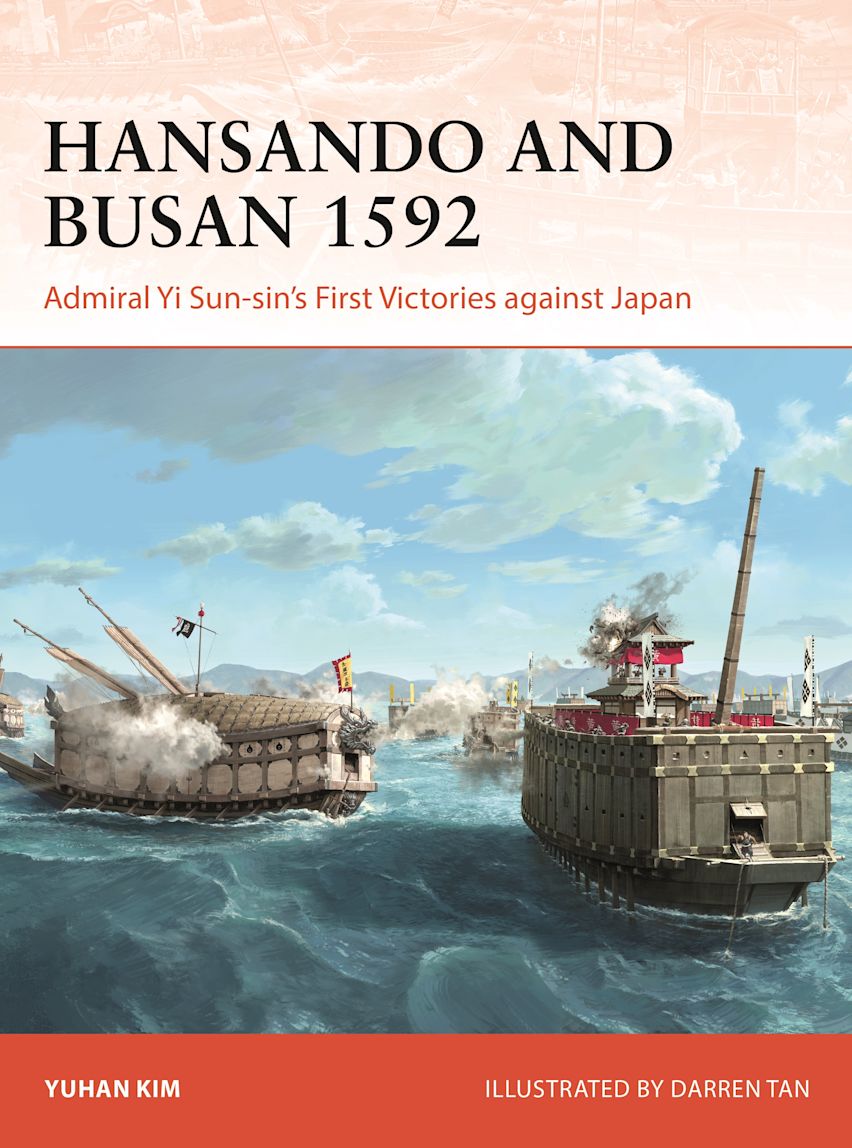
Yuhan Kim, Hansando and Busan 1592 (Osprey, 2025)
The year is 1592 and Joseon Korea struggles to repel a Japanese invasion that is sweeping all before it. At sea, though, the Japanese fleets have bitten off far more than they could chew because Korea had more than an ace up its sleeve. Step forward Yi Sun-sin to take command of an impressive navy that would hammer the Japanese ships wherever they found them. Yuhan Kim delves into this conflict and tells a fascinating story.
Kim opens his story with the initial, massive Japanese amphibious assault at Busan that began the seven years long Imjin War. He notes that over one million people would die in this conflict, which many Koreans believed could have been stopped at sea, though Kim argues otherwise. Kim continues his background set-up by considering the opposing military structures and commanders, including Yi Sun-sin for the Joseon and Wakizaka Yasuharu for the Japanese. Kim delves deeper into the opposing forces, focusing on their navies, including ships and weapons. The most famous ship was the ‘turtle ship’, the geobukseon, designed specifically to disrupt Japanese fleets, according to Kim. With his set-up established, Kim moves on to his narrative of the main campaigns. He begins with the Okpo campaign, initiated by the fall of Busan and the chaos that ensued. The battle was a crushing Joseon victory under Yi’s command. He was soon on the campaign trail again, intercepting an enemy squadron at Sacheon, trapping a Japanese fleet at Danghangpo, luring a Japanese fleet into deep water off the Gyeongnaeryeang Strait, and pounding an almost captive fleet at Angolpo, winning victory after victory. Meanwhile, the Japanese invasion had stalled, but Yi struck again at the Nakdong delta before sailing to Busan where he battered the main Japanese fleet. Kim moves on to Yi’s fifth campaign, in 1593. Yi’s fleet arrived at Ungpo bay, but the Japanese fleet would not come out. So, Yi organised an amphibious assault on Japanese fortifications, but it failed. A blockade ensued, but Yi had to give up for logistical reasons. In the aftermath, the war dragged on, but while victorious in every battle, Yi could not overcome his manpower and resources issues. Kim notes, however, that there was little doubt that Yi had saved Korea through his bold command decisions.
This is an excellent survey of a conflict that may be unfamiliar to many military history readers outside Korea and the Far East. Kim deftly handles the context of the Imjin War and how it was fought. And it was not all about the famous Turtle ships, though they played a significant role in the demise of the Japanese navy. Kim’s narrative balances the action in numerous battles with the less thrilling aspects of warfare such as logistics and politics. He is well supported by Osprey’s typically excellent illustrations and selection of photographs. Naval history readers will undoubtedly appreciate a book that covers a very different military culture.