by RNS | May 14, 2020 | Beating Tsundoku
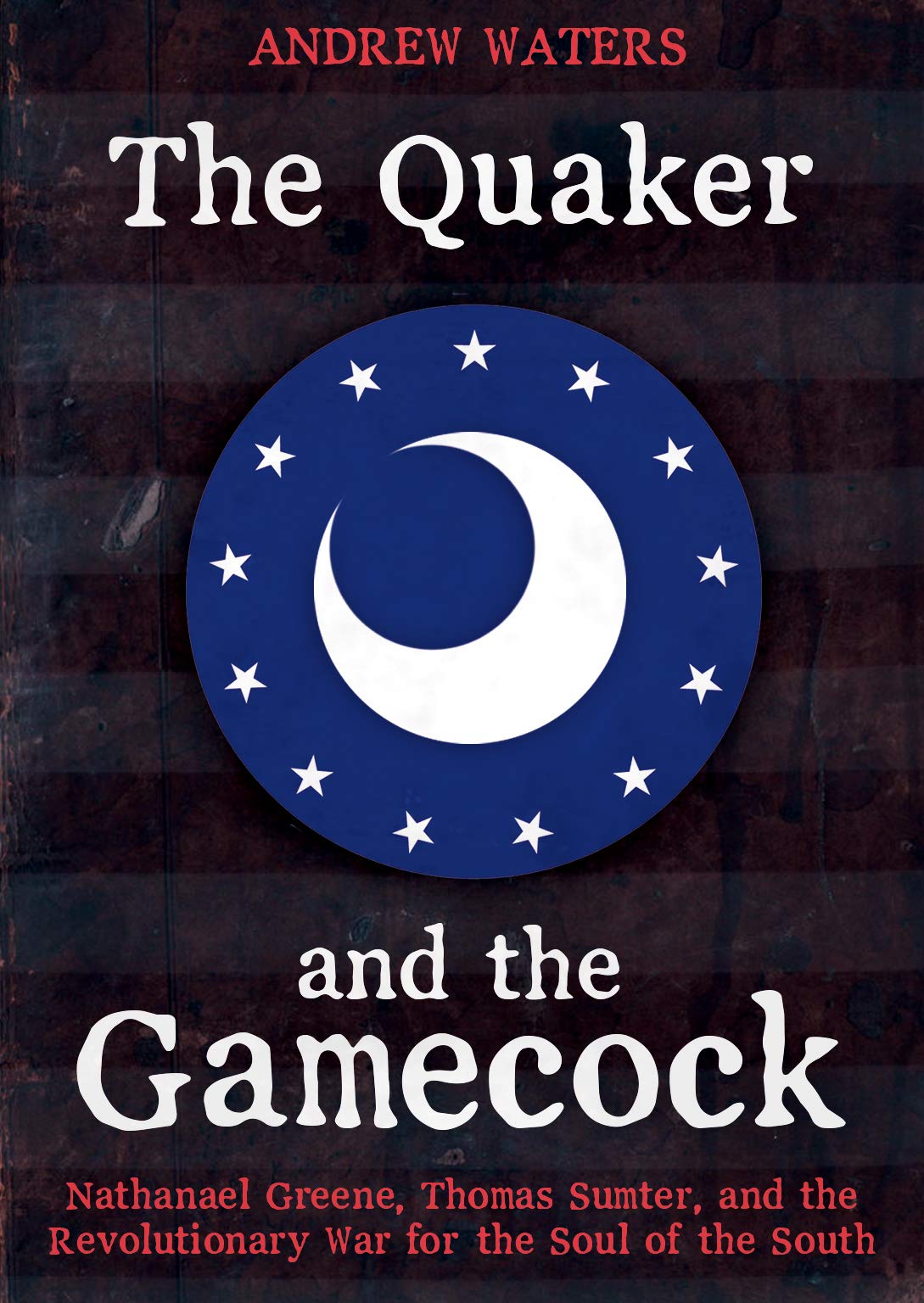
Jenn Scott, I am Minded to Rise (Helion, 2020)
In I am Minded to Rise, another book in Helion’s excellent Century of the Soldier series, Jenn Scott surveys the clothing, weapons, and accoutrements of Jacobite supporters between the Battles of Killiecrankie in 1689 and Glenshiel in 1719. Scott begins with a handy timeline of events, followed by a background chapter on the clan system in the Highlands during the 17th Century and into the Rebellion era. Religious divisions played a role in who supported the Stuarts, and many Highlanders had military experience, though not as many went around armed as previously thought. Nevertheless, those outside the Highlands viewed clansmen as nothing short of barbarians. Highlanders also became synonymous with bright tartans and blue bonnets, but, in the first of quite a few surprises in this book, these were rarely attributed to any particular clan.
Scott examines the Jacobites in greater detail in subsequent chapters. Those who best fitted the classic description of Highlanders fought in the first rising, complete with long hair and beards while carrying swords, targes, dirks, and Lochaber axes, and some still carried bows – firearms became more popular in future campaigns. The proliferation of edged weapons led to the famous and devastating Highland charge. Scott describes that in among her accounting of the all the weapons used by the various Highland contingents. The demographics changed for the 1715 rebellion with many more coming to join the Standard from outside the Highlands. Tartan still dominated Jacobite dress, but long wool or linen shirts became common as did coats with waistcoats or vests underneath. Stockings and boots or shoes, and a wee leather bag, known as a sporran, completed the ensemble. The Spaniards arrived in 1719 to help the cause. They wore regulation uniforms in the Battle of Glenshiel, which was fought almost exclusively with guns rather than swords. Another significant difference there was the lack of beards and long hair. Scott concludes her brief but interesting book, about seventy pages of information, with descriptions of the colour plates of soldiers and flags and an extensive bibliography.
Reenactors, wargamers, and historians of dress will welcome this book. Scott’s ambitions are limited as you might expect given the subject, but she achieves her goal of informing while entertaining, and I enjoyed reading this. 9/10
BUY NOW

by RNS | May 13, 2020 | Beating Tsundoku
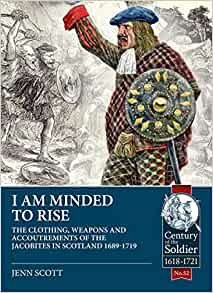
 Martin W. Bowman, Hitler’s Invasion of East Anglia 1940 An Historical Cover Up? (Pen & Sword, 2018)
Did the Germans invade England in 1940? They certainly planned to under the codename Operation Sealion, and much ink has been spilt on those plans along with many counterfactuals on what would have happened had the Germans succeeded. Martin Bowman posits in Hitler’s Invasion of East Anglia 1940 An Historical Cover Up? that they did, or at least maybe they did. He explains in considerable detail how the Germans would have proceeded, deploying the invasions of Belgium and Holland to provide illumination. Bowman discusses spies, Brandenburgers operating behind the lines, paratroopers, commandos, gliders, the Home Guard, fire weapons, mysterious corpses washed up on beaches, co-op drivers, and much more. He throws everything and the kitchen sink at demonstrating that something happened, probably in Suffolk or just off the coast, and that the government covered it up and still does. But ultimately Bowman comes up short, resorting to his imagination to fill the hole all that evidence still leaves open.
Bowman’s assemblage of evidence serves him well, though perhaps not how he intended. The sections on Holland and Belgium are very informative, as is his dissection of Operation Sealion. He also adds to our understanding of German clandestine operations as they set up their blitzkriegs. Indeed, there is not much Bowman misses in synthesizing larger works from other historians into a coherent narrative and analysis of events in 1940. More footnotes would have been nice, however, particularly in a book that slides into fiction for the crucial reconstruction of the German attack – some readers might want to know how Bowman pulls all this together. A more judicious editor might have been helpful too in parts of the book that felt tacked on and not germane to the thrust of Bowman’s argument; for example, the stories of British commando operations in Norway seemed unnecessary.
The biggest failing, however, is in the argument that the British covered up what must have been a morale-boosting victory after the woes of Dunkirk and the Blitz. An accident, or disaster, is understandable, as would be weapon testing, but where is the benefit in covering up a significant victory, particularly when the British were spreading rumours designed to affect German morale, stating exactly what Bowman contends happened? Surely the British public would want to hear about dead Germans on the beaches, not have them carted away in civilian trucks and everyone sworn to secrecy? Unfortunately, I do not buy the German invasion theory, which is a pity because there is much to commend Bowman for in this entertaining and thought-provoking book. 7/10.
by RNS | May 12, 2020 | Beating Tsundoku
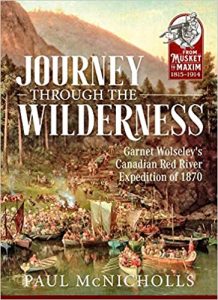
 Paul McNicholls, Journey Through the Wilderness Garnet Wolseley’s Canadian Red River Expedition of 1870 (Helion, 2019)
Garnet Wolseley is probably best known for his mission up the Nile in 1884 to save the doomed Gordon of Khartoum. That was a noble and heroic effort, but Wolseley had previous experience with river expeditions, most famously in Canada in 1870. Paul McNicholls narrates that story in Journey Through the Wilderness Garnet Wolseley’s Canadian Red River Expedition of 1870.
The Red River Expedition is a story of a great military adventure rather than a military conflict. McNicholl’s begins with a description of the colonial settlement in Western Canada, and the formation of the Canadian Confederation in 1867. When the Canadian government bought the Red River region from the Hudson Bay Company, it prompted a backlash from the local Métis people led by Louis Riel. He organized a provisional government that negotiated with the Canadian Government to create the province of Manitoba, but in the process executed an English speaking, pro-Canadian settler, Thomas Scott. It was therefore deemed necessary that a military expedition be mounted to assert Canadian authority in the region and that the British Army should do that. Lieutenant-General James Lindsay was sent out to oversee the operation and he placed Colonel Garnet Wolseley in command of the Red River expedition.
The Victorian British were a can-do people who barely allowed anything to get in their way once they decided on a course of action. Wolseley defined the stereotype: an ambitious, pugnacious officer who had fought his way up the ranks, demonstrating the sort of blithe courage mixed with administrative capabilities that exemplified the finest Victorian officers. The Red River Expedition was his first independent command and he was determined to succeed. The problem was that no clear passage existed to cross Canada and the window of opportunity was a narrow one because of the lengthy and severe Canadian winter.
McNicholls follows the expedition across the country; from the raising of the force and preparing all the other logistical concerns; organizing transport across the Lakes; overcoming American objections to using their canal; building and repairing roads; embarking and disembarking troops; setting up and dismantling camps; and all the while negotiating forest fires, insects, and incessant rain. At times, Wolseley had to order the boats lifted out of the water and dragged past rapids and falls using portage methods. The phrase ‘not a happy camper’ might have originated with Wolseley who feuded with the Canadian engineers responsible for the roadworks that proved insufficient. McNicholls detours to narrate the activities of British intelligence officer Lieutenant William Butler who travelled through America and onto Fort Garry to prepare the way for Wolseley’s arrival. He then reported back to Wolseley who he met on his advance. The expedition continued, aided by the skill of its Iroquois guides and Canadian boatmen, until it arrived, predictably in pouring rain, at their destination at Fort Garry. But any hopes of a battle were dashed: Riel and his followers had fled. McNicholls concludes, rightly, that the expedition was a “minor masterpiece of logistics and sheer physical effort”.
Journey Through the Wilderness is a very detailed account of Wolseley’s expedition with a solid base of footnotes to guide the reader – it must surely be the definitive version. McNicholls writes well and keeps the story moving along while adding commentary on the events and people involved. Anyone interested in Canadian or Victorian military history will enjoy this, but so will those seeking an interesting tale of adventure and drama. McNicholls also provides an excellent bibliography for further research.
Highly Recommended. 9/10
BUY NOW
by RNS | May 9, 2020 | Beating Tsundoku
 Andrew Waters, The Quaker and the Gamecock (Casemate, 2019)
In The Quaker and the Gamecock, Andrew Waters explores the dichotomy of two very different characters leading the Patriot war effort in the South during the American Revolution. The Quaker, Nathaniel Greene, commanded the Regular Army with all that entailed for an 18th Century general. The Gamecock, Thomas Sumter led the Irregular Militia, the backwoodsmen, waging a guerrilla war upon which much of the southern war effort rested. The two did not get along.
Sumter was an opportunist and adventurer who found his home as a merchant among the fiercely independent back country settlers of South Carolina. In 1776, he recruited a regiment of troops for the Revolution. He resigned his commission in 1778 to become a politician and businessman but took up arms again in 1780, leading the militia against Banastre Tarleton who had burned down his house. From there, Waters follows Sumter through the ups and downs of his military career.
Greene was an autodidact in military matters whose meteoric rise to Major General in the Continental Army is something of a mystery. His first few efforts at battlefield command produced mixed results. His business experience, however, made him an invaluable aide to General Washington as a logistics expert. Greene became Quartermaster for the army but chafed at the politics involved and his own ambition as a combat commander. His chance came when Washington appointed him to command the Southern Army. He arrived at an opportune time because Sumter had just been wounded, giving Greene a free hand at least in the beginning.
Greene had little time for the militia, but he developed a strategy, probably Sumter’s, that depended on them. Sumter had little time for Greene, or Francis Marion, the Swamp Fox, who seems to have had little time for him too. Waters narrates the fractious relationship among these commanders while they worked on clearing the British out of the Carolinas. He detours to describe the economic and social background of South Carolina, ending in Sumter’s Law, a system of enlistment payable in captured slaves. Watson turns next to the War of Posts, the attacks on British forts and bases in South Carolina, and the dramatic Battle of Hobkirks Hill. Waters blames Greene for that defeat but praises his tenacity in rising again to fight on. Greene failed again, this time to take the British Fort at Ninety-Six. The American militia continued the war, Sumter threatening Charleston, but received a sharp check at Shubrick’s Plantation. However, Greene’s subsequent drawn battle at Eutaw Springs ended the British war in South Carolina: Sumter wasn’t there for reasons that never became clear. Greene was organizing another campaign when news of the surrender at Yorktown came through, ending the war. Waters tracks Greene and Sumter through the reorganization at the end of the war and their widely divergent fortunes afterwards.
In The Quaker and the Gamecock, Andrew Waters tells an engaging story, though one familiar to many readers of the American Revolution. His focus on command relations, however, provides an interesting angle. He also nimbly juggles his historical characters without creating confusion, an easy mistake he could have made with such strong personalities. His unnecessary and jarring passing references to President Trump and modern terrorism aside, this is a well-written and useful book for understanding the war in the South.
8/10
BUY NOW