Enrico Cernuschi, Italian MAS & MS Boats 1915-49 (Osprey, 2026)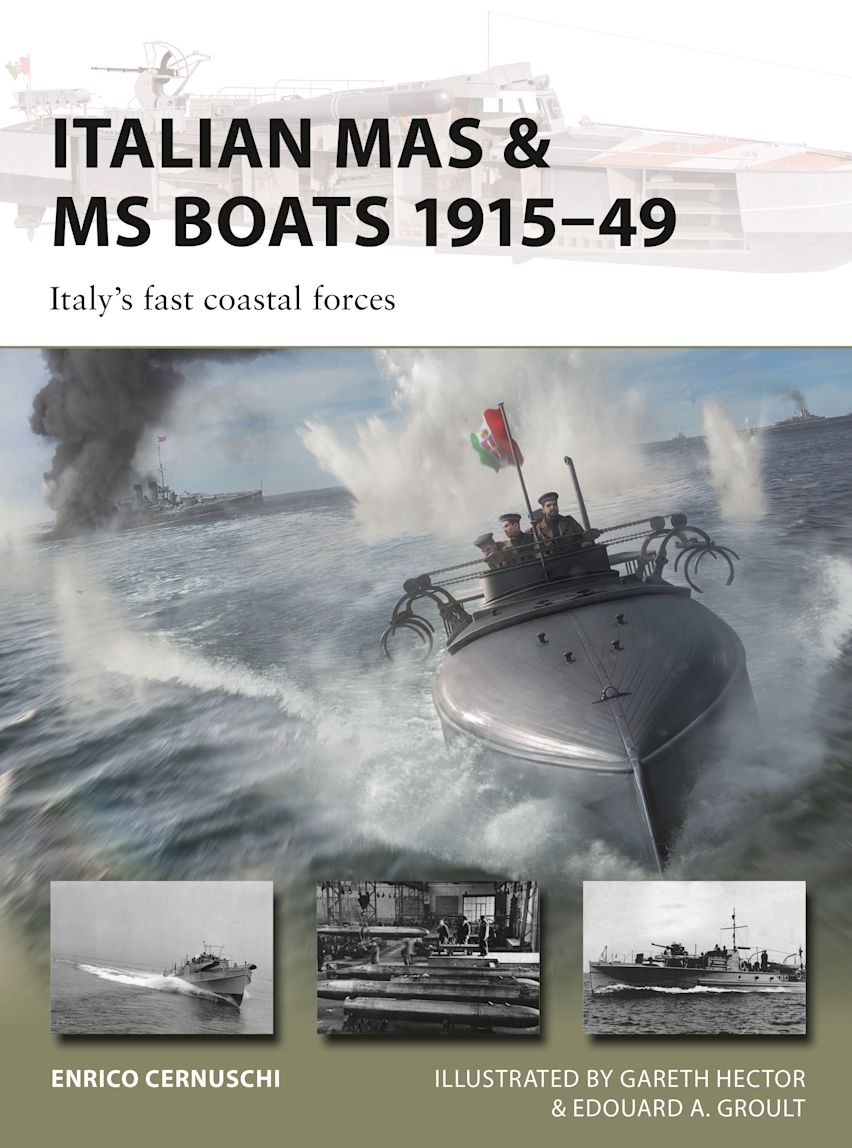
Italy, that boot-shaped peninsula dominating the central Mediterranean, has a long coastline to defend. In the early 20th Century, Italy was also flanked by potential enemies with powerful fleets. Therefore, Italy had to project seapower as well as defend its coasts. That required a wide variety of naval vessels for the Regia Marina (RM). In this book, Enrico Cernuschi surveys the development of Italy’s fast motor torpedo boats (MTB) and their actions in war and peace.
Before the Great War, begins Cernuschi, Italy was quick to grasp the advantages of small, fast attack boats. Developing them to the required specifications proved the hard part. But, by 1917, the RM had found what they needed: a versatile, multi-function boat, the MAS, that could take the war to the Austro-Hungarian and Ottoman enemies in several successful actions. Between the wars, development continued with the emphasis on finding a MTB that could cope on the high seas rather than just an Adriatic vessel, and one that could carry mines and torpedoes. Building the right engine seems to have been the biggest problem; that, and a lack of belief in these boats amongst the Italian RM high command. As World War II approached, however, the necessity was not for quality but quantity to suit Italy’s strategic situation.
That brings Cernuschi to the operational history of the boats in WWII. In the early war, they took on the French, prowled Malta’s Grand Harbour, hoping to spring night ambushes, protected Sicily, and operated amongst the Greek islands. Political rivalries and a lack of aerial reconnaissance diminished their capacity, however, but they still had some successes against the Royal Navy. In the war’s middle period, the MAS pestered British convoys to Malta, but their biggest victory was sinking of HMS Manchester in August 1942. The tide turned against the Italians in 1943, though they were still involved in many combat actions. From October 1943 to May 1945, the MAS boats carried out 307 missions for the Allies. After the war, the Italian boats worked against sea traffic to the communists in Yugoslavia. The last hurrah of the MAS boats came with a police action in 1965.
This is a slim volume in Osprey’s New Vanguard series, but Cernuschi squeezes in a lot of useful information. He weaves together technical details, tracing them through the development of the Italian MTBs, and combat narratives, following the MTBs on a range of different operations. They had a busy war on both sides! Cernuschi is assisted by Osprey’s usual excellent photographs and artwork to create an introductory book that is well-worth reading for naval and military history readers.