by RNS | Mar 30, 2023 | Beating Tsundoku
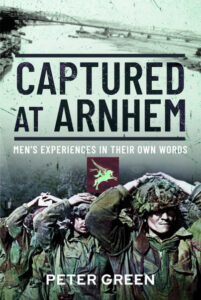
Peter Green, Captured at Arnhem (Pen & Sword, 2022)
A most unusual book. Weighing in at 564 pages, Captured at Arnhem seems like a daunting read even for the most avid reader of Operation Market Garden literature. There’s a catch, however, but a good one as we shall see. Peter Green’s mission was to uncover the experiences of the Allied soldiers captured at Arnhem gleaned from questionnaires given to them on their return to England. Not only does he throw the kitchen sink at it, Green also gives you the sink to see for yourself.
BUY NOW
If you don’t know, Operation Market Garden was an ill-fated attempt by the Allies to shorten the war in September 1944 by capturing the Dutch town of Arnhem to open a bridge across the Rhine and drive a stake into the heart of Nazi Germany. It didn’t go well, and 6,000 Allied soldiers entered German captivity as Prisoners of War. On their release at the end of the war, MI9 gave them questionnaires to complete; 2,357 did so, and Green dredges through them to find out what happened to those men. In Green’s prelude to his findings, he outlines the questionnaire, the problems with locating those missing, and the general findings. Then we are into the tables.
The first table is Prisoner’s Details, 168 pages of listings of name, rank, unit, numbers for service and PoW, wounded status, and camps in which they were initially interned. How men became prisoners and where comes next with brief descriptions of the camps. Interrogation methods follow, with Green highlighting specific answers to quote as he does throughout his book. Table 3, of 62 pages, lists the men’s answers to the question if they were interrogated, where, and how. Chapter 4 surveys some of the camps the men would call home for the remaining months of the war, and the subsequent chapter examines camp life, complete with another 161 pages of tables. Attempted escapes (fewer than you might expect because these were deterred with the war’s end so close), evacuation marches, and liberation conclude Green’s book, including another table.
Somewhere in Captured at Arnhem there is a very good book waiting to break out. Green does well enough, teasing out a useful text from his main sources, but you’re left thinking he could have dumped the tables into his research folder and written a more fluent book. There is, however, something to be said for the pleasure of reading through all the entries, particularly the various attempts to escape by the intrepid soldiers; some of them are quite remarkable. Those that enjoy reading about Arnhem or PoWs will enjoy this text and rummaging through the tables, I did, but it’s not a book I would give to open someone’s Arnhem reading account.
by RNS | Mar 28, 2023 | Beating Tsundoku
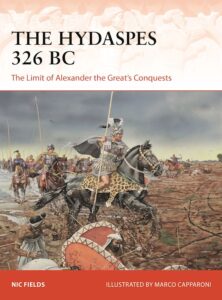
Nic Fields, The Hydaspes 326 BC (Osprey, 2023)
Even the greatest reach their limits, no matter what they excel in. For Alexander the Great, the Macedonian general that bludgeoned his way through the mighty Persian empire, that limit lay just beyond the River Hydaspes, when his army urged him to turn around even though he had just won another great battle. In this Campaign book from Osprey, Nic Fields describes that battle, the last to showcase Alexander’s tactical genius.
The Campaign series of books are formulaic in their structure, and The Hydaspes does not deviate from that. Fields opens with the necessary background narrative that brings the combatants to the banks of the Hydaspes. He also works through the main sources for the battle; the Greek historians might be familiar but the Indians probably less so. After an annotated chronology of Alexander’s reign, Field comes to the opposing commanders; the still controversial Alexander and the more obscure Poros. Then there are the respective forces; Alexander’s all-conquering phalanx against Poros’ elephants, though obviously there was more to both armies than that simple equation suggests. That brings us to the Hydaspes with Alexander on one bank and Poros on the other, and Poros intended to keep it that way. Alexander had other ideas, however, and crossed downriver overnight to appear on Poros’ flank. The resultant crushing victory for Alexander, though at some cost, opened the gates to India. Fields calls this ‘the triumph of genius in command’, but Alexander’s soldiers were at the end of their rope; so, after this signature victory, the Macedonians turned west not east.
The Hydaspes is an outstanding introductory survey of Alexander’s last great battle. Fields obviously knows his material and writes well, and he is ably supported by Osprey’s usual excellent graphics content in maps, artwork, and photographs. Most books of this kind focus almost exclusively on Alexander, so I particularly enjoyed finding out more on the Indian side of the campaign, and also noted the useful bibliography for further exploration. The Hydaspes is recommended for anyone starting their journey into discovering Alexander’s greatness and for those who knew it already.
by RNS | Mar 27, 2023 | Beating Tsundoku
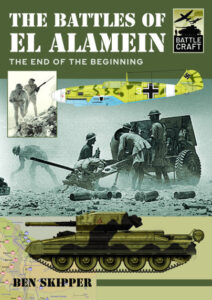
Ben Skipper, The Battles of El Alamein (Pen & Sword, 2022)
In this opening edition of Pen & Sword’s Battlecraft series, Ben Skipper presents an entertaining survey of the battles of El Alamein that lasted six months in 1942 and changed the course of the Second World War.
BUY NOW
Skipper begins with brief biographies of the three major commanders involved in the El Alamein battles: Rommel, Auchinleck, and Montgomery. Then he lists the orders of battle and narrates the prelude battles of Gazala and Mersa Matruh before we encounter Act One, the First Battle of El Alamein. After an interlude, incorporating the Battle of Alam Halfa, Skipper introduces the Second Battle of El Alamein, or Operation Lightfoot, fought in three stages.
Having finished his narrative, Skipper turns to the equipment used in the battles in the ‘Quartermaster’s Section’ aimed at military modellers. He begins with the Allied Crusader tank, which includes a brief overview of the tank’s development and the various model kits you can buy so that you can build your own. The Panzer III Ausf L follows in the same format, then the Messerschmitt Bf 109 E-4/N, and the Curtiss P-40. And with that, the book ends rather abruptly.
This is very much an introductory book for the El Alamein battles that could easily spark more in-depth reading, though the lack of a bibliography makes that harder work than it should be. My other quibble is that, while Skipper’s enthusiasm and knowledge are evident, the intervention of a copy-editor would have been useful in places. Nevertheless, the text is readable, and that is well-supported by numerous photographs and maps. In addition, the modelling section is well worth a look; certainly, this jaded modeller was inspired enough to have a go at a Crusader. All in all, even if you are knowledgeable on El Alamein, Skipper’s book is worth a gander; and if you are not, then this is a good place to start.
by RNS | Mar 26, 2023 | Beating Tsundoku
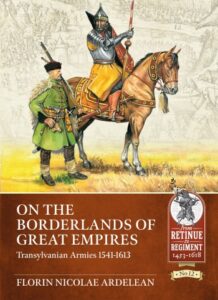
Florin Nicolae Ardelean, On the Borderlands of the Great Empires, Transylvanian Armies 1541-1613 (Helion, 2022)
Florin Ardelean tells the tale of the Principality of Transylvania, its birth after the defeat of the Hungarians at Mohacs in 1526, and its struggle for survival, coveted as it was by both the Hapsburgs and the Ottoman Empires. Politically, it was a complex mix of Noble, Saxon, and Szekely estates overshadowed by its larger neighbours. Be warned, its complex and confusing, with power struggles, dynastic changes, and some characters seemingly appearing, disappearing, and then reappearing again.
The organisation of the army reflects that complexity, being a mix of Nobles and their levies, Szekely (Southeast Transylvania), and Saxons sprinkled with tax exempt riflemen and guardsmen. All in all, it must have been quite a colourful spectacle but quite difficult to control. The principality also had a fairly substantial number of fortresses, which were frequently fought over. Ardelean details the most important ones and what happens to them throughout the period.
The final chapter of the book focuses on the military campaigns and is supported by clear diagrams of the major battles. There are civil wars, fights involving Spanish Tercios and Landsknechts, and battles against Ottomans and even Wallachians; enough to ignite those thoughts of new armies and exciting wargame scenarios.
The book has a range of period illustrations and a set of coloured plates by Catalin Draghici, which are particularly finely done. I’ve never heard of the artist before, but I look forward to seeing more of her work. The only minor quibble is that four out of the eight plates represent non-Transylvanian troops; most readers will already know what a landsknecht looked like.
Helion is developing a real niche in finding subjects not commonly covered in the current literature and bringing them to the English reading world. This is an interesting and complicated story that is well presented, and one that I would recommend for early modern era readers and those wargamers who are looking for something a bit off the beaten track that could tie in with pre-existing interests in the Ottomans and Habsburgs of the late 16th and early 17th Century.
(Reviewed by Mike Huston)
by RNS | Mar 25, 2023 | Beating Tsundoku
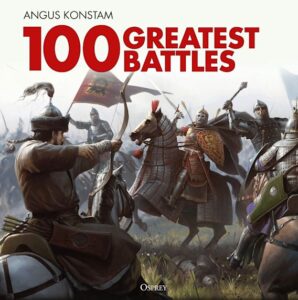
Angus Konstam, 100 Greatest Battles (Osprey, 2023)
We seem to live in a world of lists in this Internet Age. In particular, we can’t resist clicking on the ‘greatest’ list of whatever the subject happens to be, and most of us have an opinion on what qualifies. The prolific Angus Konstam has presented a list of the 100 greatest battles in the ‘old-fashioned’ book format, but the effect is the same. Many of the battles Konstam lists will receive knowing nods, but some will have you reaching for your red pen with a frown or perhaps even an expletive.
Konstam judges greatness for battles that have had a significant effect on a war or campaign, and he supports the ‘turning point’ thesis for them. He recognises, however, the subjectivity in his approach. The battles Konstam selects are organised into eras: the Ancient World, the Medieval World, the Renaissance, the Age of Reason, the Napoleonic Era, the Age of Empires, World War I, World War II, and the Modern Age. Many of the battles should be obvious – Marathon, Waterloo, Gettysburg etc. – but I should note that Konstam selects just 9 of Creasey’s 15 famous, or infamous, decisive battles, and only 3 from outside the European sphere of influence. Each battle account is spread across two pages and is partnered with a painting of the fighting drawn from Osprey’s considerable gallery of work previously published in more specific books relating to that battle. Konstam provides some background and a brief overview of the battle and its consequences.
100 Greatest Battles is an odd little book, both in its physical appearance (a half-sized ‘coffee table’ book) and its concept (a list of ‘great’ battles). Konstam writes well enough, and the artwork is excellent, but there is not much meat on the bones. Nevertheless, like those internet click-bait lists that we can’t resist, I found myself arguing with some of Konstam’s choices while happily flipping through the pages, and that seems to be all that the author asks from his readers on this occasion. If so, job done.