by RNS | Oct 26, 2021 | Beating Tsundoku
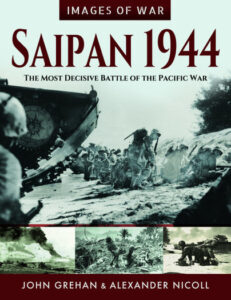
John Grehan & Alexander Nicoll, Saipan 1944 (Frontline, 2021)
Spring 1944, and the war in the Pacific had turned against Japan. But as long as their homeland remained free from threat, argue Grehan and Nicoll in Saipan 1944, then war’s end looked no closer. If the Americans could take the Mariana Islands, that would change because the new B-29s could hit Japan. The most heavily defended was Saipan; this book in the Images of War series tells the story of the American assault and the bitter fighting that followed.
BUY NOW
The authors take us through the whole of Operation Forager intended to capture Saipan. The Americans underestimated Japanese strength on the 12.5 mile long misshapen island where 32,000 Japanese defenders waited, not the expected 17,000. D-Day was 15 June 1944, supported by naval gunfire and aerial bombardment, but that didn’t prevent the Marines deploying onto the beaches under a storm of Japanese fire. Nevertheless, the Marines pushed inland and onto the high ground, winkling the Japanese out of their caves and bunkers one by one in intense combat that lasted for several days before entrapping the Japanese remnants on the north of the island. Grehan and Nicoll detour to cover the massive but one-sided naval battle of the Philippine Sea that took place during the conquest of Saipan. Returning to the island, the authors describe the last desperate banzai attack of the defenders on 7 July: over 4,300 Japanese died. All that was left was to mop up holdouts and survivors, but the horror was not over as hundreds of civilians committed suicide by jumping from cliffs. With Saipan taken, the authors conclude with photographs of B-29s taking off to bomb Japan, mission accomplished.
As with all Images of War books, Saipan 1944’s success lies in the range and quality of its photographs. On the whole, these are informative and sometimes thought provoking. There are perhaps too many naval photographs, but the modern pictures of where the action took place are interesting, and the combat photographs of US Marines graphically portray what they endured. The accompanying text is concise, and the authors make good use of quotes from those involved. They also include some very useful maps so that readers can follow the action. Overall, this is a solid addition to the series.
by RNS | Oct 24, 2021 | Beating Tsundoku
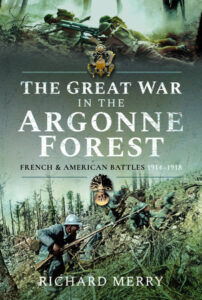
Richard Merry, The Great War in the Argonne Forest (Pen & Sword, 2020)
Mention the Argonne Forest and the likely response will be to remember the Americans who fought there so bravely in 1918. But in this quite unusual book, Richard Merry reminds us of all the others of various nationalities who sacrificed so much in this quiet, heavily-wooded part of France, including his great uncle Bob.
BUY NOW
Merry begins by describing the isolated but strategically important Argonne region in northeast France and its sometimes bloody history even before WWI. For one year from the Autumn of 1914, the Argonne was torn apart by the war, but that sector fell mostly quiet from Autumn 1915 to 1918. Having set that table, Merry gets into the details of the fighting and the role of Bob who joined the French Foreign Legion because he was too old for the British army but ended up in the British army anyway!
The book proceeds chronologically, Merry narrating the action in the forest during 1914. As with everywhere else along the Western Front, trenches soon appeared and the war of attrition with which we are so familiar set in as the hoped for Christmas victory faded into history. The New Year began with an assault by Italians, fighting with the French Foreign Legion, in the Argonne then more of the tit-for-tat attacks that typified trench warfare. That included underground fighting as the enemies tried to dig under each other, and the use of dogs to locate wounded men. One notable luminary on this front was Erwin Rommel who would remember this region well for another war. In 1916, the action shifted to nearby Verdun, leaving the Argonne relatively calm.
In 1917, America entered a war for which they were completely unprepared. That would have a great impact on the Argonne region in 1918. And that is where Merry goes next, with the Americans into the forest, including the stories of the ‘Lost Battalion’ and Alvin York’s heroics. On 10 October 1918, the Germans finally left the Argonne. Merry’s closing chapters narrate the aftermath and rehabilitation of the Argonne after the Great War only for it to become the scene of more fighting in World War II. As for great uncle Bob, he survived the war physically, though whether he did mentally is another question. Merry adds a brief guide for the Argonne to the modern traveller wishing to visit where hell happened.
Merry’s account of the Argonne is unusual for a military history narrative in that he focuses on a single region over the whole war and beyond. He makes this work by placing this local sector into the broader conflict and world events. For events in the forests, Merry uses local knowledge mixed with secondary source narratives and primary source quotes, including some from Uncle Bob, to illuminate the often confusing war in this region. A reasonable assortment of maps accompanies the text. The result is an engaging book that Great War enthusiasts will appreciate even if some of it treads familiar ground.

by RNS | Oct 21, 2021 | Beating Tsundoku
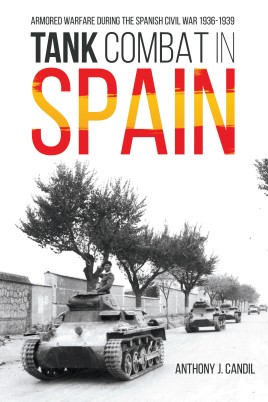
Anthony J. Candil, Tank combat in Spain, Armored warfare during the Spanish Civil War 1936 – 1939 (Casemate, 2021)
Anthony Candil was a career tanker in the Spanish army and brings his expertise to this slightly neglected subject. It is taken as gospel that the Spanish Civil War was a testing ground for the major powers, but Candil challenges this and other assumptions about the war. He sets out his case that the war had more effect on tank design than on tactics while accepting that the Spanish terrain is very different from the Steppe or North Africa.
The chapters start with the origins and beginnings of the war, through organisation and structure, foreign intervention, etc in a straightforward narrative. Candil examines the use of armour by both sides and tactical deployment both good and bad. He ends with an appraisal of equipment and armament produced and used on a country by country basis, examining the Soviet Union, Italian and German tanks, setting out the advantages and disadvantages of all.
There are a number of things which were new to me, possibly because unlike most writers in English, Candil has examined sources in Spanish that may have been inaccessible to others. Want to know how to disable a Soviet tank using only two blankets? This book will tell you how, though it only works if the tanks don’t have infantry support. Candil also makes the interesting point that despite the Nationalist tanks being markedly inferior to the Soviet supplied Republican ones, they tended to take fewer casualties due to better tactics and the development of anti-tank tactics and weapons. In Candil’s view, these combined arms groups were more the predecessor of WW2 tactics than the tanks themselves.
My one criticism would be that occasionally Candil’s politics seep out; he was after all an officer who joined the army ten years before Franco’s death. The Republic is described as “Red” and he also claims that “there was no real democracy on the Republican side” even though they were the elected government. Despite being a career Spanish army officer, Candil is now a US citizen and lives in the South. That said, this is a very useful book for anyone with an interest in armour in the war as it comprehensively covers the organisation and use of armour by the Republic, the Nationalists, and intervention forces.
This book runs to 240 pages, including 20 pages of endnotes and an extensive bibliography. There are numerous photos and though they tend to be similar and generic, for example “Pz I in a Spanish town”, they are good for both modellers and wargamers. The Spanish Civil War sometimes seems to be approaching saturation point with books, and many cover the same well-trodden ground, but with this book Candil brings fresh insights and new information to the debate. This book is a worthwhile investment for any wargamer with an interest in the period and might cause some to rethink their assumptions on armour and its use. Reviewed by Jim Graham

by RNS | Oct 19, 2021 | Beating Tsundoku
Peter Hoskins, The Black Prince and King Jean II (Pen & Sword, 2020)
The Black Prince, heir to the English throne, and King Jean II of France met in Battle at Poitiers in 1356. This was a significant engagement in The Hundred Years’ War, a series of conflicts between France and England from 1337 to 1453. Peter Hoskins notes immediately how much the two men had in common, yet one emerged victorious while the other became a humiliated prisoner of war. His book attempts to answer why that happened with an emphasis on their generalship and character.
BUY NOW
This is a book in three parts. The first sets down the two biographies of the Black Prince and King Jean II. That provides the necessary background to follow Hoskins’ analysis while giving him the opportunity to prepare quick character sketches. Part Two describes the principles of war and command and leadership in the Hundred Years’ War. He starts that with a consideration of generalship and the conduct of war through the lens of Sun Tzu’s Art of War, which seems incongruous at times as Hoskins recognises in passing. He is on much firmer ground with Vegetius’ The Epitome of Military Science, and he just about skirts charges of anachronism with his third framework, the principles of war used by the modern UK forces. Command, Hoskins concludes, was the preserve of the nobility; commanders had to be courageous and disciplined, and they had to project their personality onto their armies, but that did not always guarantee competence.
Hoskins moves on to the campaigns of the Black Prince and King Jean II in Part Three. For the Black Prince, those were the expedition in France of 1355-56, leading to the Battle of Poitiers, and the 1367 campaign leading to the Battle of Najera in 1367. Jean comes under Hoskins’ microscope for the sieges of Aiguillon in 1346 and Breteuil in 1356 before bringing him to Poitiers and his fateful meeting with the Black Prince. Hoskins does all this in chronological order. At Aiguillon, for example, Jean lost focus on his primary objective, while on his 1355 chevauchee, the Black Prince demonstrated quite the opposite faculty, keeping his eyes on his prizes. The Battle of Poitiers – an event that occupies the central place in this book – emphasized the qualitative differences between the two commanders, Hoskins argues. He continues his narrative and analysis into the campaign of Najera in 1367 and the Black Prince’s last great victory. Hoskins concludes with his theory on the location of the Poitiers battlefield.
The Black Prince and King Jean II is an enjoyable narrative history with some cogent analysis of command in the Hundred Years’ War. His clear writing makes it easy to follow Hoskins through a complex period, and the double-sided biographical introduction is a clever way to lead into the heart of this study. There is perhaps too much narrative at times for some of the operations where more analysis would be welcome. The inclusion of the Najera campaign also felt unnecessary; the climax of the book is clearly at Poitiers. Nevertheless, Hoskins’ even-handed approach to his two major protagonists produces a balanced account that is well worth reading.

by RNS | Oct 16, 2021 | Beating Tsundoku
A Doomed Offensive
John Carr, Mussolini’s Defeat at Hill 731, (Pen & Sword, 2020)
The Italian invasion of Greece in 1940 was, at best, a disaster. There are very few parts of it that show the Italian Army in a good light, and the final offensive of that invasion is no exception. In this book, John Carr takes us through the final Operazione Primavera (Spring Offensive) that was carried out at Mussolini’s behest. It focusses on the fight for Hill 731, the key part of the Greek Defensive line some 20km north of Këlcyrë in Albania. The Italian plan saw the main strength of their assault fall upon a 6km long line of the Greek positions. This relatively small tome comes in at 213 pages long, with some black and white photographs and a rundown of the overall commands involved in Operazione Primavera.
BUY NOW
For being a short book there is a lot of detail, and the author’s prose brings that to life so that it never gets dull even when discussing the minutiae. The author has taken the source material and woven a story from it, not just a military history. He concentrates on the soldiers doing the fighting and their experiences whilst still providing the reader with the overall strategic view. Carr does an excellent job of discussing the Italian Army, highlighting their problems, of which there were many, without falling into the lazy trap of dismissing them as rubbish as so many people do. He does an even better job of piercing that stereotype towards the end of the book. There are also some nice personal touches of the more humane side of war taken from both sides.
It’s not all rosy in this military history garden; my main gripes are the lack of maps, and the ones that are there are flat. I am someone who needs detail in maps so I can try and understand the areas being talked about; with the maps provided, you would be forgiven to think the fighting took place on a plain as there are no topographical differences between Hill 731 and the Proi Math ravine. There is also no traditional bibliography in the book; the author makes the case that most the sources are in Italian and Greek, and provides some suggestions for further reading, but I would have preferred a full bibliography. The book is also told mainly from a Greek perspective; whether this is because of the available source material or the author’s bias is not clear, but some more balance would have been good.
This is a well written tale of a doomed Italian offensive in the Greco-Italian war. It has enough detail to satisfy most without the dryness such detail can often suggest. For me as a wargamer it has me wondering if I could recreate some of the fighting in a satisfactory manner. That might be difficult, but I do know I have the book I need if I want to do that. If you have any interest in this theatre of World War 2, then this book is probably a must have.
Reviewed by Dom Sore