Matthew Willis, Beaufighter vs German Flak Ships (Osprey, 2026)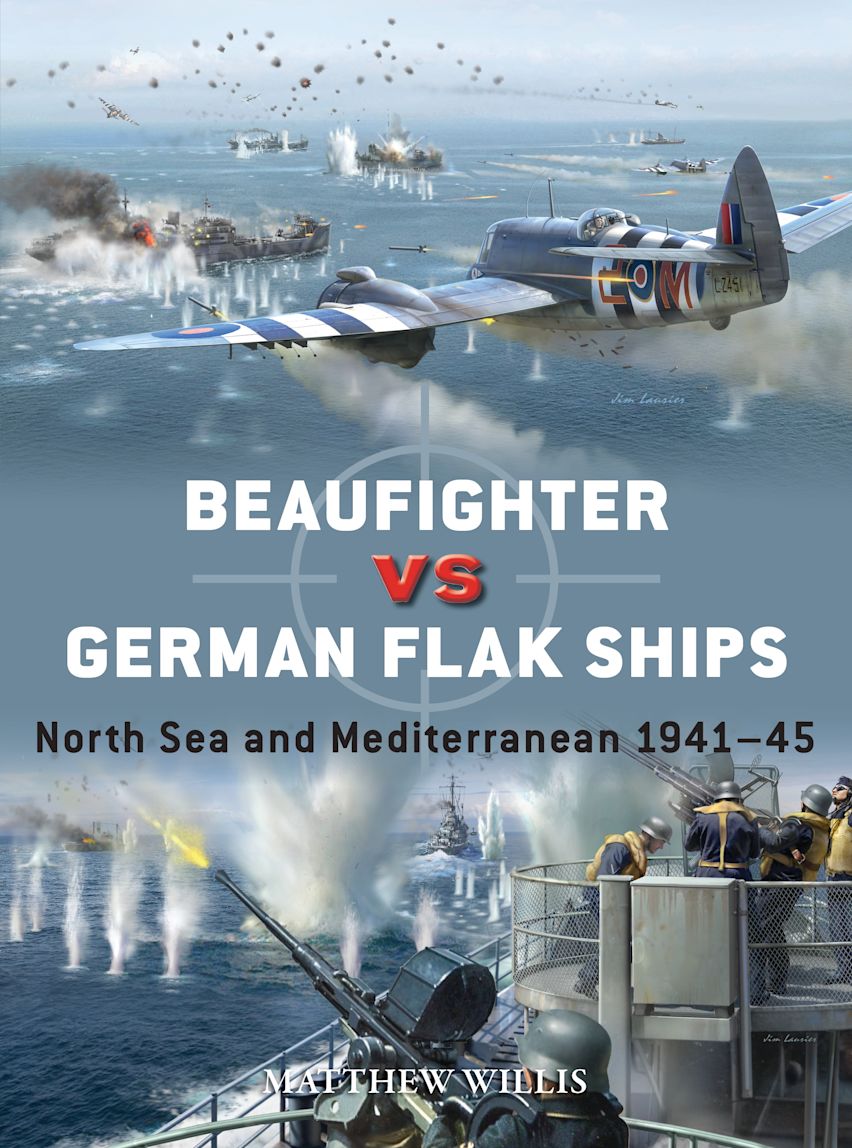
The ability to control logistics is the unseen power in warfare. In a massive war such as World War II, that usually meant that who dominated the sea lanes was likely to win. Yet, as Matthew Willis points out in this edition of Osprey’s Duel series, the RAF began the war without a modern anti-shipping aircraft. By 1943, that had changed with the adaptation of the Bristol Beaufighter to carry torpedoes then rockets. To counter them, Germany developed specialist flak ships, which in turn led to tactics to take them out to open the lanes for strike aircraft to do their job.
Willis begins his survey by describing the development of the Bristol Beaufighter. After some teething problems and modifications, the powerful warplane became operational in September 1940, initially as part of the blitz then as a specialist for maritime operations. In 1942, the external torpedo carriage was added, and with a few more tweaks, it became an anti-shipping aircraft. The Beaufighter was initially equipped with four fuselage-mounted 20mm cannons and carried bombs then rockets. Opposing the Beaufighters, were the German flak ships, which were not officially designated Kriegsmarine vessels, but anything that was primarily an anti-aircraft ship was designated as such by the RAF. These came in all shapes and sizes from armed trawlers to 7,000 ton auxiliary vessels loaded with anti-aircraft guns, many of them on flak towers.
As you might expect from a Duel book, the author digs into the weapon specifications in some detail, accompanied by excellent coloured illustrations, before moving onto a narrative of operations, beginning with the strategic situation. In essence, this was Germany’s increasing need to import supplies by sea, and the Allied effort to stop them. Willis’s overview encompasses an area from the far North Sea through the Baltics and into the Mediterranean. Unusually, for a book in this series, Willis surveys the combatants on both sides. He describes the Coastal Command crews as a ‘breed apart’, which they had to be to contend with the highly trained Flak crews. Willis also describes combat, which must have been a hairy experience for both sides. He concludes with his analysis of this particular duel. The British were on the receiving end before 1943, he argues, but with adoption of flak suppression tactics, the tide soon turned against the Germans. Willis concludes that the Beaufighters did have a material effect on Germany’s defeat.
The best volumes in Osprey’s Duel series, for me, are those in which you cannot decide who you would rather be. In this case, you have Beaufighters bearing down, ready to unleash devastating cannon and rocket fire on ships preparing to send out a storm of bullets and flak. Willis captures the moment well, measuring the machines and men against each other and the development of tactics and technology that led them there. The supporting graphic illustrations and dynamic combat photographs add to the flavour of what is an interesting and informative read. World War II and naval history readers will enjoy this.