by RNS | Dec 18, 2023 | Beating Tsundoku
Charles Singleton, Ed., 1648 and All That – the Scottish Invasions of England 1648 and 1651 (Helion and Company, 2023)
Reviewed by Dom Sore
The English Civil Wars of the mid-17th Century are a fascinating microcosm of the much greater wars being fought on the continent at the same time but with a somewhat different outcome. The Civil Wars did not involve just English forces, though most fighting took part in that country, there were also Irish, Welsh, and Scottish participants. The Scottish effort was maybe the most important even if the Irish involvement had a longer lasting impact; the Scots Covenanters started in opposition to the King’s policies rather than on the side of Parliament but ended up supporting that same King when it looked more advantageous to do so.
This book looks at some of the later phases of the Civil Wars via the collected works that formed the 2022 Helion and Company Century of the Soldier Conference. That was a full day of historical discussions attended by experts and interested parties. The topics included the fortifications of Scotland that were constructed to defend Scotland from internal and external antagonists, the command and control of armies of the time, whether the second Civil War was pro or anti-monarchy, and the logistics of raising a rebellion in the period.
The essays in this book are detailed and academic, delving into the minutiae of specific topics and examining sources that provide such useful insights into the time. They are all well written, if a little scholarly at times, but all very interesting in their own way. The fortress essay, for example, could be the basis for a book and a travel guide. You can also dip in and out of this to read the parts that interest you the most as they are all stand-alone essays. The whole book, however, could have used a few maps to help visualise where important events happened, but it is still well worth reading for Civil War enthusiasts and students of the early modern era.

by RNS | Dec 15, 2023 | Beating Tsundoku
Chris McNab, Coalition Armor v Iraqi Forces (Osprey, 2024)
Before the current war in Ukraine, the wars in Iraq in the early 21st Century provided the most recent theatre for modern armoured warfare. That western armour dominated that battlefield is no revelation, but Chris McNab demonstrates how that played out, while showing that the West did not have things all its own way when the fighting entered the urban environment and Iraqi insurgents improvised techniques to fight back.
McNab begins with a brief survey of the thrashing the Coalition armour meted out to the Iraqis in 1991’s Gulf War, but he argues that the fighting between 2003 and 2006 differed for various reasons. He then highlights the differences between combat in Iraq between 1991 and 2003 and surveys the armour on both sides of the conflict from 2003 to 2006. That includes the main battle tanks (MBT) and Infantry Fighting Vehicles (IFV) of the United States, the United Kingdom, and Iraq. Reading the technical specifications, it does not take a genius to realise that the Iraqis faced a thumping as they did in 1991. But McNab adds a section on Rocket-Propelled Grenades (RPG) and Improvised Explosive Devices (IED), noting that these were the greatest threat to Coalition armour.
McNab sets out the strategic context of the 2003 war with the Coalition plan of attack, along with the forces involved, and the Iraqi plan for defence in depth built around urban centres. McNab notes, however, that the Iraqi army was ‘destined for defeat’. To demonstrate this, McNab singles out match-ups between Iraqi and Coalition armour, starting with the T-72M vs the M1A2 Abrams, a mismatch if ever there was one. The Bradley M2A3 vs the Iraqi BMP-2 follows. These were more equal, but technology favoured the Bradley. Then comes the lowly RPG/IED vs the British Warrior: on paper, an obvious mismatch, but surprise and close proximity could be a great equalizer.
The forces involved are next on McNab’s agenda, beginning with the Iraqis, who possessed a massive field force with some effective troops, but mostly they were ill-trained, ill-equipped, and serving under a corrupt regime. The Coalition forces occupied the other end of the military spectrum: disciplined, well-equipped, and mission orientated. How those men performed in combat comes under scrutiny. There was a rapid advance into Iraq that met with stiffening resistance, particularly in the urban areas. The Royal Scottish Dragoon Guards participation in Operation Panzer follows with the British attacking Basra. At the Battle of Mahmudiyah, US tanks supported by Bradleys cleared T-72s from a town. The Insurgency that followed the cessation of organised resistance proved more difficult for Coalition armour. McNab highlights the battle for Falujah in 2004 as the most intense action in this phase of the war and notes how armour became a valuable force multiplier. In his analysis of the combat in Iraq, McNab emphasizes the asymmetry of the forces but also the rapid doctrinal changes the Coalition had to make to cope with unconventional warfare.
Despite the mostly one-sided nature of the armoured combat in Iraq, McNab’s survey of the machines and men contains enough action to merit inclusion in Osprey’s Duel series. Those who enjoy reading technical information will no doubt enjoy this, while the addition of combat stories and analysis balances that out to prevent the text becoming too dry. McNab could have made more of the IED/RPG aspect of the combat, though he obviously needed the armour v armour combat to set the scene and demonstrate why the formal Iraqi defence collapsed so precipitously. McNab is aided by the usual high quality Osprey graphics and photographs, and along with the informative text, that makes this a useful library addition for modellers, wargamers, and any reader interested in the wars in Iraq.
by RNS | Dec 10, 2023 | Beating Tsundoku
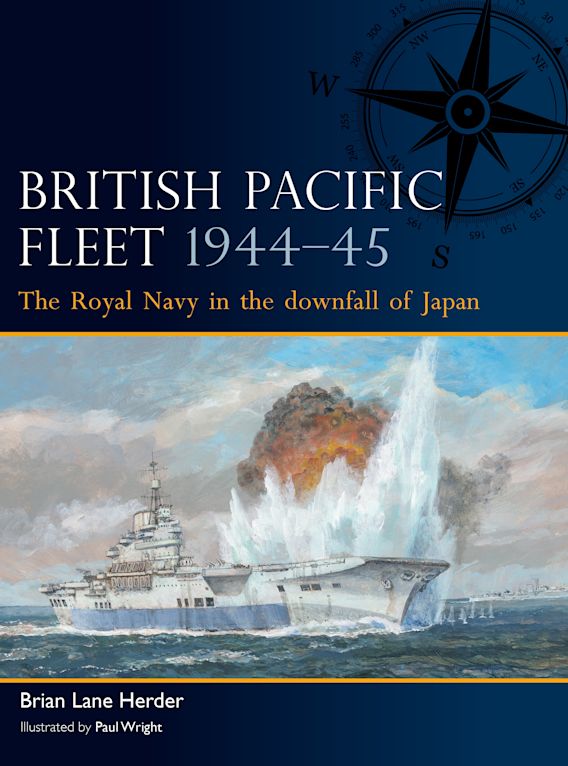
Brian Lane Herder, British Pacific Fleet 1944-45 (Osprey, 2023)
Victory in the Pacific in 1945 is largely remembered as a US Navy success, and rightly so; but the Royal Navy played its part too, providing carriers and other warships to the final campaigns to defeat Japan. In this volume of Osprey’s Fleet series, Brian Lane Herder takes readers inside the British Pacific Fleet to examine how it impacted those late war naval operations.
Herder begins with the British Pacific Fleet’s purpose, which was to serve as a Task Force alongside the US fleets that were steadily reducing the Japanese war machine across the Pacific. This was a somewhat reluctant marriage because of differing Anglo-American political agendas, but once military objectives were apportioned by the end of 1944, the Royal Navy was soon underway. Herder surveys the ships that took part in the British Pacific Fleet with the fleet carriers taking pride of place, though they were ably supported by light carriers, battleships, cruisers, destroyers, and submarines. Herder notes that the crews included Commonwealth sailors. He also reviews the variety of warplanes the RN carried, including the superior US planes such as the Corsair and Hellcat. How the fleet cooperated with the Americans follows, with Herder considering command, formations, communications, logistics, and the roles of maintenance carriers along with escort and convoy carriers – the fleet formations are accompanied by excellent graphics. Herder annotates the actions the BPF undertook in Operations Robson, Iceberg, and Inmate, and their part in the naval siege of Japan in July-August 1945. This includes accounts of the fighting, with the kamikaze attacks standing out as arguably the most terrifying moments a sailor can endure. In his analysis of the BPF, Herder praises the men while blaming Churchill for the late arrival of the fleet and its relative unpreparedness.
Herder writes well and provides his readers with an informative overview of the British Pacific Fleet. He packs a lot of detail into a short introductory book but adds a useful bibliography for further exploration. Herder also does a very good job of placing the fleet in its military and political context without losing sight of the immediacy of the situation the men and ships encountered against a beaten but not yet defeated enemy. It is clear from Herder’s account that the Royal Navy played a significant role in the final demise of Japan. Overall, this is another excellent addition to the Osprey Fleet series.

by RNS | Dec 7, 2023 | Beating Tsundoku
Michael John Claringbould, A6M2/3 Zero-Sen (Osprey, 2023)
The Japanese Zero must be high on the list of iconic WWII warplanes. It is also one of the most written about. However, in this book in Osprey’s Dogfight series, Michael John Claringbould surveys the aircraft, the pilots that flew it over the Solomon Islands in 1942, and their tactics to produce a fascinating account of a small but important slice of the War in the Pacific.
Claringbould begins abruptly with a detailed account of a mission flown by the Japanese in New Guinea in February 1942. Then he sets the scene with the origins of the land-based Zero-sen unit at Rabaul. Their original function was as a bomber escort but soon became a separate fighter unit. They were also quickly occupied in dogfights with American bombers and fighters. Aerial combat intensified from May 1942 with many losses on both sides. Lack of navigational aids caused more losses for the Japanese. Claringbould introduces us to some of the Zero pilots, an elite group of individuals and not the automatons of popular culture, he argues. They were well drilled but those that remained inflexible in combat often failed to survive. To that end, the seven month campaign over Guadalcanal whittled down the cadre through combat and poor health. Stress also took its toll. By the end of 1942, they were severely depleted. Claringbould turns to the planes these men flew, beginning with the Zero’s origins and proceeding through development, tactics, weapons, and maintenance. The author then takes a deeper dive into tactics. The Japanese discovered that their tactics honed over China needed to adapt for missions over the Pacific, partly because of the range of combat actions they had to undertake. Claringbould notes, however, that there were never enough planes or properly trained pilots once combat attrition took hold. He then picks some instructive combat stories to show the variety of Zero operations, including a detailed accounts of dogfights with American Kittyhawks and other US aircraft.
The combat descriptions are the highlight of Claringbould’s somewhat truncated overview of the Zero in action. The stories of how the pilots adjusted to the conditions over the Solomons makes the book worth reading, and Osprey’s excellent illustrations of Japanese tactics works well with those accounts. Claringbould also clearly knows his material inside out, though there are points where he could have excised some of the detail, and I felt that he struggles to talk down to his less knowledgeable readers. That isn’t helped by the lack of an introduction or conclusion; Claringbould pitches his readers straight into the action, works his way through some of the background information you need, more combat stories, then he stops, leaving the reader with many questions. That, of course, may be a positive, but overall Claringbould’s book reads like a chapter taken from a longer work. Otherwise, this slice of WWII combat was an illuminating and insightful study of pilots at war.

by RNS | Nov 21, 2023 | Beating Tsundoku
Bruce Oliver Newsome, Valentine Infantry Tank vs Panzer III (Osprey, 2023)
I blame Hollywood. World War II tanks on the big screen tend to be portrayed as behemoth fighting machines, bristling with firepower and guaranteeing death and destruction on a grand scale. In reality, those tanks were few and far between; rather, most tanks on both sides were relatively small and nimble, performing multiple battlefield tasks. Bruce Newsome examines two of those tanks from the early war and how they clashed in North Africa.
Newsome notes right off the bat that Panzer IIIs and Valentines constituted one-quarter of German and British tank production, though both underwent numerous upgrades as the war proceeded. Newsome narrates the design and development of both tanks, their specifications, production (6,094 Panzer IIIs, 7,260 Valentines), and deployment in various theatres through August 1944. It is North Africa, however, and in particular Tunisia, where Newsome focuses his attention. He surveys the strategic situation and planning with box-outs for the main commanders. Then Newsome revisits the technical aspects of the tanks, including the roles of the crew members. Newsome returns to Tunisia to describe, quite extensively for an Osprey book of this nature, the battles around Tebourba in November-December 1942 and the lessons both sides gained from them.
This book should appeal to World War II tank enthusiasts. Newsome regularly flips between the two tanks so that the reader gets a genuine sense of comparative parallel development. That also prevents the less technically educated reader from becoming bogged down, making for a solid introductory book in keeping with Osprey’s overall mission for this Duel series. The battles Newsome chooses are explained to a high enough degree to give a sense of what tank combat in North Africa was all about; a more nuanced event than your average Hollywood tank movie offers. The accompanying photographs and graphic art compliment Newsome’s text, as we come to expect from Osprey. Overall, this is recommended for modellers, wargamers, and novice readers to tank warfare.

by RNS | Nov 2, 2023 | Beating Tsundoku
Pier Paolo Battistelli, The Winter Campaign in Italy 1943 (Osprey, 2023)
A new volume in Osprey’s Campaign series takes us to some intense combat as the Allies pushed their way up the Italian peninsula at the end of 1943. It’s October, and the Allies are intent on capturing Rome, while the Germans drew lines on the map and determined to defend them. One of those lines, the Bernhardt Line, was designated the Winter Line by the Allies, and they expected to breach it by Christmas 1943. They didn’t. In this book, Pier Battistelli tells you why.
After a brief chronology, Battistelli provides biographies of some of the opposing commanders, which is not very useful in the context of this book but at least you know who they were. The composition of the opposing forces that comes next is more on track. We find the Allies undermanned and relying on firepower to break through the Axis defences, while the Germans struggled with manpower too but had the advantage of terrain. Battistelli next considers the opposing plans; the Allies fixated on the bauble that was Rome, and the Germans determined to defend their lines south of Rome at all costs, though that was not without argument at the highest levels with a defence north of Rome favoured by some.
Battistelli begins his campaign coverage with the Allies approaching the Winter Line and the Germans falling back into prepared positions. The Americans then probed the Winter Line, leading to the costly battles for San Pietro in December 1943. Meanwhile, the British 8th Army crossed the Sangro, and the New Zealand 2nd Division attempted to take Orsogna, again into the teeth of fierce opposition. They would not succeed despite numerous attempts. Battistelli’s account switches to the advance from the Moro River on the road to Ortona, this time with the Canadians at the forefront. It would take a week for them to capture the town in what Battistelli suggests was an unnecessary operation. In the aftermath, the Allies landed at Anzio and the epic battle of Monte Cassino began, lasting for months. A brief glance at the battlefields today and an interesting Further Reading section close out Battistelli’s book.
The Italian campaign is mostly remembered for the battles of Monte Cassino and Anzio, so this book’s overview of the fighting before those momentous events is a welcome addition to the Osprey stable. Battistelli does a good job of covering this period, ably assisted by Osprey’s usual excellent maps and contemporary photographs. It is a gateway book with limited room for detailed text, as you might expect with Osprey, so it is difficult not to go beyond the operational aspects of who did what, where, and when. However, Battistelli gives the reader a flavour of this gruelling campaign and points the way forward to further reading. You can’t ask for much more than that.