by RNS | Mar 12, 2023 | Beating Tsundoku
Massimo Predonzani and Vincenzo Alberici, The Italian Wars Vol 3. Francis I and the Battle of Pavia 1525 (Helion, 2021)
(Reviewed by Mike Huston for Full Paper Jacket)
The third volume in Helion’s excellent Italian Wars series focuses on the Battle of Pavia, one of the most important engagements in the 16th Century, and one with far-reaching consequences for the control of Europe.
The initial background, the reasons for the conflict, and the manoeuvres around Parma are laid out and flow smoothly into an in-depth description of the Battle of Bicocca. The reader is then taken on a short trip to Lombardy before heading to the siege of Pavia. There they are treated to the orders of battle for the opposing forces before they go charging into the Battle of Pavia. The result of the battle, in terms of casualties and the consequences for both sides on the outcome, are laid out clearly.
One of the joys of this period is the variety and colour in the soldiers’ clothing, exemplified in the section of colour plates, and there are chapters on the heraldry of Francis I and his nobles, the main Imperial captains, Charles III, and the German and Italian Black bands. The penultimate chapter delves into contemporary pictures of the battle, which will have you heading for the internet to review these valuable and beautiful resources with a more educated eye. Finally, the authors discuss the reasons for the outcome of the Battle of Pavia and the significance of the Spanish arquebusiers.
The volume is, like the others in the series, supported by a number of black and white illustrations and contemporary prints, and maps of the Battles of Bicocca and Pavia, although oddly, not Romagnano. In addition, there are eight pages of coloured illustrations of the protagonists in all their finery, which ties in with the more detailed heraldic chapters.
This book packs in a lot of detail and is recommended for those of us who don’t read Italian but who have an interest in the period, or at a minimum, just want to paint their wee soldiers in the right colours.

by RNS | Mar 10, 2023 | Beating Tsundoku
Thomas McKelvey Cleaver, Under the Southern Cross (Osprey, 2021)
The port of Rabaul in New Guinea was crucial to the war in the Pacific. Japanese possession from January 1942 posed a significant threat to Australia and Allied operations. Both sides knew the stakes and threw everything into a battle that lasted for over two years and controlling the skies over the Solomon Islands in Rabaul’s shadow lay at the heart of that. Thomas McKelvey Cleaver narrates that story in this riveting book.
Cleaver begins with the US on the back foot even after their victory at Midway. The Japanese had better resources and were fighting closer to home, yet the Americans had to take the offensive to stop Japanese expansion in the South Pacific. They began at Guadalcanal in August 1942. Cleaver describes the aerial and naval actions in detail, following individual pilots on both sides into combat while reminding readers of the operational context on land and sea. He maintains this structure through his chapters as the story develops to incorporate many of the iconic battles of the Pacific War: Savo Island, Cape Esperance, Santa Cruz, and the pivotal naval engagements off Guadalcanal in November 1942. Cleaver also devotes a whole chapter to the mission to assassinate Admiral Yamamoto. By summer 1943, the tide had firmly turned against the Japanese; as their fighting capabilities reduced, America’s increased, and the end was all but inevitable, though not without more hard fighting, particularly over Rabaul.
The air above the Solomon Islands was filled with Zeros, Wildcats, Bettys, Vals, Dauntlesses, Kates, B-25s, Corsairs, Kittyhawks, Hellcats, and P-38s among others. Cleaver describes aerial combat, but also bombing, anti-ship missions, and ground support actions such as those on Guadalcanal by P-400s that were seemingly quite useless in every other function. Cleaver highlights the advantages and deficiencies those planes possessed and also the disparity in pilot losses that affected the Japanese so badly as the war dragged on. In the course of the book, Cleaver stresses the importance of veteran pilots through his recurrent biographies of the top American aces; although he acknowledges that the Japanese had aces too, their numbers certainly thinned in the losing war effort. He also highlights the contributions of other American servicemen to their success.
Cleaver concludes that the South Pacific campaign was the cornerstone of the Allied victory over Japan, and on this evidence, it is difficult to argue with him. His book is full of action in a well-written narrative that offers considerable insight into how the campaign was fought mostly by the US Navy and its air force with a nod to their allies in the region. Readers who are familiar with the campaign might complain about a lack of new material, but I don’t believe that was Cleaver’s purpose in bringing this less heralded campaign to the public. All in all, this is an absorbing story that deserves the wider audience it will undoubtedly receive.
by RNS | Mar 8, 2023 | Beating Tsundoku
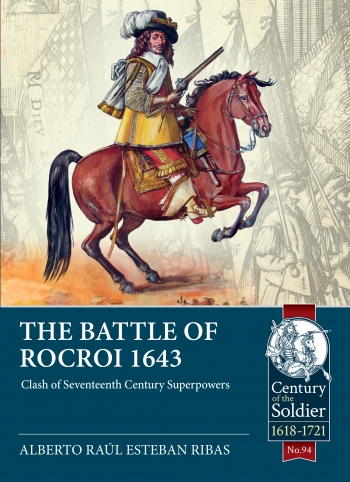
Alberto Raúl Esteban Ribas, The Battle of Rocroi 1643 (Helion, 2022)
There are those who argue that Rocroi was possibly the most important battle of the 17th Century, and one on which the fate of Europe truly hung. It marked the end of Spanish military supremacy along with their famous tercios, and the beginning of French hegemony in Europe coincident with the accession of the infant Louis XIV to the French throne. But it is a battle familiarly told from the French perspective with few Spanish historians’ voices raised in opposition. We need a proper, balanced account of Rocroi, and Alberto Raúl Esteban Ribas is here to tell it.
Battle narratives tend to follow a similar format, and Ribas’ Rocroi is no exception. The historical context comes first, followed by a description of the opposing armies. As with everything else in this book, Ribas provides a thorough overview, which is accompanied by suitable contemporary illustrations. Having surveyed the armies, Ribas moves on to examine the respective generals and commands. With the set-up established, Ribas drives into the narrative with a chapter on how the respective sides arrived at the battlefield of Rocroi. The two armies then line up facing each other, though their deployment is the subject of some dispute, which Ribas navigates well. Then we are into the action. Here too, some confusion abounds as to who was where and what they did, which you might expect if you are familiar with battle narratives. But Ribas again works his way through the evidence to present a clear picture of events. For this, he is aided by illuminating, sequential maps, all the way through to the controversial massacre of the last standing Spanish units. Ribas closes his account with the aftermath of the battle, including casualties and prisoners, then the wider consequences, though he downplays the effect of the battle on the Spanish military; despite French historians arguing otherwise, Rocroi was not the disaster for the Spanish or triumph for the French they portray. Ribas’ concluding analysis of the battle is, therefore, a particularly interesting and quite persuasive piece of revisionism – Ribas adds a useful bibliography if you would like to argue with him.
The Battle of Rocroi takes a well-trodden path as far as battle narratives go, but Ribas digs deeper than most to write an interesting story and analysis that challenges the orthodox view of the battle. That alone should put it on top of your 17th Century books pile. The production value is high too, with contemporary illustrations, maps, and colour plates of soldiers for you to peruse while you ponder Ribas’s arguments. Whether this is the new definitive account of the battle will, of course, be questioned, but Ribas certainly takes the historiography of Rocroi in a new direction.

by RNS | Mar 6, 2023 | Beating Tsundoku
Angus Konstam, Naval Battle of Crete 1941 (Osprey, 2023)
In April 1941, the British and Commonwealth forces in Greece discovered the difference between fighting lacklustre Italians and facing the German blitzkrieg. The result was a desperate evacuation to Crete, then an even more frantic escape from that island as the Germans overwhelmed it too. The instrument for evacuation was the Royal Navy, and it is that story Angus Konstam narrates in the latest Campaign series book.
After the obligatory background introduction, Konstam discusses the opposing commanders. He has a lot of respect for the resolute and intelligent Admiral Cunningham, his subordinates, and partners in command in the army and RAF. Konstam also gives due credit to the German commanders who would wreak havoc on the Allies on land and sea and in the air. But it is the struggle between the Royal Navy and the Luftwaffe that interests Konstam here. To that end, he discusses the Allied Mediterranean fleet, its strengths and deficiencies, along with their order of battle. He follows a similar line for describing the German air force but notes the absence of the Italian navy’s main battle fleet, which could have made all the difference.
Konstam moves onto the respective plans for both sides, then the reality as plans turned into action and the Axis forces launched their invasion of Crete. He follows the various Allied Forces’ naval operations through their discovery by the Axis reconnaissance planes and subsequent attacks by hundreds of bombers. Although the Allied ships did well against the initial assaults, their anti-aircraft ammunition became depleted, which led to Black Thursday when the Germans sank the cruiser HMS Gloucester along with sinking and damaging many other ships. Darkness could not come fast enough for the Allied sailors. The attacks continued as the Allied defence of Crete failed and the evacuation began. Cunningham was determined that the Royal Navy must do its utmost to help the army; a promise that cost many lives, though for the first time, the RAF provided adequate air cover for much of the operation. Konstam closes with the ‘butcher’s bill’ and his conclusion that, while costly, the operations to evacuate Greece and Crete were worth the sacrifice.
Like all the Campaign series of books, Naval Battle of Crete 1941 follows a formulaic structure, so you know what you are getting. But Konstam is a fine storyteller, particularly when it comes to naval matters. He does lean towards the Allied side of this story and defends Cunningham to the hilt where others might be inclined to stronger criticism of his command. The book is well supported by superb graphics, maps, and contemporary photographs, as you should expect from Osprey. All in all, this is a good introduction and overview of an important and under-emphasised campaign.

by RNS | Mar 3, 2023 | Beating Tsundoku
Malcolm Clegg, Railway Crimes Committed in Victorian Britain (Pen & Sword, 2023)
There is something a bit romantic about Victorian railways. This was the age of powerful locomotives shrouded in clouds of steam, sprinting through England’s green countryside, and plush carriages full of elegantly dressed passengers. But, like most aspects of the Victorian era, rail travel was something of a façade; most engines were workaday mules compared to the racehorse locomotives, and more people travelled Third Class than First. And crime, in all its facets, stalked the railways. Former British Transport policeman, Malcolm Clegg, is here to tell you all about it.
BUY NOW
We sometimes forgot in the modern age how important railways were for transporting mail and valuable goods. It is appropriate then that Clegg opens with stories of theft, from mailbags to coal to boxes of gold dust, and including the first great train robbery in 1855. Theft sometimes led to murder as happened to Detective Sergeant Robert Kidd in 1895. In this section on violence and murder, Clegg includes the real first ever railway murder, in 1840, and the tragic infanticide committed by Louise Masset in 1899. Also of interest is the scandalous affair of Colonel Valentine Baker, which sounds like a Sherlock Holmes story but was far more sordid in its details. Clegg moves onto fraud, not a crime you automatically equate with railways, but there were some eye-popping cases and look quite peculiar when matched with simple fare dodging in the same chapter. Pickpocketing follows, while the next chapter on obstructing the railways focuses on much more serious, sometimes deadly, crimes, including the famous train derailment in 1865 that nearly killed Charles Dickens. Some of the latter cases were more negligence and accident than crimes, but defendants still stood trial. Clegg concludes with some cases that definitely were accidents and feel like ‘padding’ when other true crimes could have been explored further.
Railway Crimes is not a book about railway crime; it is a collection of cases grouped under convenient headings. That does not make this a bad book, but in some ways, it is an opportunity missed. Clegg also neglects to attach any sources or bibliography, which is annoying especially for social historians who might want to dig a little deeper into some notorious crimes. Nevertheless, true crime aficionados will appreciate this collection, which is well written, and it is a good read, maybe even on a long train journey.

by RNS | Feb 28, 2023 | Beating Tsundoku
Tony Sullivan, The Roman King Arthur? (Pen & Sword, 2022)
The theory that the legendary King Arthur was based on a Roman soldier, Lucius Artorius Castus, goes back to 1924 and was revived in the 1970s. It appears here again in Tony Sullivan’s forensic analysis of the evidence for and against Artorius. If proven correct, that would settle a lot of arguments formulated over centuries of curiosity. But that isn’t Sullivan’s mission in this interesting and thoughtful book.
BUY NOW
Sullivan introduces the central character in this story. Lucius Artorius Castus, a Roman equestrian officer who comes to us through two inscriptions and a signet ring, and from those we can trace his military career. Sullivan works his way through the interpretations of this evidence and how it has become linked to contextual evidence supporting the Arthurian legend. He finds it wanting. Sullivan also presents the evidence for the King Arthur legend. Agan, the author can find no connection to Artorius. Sullivan then digs into the wider context of Roman history from 150 CE to 250 CE, asking if the case can be made for Artorius having an extraordinary career worthy of the Arthurian legend. At the end of that lengthy chapter, Sullivan summarises the case for Artorius so far, and it does not look good for the Roman Arthur. Sullivan turns to the all-important Sarmatian connection: did Artorius command Sarmatians in Britain? As with all his chapters, Sullivan works his way carefully through the evidence, and he finds nothing to support the theory. The author notes that we do not even have concrete evidence for Artorius’ timeline that would coincide with Sarmatians in Britain. Sullivan returns to the Arthurian legend to see if there is a connection looking backwards. We move into post-Roman Britain then into the legend itself. That leads into Sullivan’s conclusion, which should be crystal clear by this point.
It is not often that a book is written to demolish a theory, they usually promote one. But Sullivan clearly has a bee in his bonnet about the Artorius-Arthur connection, and he goes after it like a dog with a bone. I think it is unfortunate that Sullivan chose the straw man of a 2004 movie to test his argument against because he has enough evidence from the historical record to play with. Nevertheless, Sullivan forensically dismantles the Artorius theory in an engaging and well-organised text. Students of King Arthur will want to read Sullivan’s conclusions and take note, while the rest of us will just enjoy a thought-provoking read.