by RNS | Mar 25, 2023 | Beating Tsundoku
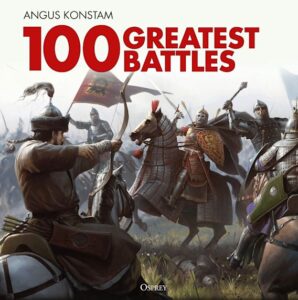
Angus Konstam, 100 Greatest Battles (Osprey, 2023)
We seem to live in a world of lists in this Internet Age. In particular, we can’t resist clicking on the ‘greatest’ list of whatever the subject happens to be, and most of us have an opinion on what qualifies. The prolific Angus Konstam has presented a list of the 100 greatest battles in the ‘old-fashioned’ book format, but the effect is the same. Many of the battles Konstam lists will receive knowing nods, but some will have you reaching for your red pen with a frown or perhaps even an expletive.
Konstam judges greatness for battles that have had a significant effect on a war or campaign, and he supports the ‘turning point’ thesis for them. He recognises, however, the subjectivity in his approach. The battles Konstam selects are organised into eras: the Ancient World, the Medieval World, the Renaissance, the Age of Reason, the Napoleonic Era, the Age of Empires, World War I, World War II, and the Modern Age. Many of the battles should be obvious – Marathon, Waterloo, Gettysburg etc. – but I should note that Konstam selects just 9 of Creasey’s 15 famous, or infamous, decisive battles, and only 3 from outside the European sphere of influence. Each battle account is spread across two pages and is partnered with a painting of the fighting drawn from Osprey’s considerable gallery of work previously published in more specific books relating to that battle. Konstam provides some background and a brief overview of the battle and its consequences.
100 Greatest Battles is an odd little book, both in its physical appearance (a half-sized ‘coffee table’ book) and its concept (a list of ‘great’ battles). Konstam writes well enough, and the artwork is excellent, but there is not much meat on the bones. Nevertheless, like those internet click-bait lists that we can’t resist, I found myself arguing with some of Konstam’s choices while happily flipping through the pages, and that seems to be all that the author asks from his readers on this occasion. If so, job done.
by RNS | Mar 24, 2023 | Beating Tsundoku
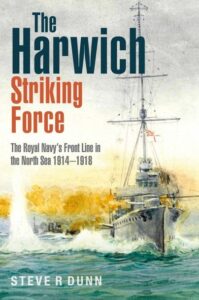
Steve Dunn, The Harwich Striking Force (Seaforth, 2022)
Much ink has been spilled over the British High Seas fleet in the Great War. And why not? The big, powerful ships that defeated the Germans catch the imagination and are worthy of our attention. But Steve Dunn highlights an indomitable force of cruisers, destroyers, and submarines, known as the Harwich Striking Force, that protected the British coast and took the war to the enemy whenever possible, doing the hard yards often without much attention paid to them let alone fanfare.
BUY NOW
Dunn begins with the development of the British strategy of controlling the North Sea through blockading Germany with a force based at Harwich. When war came, Commodore Reginald Tyrwhitt assumed command of the force with reconnaissance as its original objective, but that soon changed. Dunn provides brief biographies of the commanders of the fleet and reviews its vessels. Then we are into the action. The Harwich fleet fired the first shot of the war and suffered the first sinking by a contact mine. The fleet took part in the Battle of Heligoland Blight then continued on its regular duties of supporting the BEF, protecting minelayers and transports, and fending off coastal raids. The Harwich fleet was also instrumental in the early development of air attacks from the sea.
The fleet played a significant role in the Battle of Dogger Bank in 1915 before resuming its many roles. Dunn follows the fleet through these various operations, pausing to describe the action, then continues with his narrative. That does not mean to say that this book is repetitive, far from it. The myriad incidents Dunn describes each have their distinctive flavour, and his narrative style keeps things flowing along. Thus, we have stories of zeppelin raids, non-combat tragedies, tales of individual heroism, and a lot more combat action than this reviewer expected; although, as Dunn points out, the absence of the Harwich fleet at the Battle of Jutland was peculiar to say the least. The Harwich fleet fought on, however, throughout the remainder of the war as a frontline force and paid the price in men and material. At war’s end, the Harwich fleet escorted captured German U-Boats into Harwich, then it was all over, and the fleet was wound down. Tyrwhitt received major honours for his command of an extraordinary force.
The Harwich Striking Force is an excellent narrative history of an almost forgotten fleet. Dunn writes well and tells an informative and engaging story that bolsters our understanding of naval operations during the Great War. His judicious use of Tyrwhitt’s letters and other primary sources provides a necessary human touch and adds colour to what could have been a dry retelling of combat between ships, submarines, warplanes, and zeppelins. There are also many photographs and illustrations throughout the book of the ships and people involved in this sometimes brutal war for control of Britain’s vital sea lanes. Anyone interested in the Great War and naval operations in general will enjoy reading Dunn’s book.

by RNS | Mar 23, 2023 | Beating Tsundoku
Alexander R Brondarbit, Soldier Rebel Traitor (Pen & Sword Military 2022)
(Reviewed by Dom Sore)
The War of the Roses was a time of conflict, uncertainty, and changing fortunes. That is not unusual in any war-torn period, but what makes it stand out is the treachery that appears to have been endemic. When you read about the period, it is easy to get lost with who is on what side and that shows why it has been so fruitful an inspiration for fiction like Game of Thrones. Most of the writing is around the main protagonists and deals with kings, princes, and dukes, but other people played their part too, and this book discusses one of them in the person of John Wenlock.
Wenlock rose from reasonably minor landowning stock to be a member of the Royal household and supporter of the Kingmaker, Warwick. We follow the parts of his story that we know about from his early years and his service in France with Henry V. The book weaves the story of John through the events he was involved in, and as he gets older, he becomes more involved. He begins as a Lancastrian, becomes a Yorkist, and ends up a Lancastrian dying at the Battle of Tewkesbury. In between, he was trusted as a diplomat, with the running of Calais, and helped besiege my two favourite castles – Warkworth and Dunstanburgh. The narrative is well executed, and Brondarbit does wonders with what source material is available given we have very little of John’s actual correspondence.
What this book isn’t is the authoritative biography it positions itself as, mainly because that primary source material isn’t available. That means we do not really get to know John, but we do know what he did. The prime example is his time in Calais when he neither supports nor disparages Warwick; was this self-preservation, a sense of duty, fear, fence sitting, pragmatism? We just do not have the information necessary; we can only guess. It also means we have very little guidance as to his motives.
The book is a good synopsis of the beginning of the Wars of the Roses based around the life of one of the more important lesser lights. It isn’t a biography, but you will learn as much as you need to about the life of john Wenlock and probably a little more. It is nice to get a better understanding of the frustrations that all historians must feel when they want to know something and the source material is lacking, leaving you with more questions than answers. Brondarbit has done a good job of working round those limitations to produce a useful addition to the library.

by RNS | Mar 22, 2023 | Beating Tsundoku
Andrew Abram, The English Garrison of Tangier Charles II’s Colonial Venture in the Mediterranean, 1661-1684 (Helion, 2022)
King Charles II’s marriage to the Portuguese Infanta brought, amongst other things, the acquisition of Tangier. The resultant Tangier garrison existed from 1661 to 1684, and its story, which will be considered by many to be well off the beaten track, is fascinating and made even more so by Andrew Abram. This weighty tome, coming in at just over 380 pages, is a bit of a tour de force.
Abram starts by describing the army of Charles II and the troops sent out to garrison this new acquisition. There follow chapters on the development of the harbour and the impact of the various governors. There is, of course, the inevitable confrontation with the Alaouite Dynasty, which was securing its interests in Morocco, and the armies and various conflicts, including the siege of the garrison, are covered in detail. The demise of the colony and the multifaceted reasons for it bring the book to a conclusion. It is supported by numerous appendices and a substantial number of period illustrations.
The story of Tangier is one of underfunding, desperate men in desperate situations, unreasonable demands, politics, and skulduggery, with a series of conflicts that the garrison was totally unprepared for. At the end of the day, it is a tragic tale, but don’t let that put you off as it is a fascinating and well told adventure.
I came to this book knowing virtually nothing about Charles II’s reign and even less about the Tangier garrison. I learned a lot about the subject, and it opened a window not just on the colony but on how the country took some of its first steps in its colonial expansion. I came away deeply impressed by Abram’s ability to provide huge amounts – and I mean huge amounts – of detail while maintaining a narrative that flows through the complex politics of the time. It is reasonable to say that this book is everything you never knew you wanted to know about Charles II’s escapade in Tangier.
This is recommended for those with an interest in the period, whether history buff, wargamer, reenactor, or someone new to the period who likes a good book on an unusual subject told by someone who knows their stuff and has the skill to make is it an enthralling read.
(Reviewed by Mike Huston for Full Paper Jacket)

by RNS | Mar 15, 2023 | Beating Tsundoku
Jasna Levinger-Goy, Out of the Siege of Sarajevo (Pen & Sword, 2022)
In spring 1992, Jasna Levinger-Goy, a university lecturer became increasingly baffled by ethnic tensions in her hometown of Sarajevo that accelerated into a full-blown civil war. She lived through the hell of snipers and shelling before escaping to Belgrade then London and Cambridge, where she now lives. Out of the Siege of Sarajevo is the poignant and illuminating memoir of a woman searching for her lost identity.
BUY NOW
Levinger-Goy begins with a necessary overview of Sarajevo and her life in it before the civil war. While she saw the signs of that impending conflict, Levinger-Goy lived in denial, despite, or perhaps because of, her education and position as a professor. Then the shelling started, and she found herself having to survive amidst decreasing supplies and increasing danger. To her horror and bewilderment, Levinger-Goy came to accept that Sarajevo was under siege and the atrocities were piling up. Hunger and deprivation came with the shells, but Levinger-Goy, her family, and neighbours learned to survive. She describes her powerlessness and the randomness of death by shellfire or sniper bullet as she walked around town looking for milk and other supplies. She became a regular visitor to the local Jewish Community centre and people she knew dropped by her house just to talk. Finally, Levinger-Goy knew the time had come for her to leave. This was an ordeal in itself, but she found time to arrange a marriage with a man she was trying to help get out of the city. Then, in August 1992, Levinger-Goy boarded a bus with her parents and left.
After a harrowing bus journey, the family arrived in Pirovac where they could recuperate, and from there, they travelled to Belgrade. Settling down in a new city was not easy for a refugee, but Levinger-Goy kept going, finding work and fitting in as best she could in her desire to feel ‘normal’. Even though the complications continued, Levinger-Goy resumed her academic interests and things seemed to be going well. But all around her, the economy was collapsing, and refugees were scapegoated, yet she could not go back to Sarajevo. Levinger-Goy chose the UK, and she emigrated with her mother three years after the war came to Sarajevo. The settling in process began again, this time more successfully, though not without its obstacles. Levinger-Goy married a UK citizen and moved to Cambridge. When her husband died in 2000, she lapsed into depression from which she struggled to recover. Levinger-Goy finally returned to Sarajevo in 2004 but met with resentment and hatred for leaving; she has never gone back. Her memoir closes with an addendum on Yugoslavia in WWII, an update on all the people she mentions in the book, and an excerpt from a short story that illustrates some of the issues that linger in Sarajevo.
Memoirs are difficult to review because you are challenging the writer’s lived experiences. When they fail, they do so usually for fabrication, grandstanding, or too many errors. Sometimes, they are just boring. Levinger-Goy’s memoir is none of those. This is a well-written and touching account of a woman’s struggle to comprehend her ordeals, first under fire in Sarajevo then as a refugee. With Europe roiled once more by war and a seemingly constant refugee crisis, memoirs such as these are important guides to understanding. Only a monster could read this and not feel compassion for Levinger-Goy and those like her who have faced the worst humanity has to offer yet show resilience and fortitude in trying to rebuild their lives.

by RNS | Mar 13, 2023 | Beating Tsundoku
Richard Mackinder, Bosworth The Archaeology of the Battlefield (Pen & Sword, 2021)
Most history students will recognise that there are 5 Ws* to consider when approaching historical events. Of those, the most important and open to interpretation is ‘why’, but that is often contingent on knowing the other 4 Ws. When it comes to the pivotal Battle of Bosworth (1485), Richard Mackinder tackles those questions, building on the archaeological discoveries that he helped to find. In doing so, he attempts to overturn much of what we thought we knew.
BUY NOW
Mackinder leaps straight into his interpretation of events based on artefacts by questioning the pre-battle build up, including the antagonists’ camps and a preliminary skirmish. The arrival of the forces and deployment at Bosworth follows, with an interesting discussion on the use of mediaeval cannons. Archaeological evidence also suggests who amongst the nobility might have been at the battle. Mackinder digs through that, along with the unsuccessful search for a grave-pit, before moving onto Richard III’s alleged deformity and the battlefield positioning of the passive but dangerous Sir William Stanley. Richard’s cavalry charge is next in the sequence, and, of course, his untimely demise. How he died – violently – is no longer open to conjecture other than in the exact details, but where he died is. Mackinder surmises that from the opening charge to Richard’s death only took a few minutes, but that was long enough for Stanley to choose his side and for the Earl of Northumberland to realise the game was up. The battle ended in a rout, and Mackinder traces where part of that might have happened, as he does for King Henry’s crowning.
The aim of his book, states Mackinder, is to open the floor for discussion. He has many questions, some of which he answers through speculation guided by the available evidence. After an oddly placed but interesting chapter on roundshot, Mackinder throws down the gauntlet to Mike Ingram’s recent theory on the battle. He does this through the changing nature of interpretation based on new or reinterpreted evidence. I wasn’t convinced, but at least Mackinder puts his cards on the table, which is good news for students of battlefields. Mackinder also adds a thorough self-guided tour of the battle, including useful maps, for you to judge for yourself what happened. He also suggests a plethora of potential future investigations. Five appendices listing archaeological finds concludes the book.
This isn’t a book I would recommend to anyone that lacks a passing knowledge of the Battle of Bosworth. Beyond that, this an absorbing survey of the battle that puts forward some well thought out arguments based on Mackinder’s interpretation of the evidence. Also, as he is a battlefield guide of longstanding at Bosworth, his views must be taken seriously. I wasn’t convinced, however, by all of Mackinder’s arguments, particularly his swipe at Mike Ingram’s theory, which I found a bit odd as it is presented in isolation and weakens the structure of the book and Mackinder’s thesis. Nevertheless, that discordant note aside, Mackinder’s presentation of the evidence is certainly thought-provoking, and his battlefield guide will undoubtedly be valuable for researchers on the ground.
*And an inconvenient H.