by RNS | Apr 29, 2022 | Beating Tsundoku
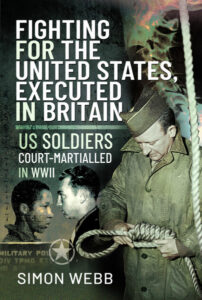
Simon Webb, Fighting for the United States, Executed in Britain (Pen & Sword, 2021)
In 1942, the first of thousands of American soldiers arrived in Britain to help win the war in the west. But in keeping with the maxim that an army reflects the society from which it is drawn, some of these men proved to be dangerous criminals subject to the most extreme punishment: death by execution. In a curious anomaly, they were tried under American military justice but executed in an English prison. That should have been a major problem because Americans still executed men for rape, Britain did not, and American justice was riddled with racial and ethnic bigotry, which created such a suspicion of bias in the punishments that questions were raised in Parliament. But the expediency of war and the desperation to keep America onside resulted in this perversion of the justice system being glossed over. In this interesting but ultimately shallow survey, Simon Webb recounts the cases that deserve our attention.
BUY NOW
Webb notes that all but two of the condemned were executed by hanging, conducted by English hangmen – the other two died by firing squad – eight were convicted of murder, eight for rape, and three for both. He also reminds us that executions in this era were not uncommon. Webb sets the scene by returning to America’s foundation and its refusal to become entangled in formal foreign alliances even upon entering WWII as an ally. That included the American insistence of no interference with its citizens in Britain no matter the crime or the victim, something that did not apply to any other ally. The British gave them Shepton Mallet prison to conduct their proceedings. David Cobb was the first to die under this agreement for a murder he committed in December 1942. He was executed in England as a deterrent, though Webb does nothing to dispel this fallacy. Webb moves on to describe the prison and the different methods of hanging by the British and the Americans; the British insisted their method was used on British soil and by British hangmen – Thomas Pierrepoint killed Cobb.
The Death Penalty for Rape ended in England in 1841, but America still executed rapists through WWII. They executed 6 soldiers for rape in England out of 126 convictions: 5 Black Americans and a Hispanic American. Webb delves into their cases, then comes 3 double execution cases, of which the process was expedited in the last case so that the Americans did not have to return to the US with condemned men. After describing the case of an innocent Black man, Leroy Henry, sentenced to death with the verdict set aside by Eisenhower for expedient reasons once a petition was signed by over 30,000 people, Webb continues onto the murderers executed by the Americans. One of them, Wiley Harris Jr, also received great British support for clemency, but Eisenhower obviously saw this one differently and Harris was executed. Webb lingers on the murder of Sir Eric Teichman, murdered by ‘poachers’ in December 1944. For that crime, George Smith, with a mental age of 9 years old, paid the price. Two American soldiers faced firing squads in England but these were carried out by American soldiers; as with many of the cases in this book, there were troubling overtones in both of these executions. Only one American soldier was tried for murder in a British court, Karl Hulten for the Cleft Chin Murder; he was killed, his British accomplice was granted clemency. The last execution at Shepton Mallet was for rape; Aniceto Martinez was killed on 15 June 1945.
Webb closes with some conclusions. He argues that the British insistence on conducting hangings was justified based on the American bungling of post-war executions of Nazis, though he praises British efficiency a bit too lightly – while America’s John Woods was undoubtedly a psychopath, England had its fair share of notorious hangmen. Webb also highlights that the American involvement in British justice remains blurred in the 21st Century. Finally, Webb notes the closure of Shepton Mallet prison in 2013, before adding two appendices on where America buried its executed prisoners and potted biographies of the Pierrepoint family of hangmen who wracked up hundreds of judicial killings between them.
The importation of the American military death penalty system into wartime Britain is a fascinating and important subject, but Webb’s book on it sadly lacks substance. In addition, his lack of adequate analysis and deficient methodology provokes more questions than answers. Webb is right to highlight the disquieting racial and ethnic bias in the American executions, but other than some anecdotal evidence, he does not present the complete picture of the appalling level of injustice that the British allowed to scar their judicial landscape. He is not helped here by his slender bibliography, of which only about a dozen books are obviously relevant to this study. Moreover, Webb’s focus on narrating the crimes with only a passing reference to the trials and processes of the American system skews the discussion in favour of the executioners when almost every death sentence passed involved disturbing factors even outside the race and ethnicity of the condemned. Nor is there any analysis of the dozens of cases where guilt was found but the death penalty was not applied. Readers interested in this subject might find Webb’s book a useful source of information on the crimes and some of the men condemned to death for committing them, but they will have to go elsewhere to discover the full story of this dark chapter in American and British justice.

by RNS | Apr 19, 2022 | Beating Tsundoku
Daniel Berke, Captured Behind Japanese Lines (Pen & Sword, 2021)
The Chindits’ operations behind Japanese lines in Burma during World War II still arouse great controversy. Were they morale-inspiring victories or the follies of a vainglorious commander, or both? For the men involved, many of whom never came back while others languished as Japanese PoWs, there is no doubting their courage. Frank Berkovitch was one of those soldiers, and this is his story as told by his grandson.
BUY NOW
Berkovitch joined the 13th Battalion, King’s Regiment at the outbreak of war and was sent to India in 1941. Berke leaves him there to discuss Orde Wingate, who would command the Chindits, and the fearsome and brutal Japanese enemy. Berkovitch would join Wingate’s Chindits as a Bren-gunner and one of Wingate’s batmen. After intense training, he crossed the Chindwin with the Chindits to fight the Japanese. Berke describes Burma, then and now, before narrating the Chindit expedition, providing information where his grandfather didn’t. Berke also travelled to Burma, following the route of the Chindits. The most poignant moment is when he starts on his return journey and realises that he was no longer following in Berkovitch’s footsteps because his grandfather didn’t make it back to Allied lines. The Japanese had captured Berkovitch in the Chindits’ desperate struggle to escape from Burma, and he would spend two awful years in a Japanese camp, the horrors of which are almost indescribable. Then on 30 April 1945, Berkovitch and his surviving comrades were freed by the advancing Allies. Frank Berkovitch’s physical war was over, though his mental war continued in tortured memories. Berke concludes his account with Berkovitch’s complete memoir, all of 8 pages; a brief description of the tragic fate of Michael Calvert; and a short biography and defence of Orde Wingate.
Berke does a lot with very little in this moving book that is part history, part travelogue. He only had a few pages of memoir to work with but managed to integrate that into a broader narrative of Chindit operations that focuses on all the main themes. Berke’s personal account of following his grandfather’s path to try and understand him is woven through the text, including valuable insights into Burma then and now. The result is a rewarding read for those interested in the war in Burma and those who recognise that history isn’t something consigned to dusty books on seldom visited shelves, but is contained in our experiences, both personal and collective.

by RNS | Apr 17, 2022 | Beating Tsundoku
Andrew Abram, For a Parliament Freely Chosen – The Rebellion of Sir George Booth, 1659 (Helion, 2021)
Review by Dom Sore
Helion’s Century of the Soldier series has a new addition, this time covering one of the very last acts of the 17th Century English Civil Wars, according to the plaque for the main battle of this rebellion. In this book, Andrew Abram examines the events that led up to the Rebellion of Sir George Booth and Parliament’s response to it. This is one of the softback volumes in the series and comes in at 203 pages with eight chapters, three appendices, and ending with a substantial bibliography. You will find pictures and maps interspersed throughout the text as you go.
This is a very easy read, the prose flows nicely and you get a lot of detail without being overwhelmed or overly confused. The research that has been put into this is obvious beyond the bibliography, and the author really knows what he is writing about. The scene is set in an England in disarray with the Army and Parliament at each other’s throats, disaffected Presbyterians roaming the country, and Royalists champing at the bit to restore the Monarchy. We are treated to details of plots that were stalled before they started, and Sir George’s rebellion itself was meant to be part of a wider plot. However, that was not to be as we soon find out, and the rebellion was left on its own at the mercy of Parliament. The rebels were quickly defeated, and the aftermath would eventually see the restoration of the Monarchy as planned. Ironically the failed rebellion helped this along!
This is a small part at the end of the Republic era in British History and is fascinating in the amateur nature of it given the characters involved had all mainly been involved in actual wars. It shows that being able to command a regiment does not make you suitable to lead an army. It is a nice read, contains some interesting snippets, and shows you just how precarious a grip on the nation a government has even in the face of a farcical rebellion; they didn’t even fight very well.
These softback editions from Helion are an odd fish; the paper in them is very nicely glossed and feels luxurious to the touch, but the very soft cover means it has no stability and flops in the hand as you read meaning you end up holding it in an unusual way. The addition of a slightly stronger and less flexible cover would make these much more enjoyable. There are a few little proofreading errors that stand out given the otherwise excellent quality of the book – the one where a quote is paraphrased and then provided in full on the same page did make me smile. Nevertheless, this book is a welcome addition to my library.

by RNS | Apr 12, 2022 | Beating Tsundoku
Jim Moran, Battle of Peleliu 1944 (Frontline Books, 2022)
In this bigger than usual Images of War series book, Jim Moran takes us on a survey of a battle that was supposed to last three days but took ninety to complete. The invasion of Peleliu took place in September 1944 and would cost the Americans 9,500 casualties against a well-fortified Japanese force of 14,000 that fought almost to the last man. The operation had no strategic value: it was a waste of lives and resources and an exercise in vanity and hubris.
BUY NOW
Moran begins with the respective operational plans for the US and Japanese forces. The US thought it would be an easy win with landings behind a barrage, but the IJA had been digging in since April, and they had learned the art of hit-and-run over expensive banzai charges. They intended to bleed the Americans dry, withdrawing into the mountainous interior while fighting for every yard. Moran surveys the commanders and forces, including the invaluable Navajo code-talkers, then we are into the action. The landing set the tone for what followed with the Marines coming under sustained fire and counter-attacks despite the aerial and naval bombardment. The Japanese even conducted a tank attack across the island’s airfield; although the Marines repelled the tanks, they were now fully on notice. The major problems set in when the Marines moved into the Umurbrogol mountains with their 500 caves and tunnels. The 1st US Marines that had spearheaded the assault were decimated. Moran detours for the 81st Infantry Division’s assault on nearby Angaur and Ulithi, which went more according to plan. Back on Peleliu, the Marines struggled to isolate the island and prevent Japanese reinforcements. Even when they did, the mountains still had to be cleared, ridge by ridge and cave by cave while the Marines could not dig in for defence on the hard coral ground. Finally, on D+70, the remaining organised Japanese force of 56 men launched their last attack with most of them cut down. The battle was all over, yet some Japanese remained on the island until 1947 and the last surviving member of the Japanese forces did not give himself up until 1954! Moran concludes with some fascinating Tom Lea paintings of the combat, an annotated list of Medal of Honor winners, and the text of ‘surrender’ leaflets, which proved as futile as just about everything else on this island.
Moran provides quite a detailed text for one of these books, but his narrative flows well enough while complementing the many monochrome photographs that are the book’s selling point. Those pictures also tell the story. Many of them cover the landings and could come from just about any of the Marine invasions during the War, but others depict the hostile terrain and the claustrophobia of fighting in the relatively confined spaces that look distinctively Peleliu in nature. Newcomers to the Pacific War will gain insight from this book, but there is enough in it for anyone interested in the theatre.

by RNS | Apr 4, 2022 | Beating Tsundoku
The Athenian Middleman
Jeffrey A. Smith, Themistocles – The Powerbroker of Athens (Pen & Sword, 2021)
(Reviewed by Dom Sore)
Many of us who have studied any amount of ancient history will have heard of Themistocles and may even be able to recount some details about him, but he tends not to be one of the “famous” Greeks. There are many more people who know nothing about him, what he did, how he did it, or his impact on the Western World. In this new biography, Jeffrey Smith narrates Themistocles’ life in a highly accessible manner. We learn a little of his upbringing, then his early career, his domination of Athens, and his final downfall. This was all encompassed within the world Athens founded and the Greek concept of arete (which you will need to buy the book to learn about).
BUY NOW
This is a standard biography in that it covers Themistocles life and deeds in chronological order. And it does it really well. It is a very easy book to read, you get all the information you want with context that makes sense and no great leaps of imagination required with the sources. The ins and outs of Athenian politics are covered with aplomb and explained clearly without any dumbing down of the concepts. Ancient Greek concepts of honour are especially well handled and explanations of the differences between our morals compared to theirs handled deftly and without patronising the reader. The similarities with modern politicians are hinted at without being spelt out explicitly, and the book benefits from not indulging in such tangents.
My biggest niggle with the book was the part where it implies heavily armoured cavalry were the main component of Caesar Augustus’ army. It is something that nearly made me stop reading, but I am glad I didn’t. The author does spend some time assigning motives for what Themistocles’ did, which is not a bad thing, but it is done in a way where the reader would be forgiven if they thought we knew this was true. Given the paucity of first-hand information on Themistocles, however, we can really only guess and imply. One final error is to imply the Delian League was named at its formation rather than it being a more modern nomenclature introduced to make it easier for us to understand.
This is a rip-roaring tale from start to finish. Themistocles was at the heart of many world defining actions, and he arguably saved Greece from Persian Domination with his foresight. Without the Athenian navy, Xerxes’ invasion could have succeeded in subjugating the whole of Greece, and we would not have had the Athenian Golden Age and everything that flowed from that. If you want to know more about Themistocles, and even a simple understanding of the events he took part in, then you would be hard pressed to find a better book. It is such an easy book to read I now want to read another by Jeffrey Smith.

by RNS | Apr 1, 2022 | Beating Tsundoku
Angus Findon, Thunderbolts over Burma (Pen & Sword, 2020)
Angus Findon was almost too late to the party. As a newly trained pilot, only joining his squadron in 1945, Findon knew the war was all but done. In Europe, it was, but in the Far East, not so much. The RAF shipped Findon out to Burma to fly Republic P-47 Thunderbolts as the British and their allies winkled out the Japanese. That led to the Battle of Sittang Bend, which effectively ended the Burma campaign. Thunderbolts over Burma is Findon’s memoir, ably assisted by Mark Hillier.
BUY NOW
Findon’s memoir follows the usual arc of enlisting, training, joining his squadron, combat, then the war ended. Two things make this memoir stand out, however: Findon flew Thunderbolts and did so over Burma, both quite unusual circumstances for the World War II bookshelf. I should add that all his active service took place over seven months. The RAF replaced their Hurricanes with Thunderbolt IIs just as Findon joined 34 Squadron, one of sixteen to fly ground attack operations against the Japanese. It was an effective warplane, which the Japanese army quickly grew to fear. Findon’s second stroke of luck was arriving in Burma in time to develop his skills before taking part against the attempted mass Japanese breakouts at Sittang Bend and Pegu Yoma in July 1945. Unfortunately for them, the British had been tipped off and a slaughter ensued. For hours at a time, Findon flew missions, bombing and strafing Japanese troops and positions, throughout July and into August until there were no Japanese left to hunt. After the War, Findon flew jets, though he didn’t like them much, and he ended his service in England. That is where he also ends his memoir. The rest of the book, nearly half of it, is taken up by appendices on summaries of operations, extracts from despatches on Sittang Bend and Operation Birdcage, and reproductions from Findon’s pilot’s logbook.
Although his memoir is short, Findon is an engaging storyteller. He is perhaps too self-effacing at times, and he was clearly a better pilot than he describes. Findon also does not sugar-coat some of the more unpleasant aspects of his time in the RAF, particularly when it comes to over-officious senior commanders. My only quibble with this book was the lack of attention to accurate proofreading, but that doesn’t detract from the story. Indeed, Findon’s memoir is worth reading for his narration and description of service life in Burma and India, and aviation enthusiasts will undoubtedly enjoy it.