by RNS | Feb 12, 2022 | Beating Tsundoku
Terry C Treadwell, Lawmen of the Wild West (Pen & Sword, 2021)
There are few more stereotypical characters in American western movies than the local sheriff. He is often the hapless, fat old-timer, long past his usefulness and a ripe target for the desperado or gunman out to cause trouble. Or he is a coward afraid to enforce the law without a Cooper, Wayne, or Eastwood type to accompany him. Terry Treadwell’s tales of historical lawmen paint a very different picture; for better or worse, but always worth reading.
BUY NOW
Treadwell sets out by noting that the history of law enforcement in the fledgling United States was, much of the time, a thankless job. Many of the office-holders were former criminals and there were no obvious standard practices, a situation that lingered in some of the West well into the 20th Century. Law was often the rule of the gun or lynching party’s rope, particularly away from the more settled towns and cities. Jails, like everything else, were often ad-hoc with no State prison system to speak of. Moreover, hunting criminals was often by posse, who might or might not be keen to help but always had to be paid.
With the broader history out of the way, Treadwell launches into a collection of 36 stories about famous, and not-so-famous, lawmen in the American west during its 19th Century heyday. He starts with the first US Marshal, Robert Forsyth, who was also the first to die in service, then Colonel Charles Lynch who gave his name to extra-judicial punishment. One of the most famous, and intimidating lawmen, was ‘Wild Bill’ Hickok who was far from the upstanding citizen of popular culture. The town of Tombstone features in a group of tales involving the various Earp brothers, including Wyatt, another who was far from being a paragon of virtue. Among these famous names, and others, including Pat Garrett and Bat Masterson, are lesser known lawmen, such as Tom Smith, William Breakenridge, former slaves Bass Reeves and Grant Johnson, and the wonderfully named John Slaughter, who also lived extraordinary lives. Treadwell concludes with the story of the Texas Rangers who, like many lawmen in this book, sometimes straddled the fine line between upstanding lawmen and out and out criminals.
This is a book full of incident, as you might expect in the Wild West, but while Treadwell folds many interesting aspects of life into his biographies, this is not a social history, which is just as well given Treadwell’s tactless conclusion on the ethnic nature of modern criminal gangs. Treadwell is a story-teller, and he links many of his tales to weave a thread through them, though the over-arching narrative is not quite there. Fans of the Wild West will enjoy this collection, which matches well with his similar styled book on outlaws, while more serious students will find many of the incidental aspects, particularly on race and ethnicity, thought-provoking.

by RNS | Jan 31, 2022 | Beating Tsundoku
Miles Vining & Kevin Schranz, Into Helmand With the Walking Dead (Pen & Sword, 2020)
Miles Vining enlisted in the US Marines in 2010 as a rifleman assigned to the 1st Battalion, 9th Marines. He served two tours in Afghanistan. On leaving, he earned his degree at Indiana University while he wrestled with his inner demons in a world he no longer understood or that he felt understood him. Into Helmand With the Walking Dead is his memoir of life in the Marines and after; but it’s also a story of men lost in Afghanistan, some physically, some psychologically and emotionally.
BUY NOW
Vining’s memoir follows the usual soldier’s story format of youth, girlfriend, enlistment, training, and off to the front. The girlfriend motif is important in this instance because Lynn is the love of Vining’s life. He dwells on that and his training as a Marine; a soldier ready to kill, ready for war. His first tour is anticlimactic in that regard; Vining sees no action worth mentioning, just the day-in, day-out routines of infantry life in an occupied land interspersed with small dramas but no crises. He arrives back in the US a bit older but not much wiser, and his relationship with Lynn breaks down while he struggles to settle. That isn’t helped by a horrible training accident that kills his best friend, one of three deaths that will haunt Vining. His relief at going back to Afghanistan is almost tangible.
That second tour is a completely different story. Vining’s unit is sent to a hot zone infested by the Taliban, and he gets all the combat he can handle. His unit comes under fire while on patrol and there is the ever-present threat of IEDs and suicide bombers. Vining loses his second brother-in-arms, killed in action by a Taliban bullet, but he comes through physically unscathed. On his return to the US, Vining leaves the Marines, but the Marines do not leave him. His frustration with civilian life, now as a student, overwhelms him at times, and his growing anger is tangible. Then his ex-Marine friend, Kevin Schranz, commits suicide, which is a stunning blow to Vining. He exits his memoir with what all this means, not just to him, but to the other men he fought alongside, many of whom have also struggled to adapt, with some of them committing suicide too. It’s a sombre note on which to finish, but a necessary one.
I nearly gave up on this book after the first hundred pages, but I am glad I didn’t. As a combat memoir, Into Helmand With the Walking Dead is unbalanced with little of any substance happening until the last third. It would have been useful from that perspective to read more about Vining’s combat experiences. As a soldier’s story, however, Vining’s memoir often crosses over into social history, offering valuable insights into the ordinary infantryman’s life at war and at home. The underlying societal message shouldn’t be lost either; too many of these men commit suicide, while others feel alienated. Vining brings that out well in his remembrance of Kevin Schranz, who receives co-author status, set alongside his own post-war battles. In the end, this is a sobering book and well worth reading.
by RNS | Jan 27, 2022 | Beating Tsundoku
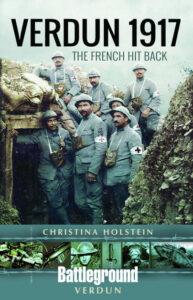
Christina Holstein, Verdun 1917 (Pen & Sword, 2020)
There are sadly quite a few contenders for the most savage battle of World War I, but for the French, Verdun stands above them all. Most historically aware people will have an understanding of Verdun as the battle in 1916 in which the Germans promised to bleed France dry, and nearly succeeded. Less well-known is the French fightback that took many months to accomplish. Christina Holstein has written two other guidebooks to Verdun, but this one covers the French offensives as part narrative and part tour guide.
BUY NOW
Holstein’s book is split into two sections. The first part narrates the battle, beginning with preparations for the planned French counter-offensive in December 1916. That was a staggering success, but the Germans were far from finished, though under their new commander General Ludendorff, they did little but tidy up the lines with minor counter-offensives. Moreover, the French had to endure the fierce winter in their captured positions. In March 1917, the Germans began their offensive to retrieve lost ground. The French barely held on, but their morale was shattered, leading to the infamous mutinies in April. The French were immobilised temporarily but prepared for a new assault. Except, that came from the Germans in June and lasted for a month until the French recovered. Then, in August, the artillery opened up again on both sides before the French launched a new offensive with 420,000 men behind a barrage from 2,000 guns. Of note here was clearing tunnels of German defenders, a grim business indeed even with the hell outside. As with seemingly every battle on the Western Front, the further men pushed at Verdun, the more resistance they met, including some successful German counter-attacks with storm troops in the lead. Nevertheless, the French August Offensive was deemed a remarkable victory
The second part of the book is a guide to the battlefield for the modern tourist. This begins with practical advice suitable for most hikers in that part of France. Then, after some more specific guidance – no lethal souvenirs, please! – we are into four driving and walking tours. Those include the major sites for the battle, hospitals, post-war cemeteries, and some post-war descriptions. Holstein also offers some snippets of information relating to the sites, and more source material to add to the atmosphere. Photographs, maps, and GPS locations complete the guide for each tour.
I’m not that familiar with Pen & Sword’s Battleground series, having no real desire to tour WWI battlefields, but Holstein’s latest volume works as more than just a guidebook. She has written an engaging and assured text sprinkled liberally with observations from the men who fought there. Those first-hand accounts illuminate the action, and in many cases, the horror of Verdun on both sides. Holstein’s book works well even for us stay-at-home readers who just want to know more about Verdun, and I think it would be indispensable for those who would visit the battlefield and surrounding countryside.

by RNS | Jan 25, 2022 | Beating Tsundoku
Anthony Tucker-Jones, Tank Battles of the Cold War (Pen & Sword, 2021)
Anthony Tucker-Jones observes in his introduction that while many might think tank warfare ended with World War II, the plethora of tank on tank operations from 1946 to 1991 suggests otherwise. This is partly because of a second misunderstanding, that the Cold War applied outside of Europe; it didn’t: wars have scarred the globe from Afghanistan to Zimbabwe. In Tank Battles of the Cold War Tucker-Jones surveys where the action was hottest, then reaches a surprising conclusion that should concern modern tank proponents.
BUY NOW
Tucker-Jones covers tank combat in chronological order, beginning in Indo-China, 1946-1954, where the French mistakenly believed they could batter the Viet Minh into submission and took half a dozen tank regiments with them to do the job. They failed, illustrating the fact that tanks do not work in all environments. We then move into proper tank battles with the Arab-Israeli wars, the first of which started in 1948, the second in 1967, and third, the Yom Kippur War, in 1973. The Korean War, 1950-1953, also saw conventional tank warfare. Tucker-Jones goes back into the jungles of Vietnam to assess US and ARVN tank warfare efforts, which did not prove particularly successful, though the NVA managed better towards the end of the war. After a short trip to Suez, 1956, and back to Vietnam, Tucker-Jones lands in the Indo-Pakistan War of 1971. This was not the first time these neighbours had fought with tanks, but this war featured the largest tank battle in the theatre. Another lesser known tank war was the Ethiopian Civil War, 1974-1991, while elsewhere in Africa, in Angola from 1975 to 2002, and the Chadian-Libyan War of 1978-1987, tanks were also deployed – in the latter example, Toyota trucks did more damage than Libyan tanks! If Africa proved difficult terrain for tanks, the Soviet invasion of Afghanistan proved almost impossible. More fruitful ground for tanks was the Iran-Iraq War, 1980-1988, though this proved mostly attritional through lack of tactical and strategic ability. The 1990s saw tank warfare in the Gulf War and in the former Yugoslavia. Tucker-Jones concludes with chapters on Soviet tank exports during the Cold War and his argument that by 1991, the age of tanks was over because they were too vulnerable. He also pays homage to the T-54/55 as the most ubiquitous tank of the Cold War. His appendices cover Cold War armoured units, Chinese and Soviet tracked armour, and Soviet anti-tank weapons.
Taken at face value, Tank Battles of the Cold War consists of well-worn narratives, but they are told from the tank warfare perspective, which adds an interesting layer to some of these conflicts where tanks were not the main weapon. Moreover, as you work your way through Tucker-Jones’s well-written and engaging text, you can trace the development of the main tanks used in the various wars. Tucker-Jones doesn’t get bogged down in the technical minutiae of tanks, which is good for the non-specialist, but he clearly knows his material. That makes his conclusion, that the age of the tank is over, all the more surprising and controversial. This book, then, is a notable introduction to tanks in the Cold War for various reasons and highly recommended.

by RNS | Jan 23, 2022 | Beating Tsundoku
Philip Matyszak, Greece Against Rome (Pen & Sword, 2020)
We are used to the story of Rome’s expansion, the piece by piece accumulation of land and power until an Empire was formed. The empire that Alexander the Great left behind, the Hellenistic world, also fell victim to Rome’s advance. That is a story usually told from Rome looking out, but Philip Matyszak tells the story from the Greek perspective; of how mighty kingdoms fell to an insignificant city state from the west that became an unstoppable juggernaut.
BUY NOW
Matyszak begins with the death of Alexander and the three states that emerged from the collapse of his empire: the Seleucids, Macedonians, and Ptolemaic Egypt. They remained culturally part of the Greek world of Alexander, but war between them proved irresistible. Matyszak surveys this world in 250 BC with Rome rising and Carthage falling in the west, neither of which was of much concern to the powerful Hellenistic kingdoms. They were too busy fighting each other and creating the rich Hellenistic culture that forms a background for much of what Matyszak narrates. As late as 220 BC, the Hellenistic kings seemingly had no idea what was coming.
Rome’s rise is well documented, but Matyszak brings that story into line with the Hellenistic kingdoms. Rome’s incredible victory over Carthage in the Second Punic War might have had little effect on the Hellenistic world if it hadn’t been for the intervention of Philip V of Macedon on the losing side. The lesson he learned was not to make an enemy of the Romans because they seldom extended forgiveness. They turned him into a puppet king and moved on to deal with Antiochus III of the Seleucids who had designs on Greece that did not please Rome. They crushed him at Thermopylae in 191 BC. Antiochus expected an end to the conflict as he fled east, but he was wrong, and the war continued on land and sea. The critical battle came at Magnesia in 190 BC; the Romans won, and Antiochus had to sue for peace.
We move into the period 185 to 175 BC when new kings emerged in the Hellenistic world to play new power games. But this time, the Romans were major players. Matyszak takes us on another tour before settling in Greece, where the Romans were about to assume control after Pydna in 167 BC, and Coele-Syria where the Egyptians fought the Seleucids. Antiochus IV then got caught up in a civil war in Judea and became squeezed between Rome and the rising power of Parthia in the east. The result was the rapid decline of the Seleucid kingdom. The Romans then completed their conquest of Greece in 148 BC and were bequeathed Pergamom in 133 BC. From then on, notes Matyszak, the Hellenistic world fell apart, beginning with the Seleucids being reduced to bit part players, then Egypt rapidly descended into a shambles of its own making. Meanwhile, Rome had its own internal struggles to deal with, which the Hellenistic leaders could not take advantage of because of their squabbles. When the Romans again paid attention in the east, it was to end the last surviving Hellenistic kingdom through the defeat and subsequent suicide of Cleopatra.
The Hellenistic period was one of the more complex eras in ancient history and more than one historian has failed to tell its story with any clarity. In addition, those kingdoms are often seen in relation to the rise of Rome, as peripheral entities somewhere in the east. Matyszak competently tackles both issues. He has written an engaging text that reads like a sweeping novel at times, and he puts Rome on the outside of the Hellenistic world, so that its insidious intrusion becomes more creeping and menacing, if that’s possible. Thus, Greece Against Rome is a refreshing and readable take on a fascinating story.
by RNS | Jan 20, 2022 | Beating Tsundoku
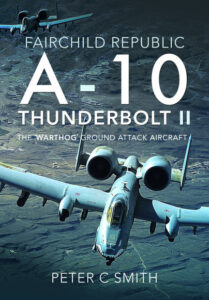
Peter C Smith, A-10 Thunderbolt II (Pen & Sword, 2020)
It’s an ugly thing, no doubt about it; it has a bulbous front tapering back to two cylindrical external engines perched awkwardly in front of its tail. But if you are driving a tank as an enemy of the United States of America, the A-10 “Warthog” would be the last thing you want to see or are likely to. That is because the A-10 packs a serious punch from missiles, bombs, and a 30mm cannon jutting out from its nose. To see one of these offload on a target, as this reviewer has, is an unforgettable experience. Peter C Smith loves this plane and tells you everything you want to know about it in this engaging book.
BUY NOW
Smith begins with a self-penned poem that highlights the virtues of the A-10 as a no-frills destroyer of tanks. That sets the tone for a lengthy panegyric on this sturdy, little plane. There are various origin stories for the A-10 but the necessity of supporting ground troops, especially against tanks, required a specialized plane despite the Air Force’s opposition. The deficiencies of available alternatives led to the development of the A-10; a process Smith takes us through in painstaking detail. In March 1976, the USAF accepted the A-10 into service.
Although part of the USAF, the A-10 remained generally unloved. Smith is keen to point out that criticism was based on ignorance; the A-10 had one job and did it perfectly. He then deconstructs every aspect of the plane: airframe, engines, weapons and ordnance etc. Next, we are into how the A-10 was deployed – wherever the threat of tanks, the Hog had to be available – and used, developing tactics for assault and evasion. With action came A-10 variants and upgrades, but the A-10’s frontline use diminished, at least temporarily. Smith surveys the Air Reserve and National Guard operations with unit histories and camouflage schemes included.
Justification and vindication for the A-10 came with American wars in the middle east. Despite some reluctance to send them, again based on prejudice, the A-10s proved themselves against tanks, stationary targets, and Iraqi helicopters; not a single A-10 was lost to Iraqi aircraft and only five were lost overall in Desert Storm. After the Gulf Wars, the A-10 served in the Balkans, Haiti, Afghanistan, and post-war Iraq. Smith gleefully notes that rumours of the A-10’s demise have been greatly exaggerated, and that they have a future with continued modifications. There has also been discussion on using them as ‘Firehogs’ to fight America’s growing wildfire problem, though that seems doubtful, as does a role for them in storm penetration work.
If you are a fan of the A-10, then this is the book for you. Smith details every aspect of the ‘Hawg’ but doesn’t get bogged down too much in the technical minutiae that sometimes makes these books a slog to all but the most dedicated. This text is enjoyable, with little vignettes of the A-10 included among the tables and charts, though Smith sometimes slips into unnecessary political opinions. The book is also lavishly illustrated with colour and monochrome photographs and taken as a whole must be considered the definitive work on the A-10.