by RNS | Jan 26, 2021 | Beating Tsundoku
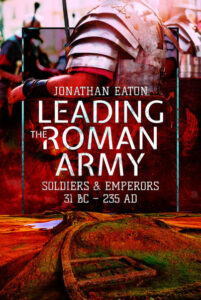
Jonathan Eaton, Leading the Roman Army (Pen & Sword, 2020)
Imperial Rome was born out of the fires of civil war. In the last century of the Republic, armies maintained allegiance to their generals who fought on and off for power in Rome. The ultimate victor, Augustus, the first Emperor to all intents and purposes, created a system whereby the army remained loyal only to him. Despite a couple of hiccups, his system of Imperial control remained useful for generations of Emperors. In Leading the Roman Army, Jonathan Eaton examines how that management worked.
Eaton takes a thematic approach to his study to avoid chronological pitfalls. In doing so, he peels back the layers of military management and analyses how the army adapted to political and strategic circumstances. Eaton also considers command as a series of power relations, with the highest power, of course, reserved for the Emperor. Eaton’s analysis begins with the Rome garrison with which the Emperor had to cultivate good relations for obvious reasons as they protected him or didn’t as the case may be. We then move into the field army, starting with discipline and morale, which sometimes broke down into mutinies, demonstrating the Legions were not the automatons as they are sometimes portrayed. Eaton turns to the Centurions, men of prestigious rank who formed the professional backbone of the army and controlled the rank and file while spreading their loyalty to the Emperor. Up next is the Roman upper class and their attitude to military duty. Almost inevitably, Eaton finds politics at play, particularly the role of Imperial patronage that favoured loyalty over expertise. Returning to the lower ranks, Eaton asks how politically aware they were. He stresses the importance of Imperial coinage and statues for spreading identification and loyalty, otherwise control of information helped shape political opinion. Eaton closes his argument with the Emperor’s direct connections to his troops through campaigns or other military exercises, sometimes bringing his family along to stress dynastic elements. In short, his message was that he was one of them. In his conclusion, Eaton argues that “no emperor could survive without the support of the army” and his book goes a long way to establishing the truth of that.
Leading the Roman Army is not an easy read or a beginner’s book for the Roman Army, as you might expect given it is based on Eaton’s PhD thesis, but it’s certainly not out of reach either for the non-academic. Eaton’s thematic approach is different, but works for what he is trying to achieve, and his examples and deployment of sources make this an argument to reckon with for other historians examining the power dynamics of Imperial Rome. Overall, while this is not a book of battles and campaigns, Leading the Roman Army is an excellent addition to Roman Army studies.
BUY NOW

by RNS | Jan 23, 2021 | Beating Tsundoku
Mike Roberts, Rome’s Third Samnite War (Pen & Sword, 2020)
In Rome’s Third Samnite War, Mike Roberts reminds us that if you are going to build a great Empire, you need to beat your neighbours first. At least that was the case for Rome that became involved in a desperate struggle for survival and supremacy against the Samnites and their allies between 298 and 290 BCE. Rome emerged victorious, and the rest is, well, history.
Roberts begins with an honest assessment of the sometimes unreliable sources for the crucial decade in the 290s when Roman expansion could have been halted. Far from the opulent place where all roads would one day lead, he describes Rome in 300 as ‘shabby and labyrinthine’ with about sixty-thousand people living there. The Romans were, therefore, just one group among many in Italy but had fought their way to prominence, a rise Roberts describes well. But to expand, Rome had to defeat the Samnites and their allies, not an easy prospect as they soon found out. The First Samnite War was a small affair, but the Second was a major war, which the Romans lost in humiliating fashion.
It takes a while for Roberts to hack his way through the undergrowth of Rome’s ascendancy to get to the Third Samnite War. When he does, Roberts describes the causes and opening of the war, exercising caution with his sources along the way. Then the narrative of strategy, campaigning, and battles begins with Roberts analysing as he goes. Although mostly penned into their towns, the Samnites opened a new front with their allies in the north. The Romans met them at Sentinum in 295 BCE and crushed the Samnite coalition. This was the turning point of the war, according to Roberts. But the Samnites were not yet finished, and plague and attrition took their toll on the Romans. Thus, the final defeat of the Samnites took two more years until the Battle of Aquilonia destroyed their lingering hopes along with their much vaunted, elite Linen Legion. Mopping up followed, but the war was mostly over. Roberts concludes with the Samnites cowed until a final hurrah and another defeat in the 1st Century BCE saw them eradicated as a functioning people.
Rome’s Third Samnite War is a fascinating story and well told by Mike Roberts. He handles his sources respectfully but is not afraid to cut loose with his imagination when warranted. In particular, his exciting narratives of the battles are built on his knowledge of the terrain and his sources. Roberts also has a novelist’s eye for character when describing the main players in this drama and rarely becomes bogged down in their sometimes esoteric biographies. Above all, Roberts questions the evidence, allowing the reader to work with him through the events, and making his book a richer reading experience for it. Anyone interested in the Early Roman Republic will enjoy Roberts’ narrative and interpretation of a pivotal time in Roman history.
BUY NOW
by RNS | Jan 18, 2021 | Beating Tsundoku
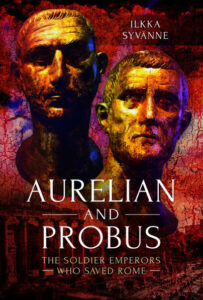
Dr. Ilkka Syvänne, Aurelian and Probus (Pen and Sword, 2020)
“Cometh the moment, cometh the man” they say. For the Roman Empire in the throes of the 3rd Century Crisis, they desperately needed a saviour. According to Ilkka Syvänne, they got two. As Emperor from 270-275 CE, Lucius Domitius Aurelianus with Marcus Aurelius Probus as his general waged relentless campaigns against barbarian invasions and internal rebellions to restore most of the Empire. Probus reigned from 276 to 282, almost completing the job his mentor had started.
Syvänne sets up his narrative with a selection of excellent maps, an overview of his sources, and a rather more detailed survey of the Roman army with illustrations. Then he gets into the story, following the military careers of Aurelian and Probus as they rose through the ranks while fighting an extraordinary range of enemies on all points of the compass. That experience would stand them in good stead when they assumed Imperial command. That was just as well because, as Syvänne makes clear, the Empire was a mess in 270 when Aurelian came to power. Aurelian took to the offensive, putting out fires and sweeping up the mess against diverse enemies, while developing a reputation for cruelty that probably helped lead to his assassination in 275.
After an interregnum of a few months under Marcus Claudius Tacitus, Probus emerged from a contested accession to continue Aurelian’s work. He fought the Goths then campaigned in Gaul, Germania, Illyricum, Thrace, and Persia before crushing revolts in Gaul, Spain, the Balkans, and Britain. But in doing so, he made enemies among the rank and file of his army and that led to his assassination in 282. Syvänne concludes his narrative with an assessment of the three Emperors who vied for the throne before Diocletian emerged to become one of Rome’s greatest Emperors. Some technical appendices on the Roman army complete this volume.
Syvänne loves to get into the weeds when writing, which he deploys well for his accounts of campaigns and battles in particular, but also many of the other major events of the period. Syvänne also pauses to provide discussion and analysis at key points, which are necessary to let his readers catch their breath, though at times there is a bit too much personal commentary and referencing of his other books. He also describes Rome’s enemies well, so that we get a good all round picture of the threats. I am not big fan of numbered sub-titles or lists, however, especially in a narrative history. Syvänne is ably assisted by the inclusion of many coloured plates, photographs, and illustrations, which taken with the detailed narrative produces a valuable book for students of the Roman Empire and military history in general.
BUY NOW

by RNS | Jan 15, 2021 | Beating Tsundoku
Gary Sterne, The Americans and Germans at Bastogne (Pen & Sword, 2020)
You might not think there is much left to say about the iconic siege of Bastogne, the lynchpin engagement in the Battle of the Bulge, Germany’s offensive in the Ardennes in December 1944. You would be wrong. Gary Sterne recasts the Bastogne story by integrating the memories of the commanders on both sides. By doing this, Sterne hopes to generate a new analysis of the battle. But he also acknowledges the problems with the sources, making his effort at piecing together this jigsaw replete with difficulties. To Sterne’s credit, he achieves most of his objectives.
Sterne begins with the German officers planning the offensive, a survey worth the price of the book on its own. Then the artillery rains down on the Americans, allowing Sterne to start mixing his sources against the chronology. The German advance begins, causing panic, and sweeping most of the Americans aside. But not all. Sterne takes us into Bastogne where the US defence is stiffening. The Germans were initially unconcerned, believing they could sweep up Bastogne at will. But they were wrong. A core force from the 101st Division, along with other units and stragglers from the retreat, held on resolutely in what became the legendary siege of Bastogne. Desperate combat ensued all around the town, but the Americans won through the fortitude of the defenders aided by control of the air, and then the final breakthrough as their comrades relieved them.
Sterne handles his German sources directly while paraphrasing much of the American sources, subsuming them into the narrative. It just works, but it sometimes feels like two different methods are being used, which can be jarring at times. Nevertheless, Sterne’s working through the command levels sweeps in and out from the front lines very effectively, lingering on the intense combat then zooming out to draw the wider picture. Sterne is supported by many excellent maps to help us understand this confusing battle. All in all, Sterne’s book adds more quality to the growing body of work on the Battle of the Bulge, and is well worth reading.
BUY NOW

by RNS | Jan 8, 2021 | Beating Tsundoku
John D. Grainger, The Roman Imperial Succession (Pen & Sword, 2020)
In The Roman Imperial Succession, John Grainger sets out to uncover how Roman Emperors became accepted in their enormously powerful position. This is not as easy as it seems: no one established a constitutional process for the handover of power. Yet there were over eighty Emperors. Grainger considers their accession, which was generally facilitated by a small group of wealthy and powerful men, though the army often had a great, and sometimes total, say at times. A dynastic connection helped too, but not always.
Grainger puts any confusion in the process at the door of the first Emperor, Augustus, and his personal and somewhat ad-hoc arrangements. That personal dynamic also usually meant that the living Emperor arranged his successor, with the obvious attendant problems of potential usurpation. The Imperial system itself was unstable, argues Grainger, through factionalism and the long ideological and nostalgic shadow of the Roman Republic. He works his way through all this by examining the various crises that came at the end of dynasties and how they were resolved, at least until the next crisis.
Grainger does a good job of untangling a complex subject, and he does so in an engaging blend of narrative and analysis. He also uses his sources well, particularly for the periods when sources were patchy at best. He is let down a little by some cheap looking dynastic family trees added to the text, but on the whole I enjoyed reading this book and generalists interested in the mechanisms of Imperial power transfers will too.
BUY NOW

by RNS | Dec 31, 2020 | Beating Tsundoku
Peter E. Davies, Ho Chi Minh Trail 1964-73 (Osprey, 2020)
There is little doubt that without the Ho Chi Minh trail, North Vietnam’s attempt to defeat its southern counterpart would have failed. The United States knew this too and did their best to close the arterial path that ran from near the Chinese border to just north of Saigon and many points in between. Both sides displayed ingenuity, tenacity, and courage in what became a war of attrition within the wider Vietnam War. Peter Davies tells that story.
The romantic image of the Ho Chi Minh trail is that of the hardy Vietnamese sneaking along a tiny jungle track with supplies for the front. While that was true, Davies demonstrates how the North Vietnamese developed the Trail as you would any other road, widening, solidifying, and providing utilities, except they were under an intense bombardment the likes of which had not been seen since World War II. The Americans threw everything they had at the Trail but were impeded by much of it being in neighbouring countries to Vietnam: the NV ignored that, the US could not, officially anyway. As well as an increasingly sophisticated air interdiction campaign to deal with the trail, the Americans sponsored covert operations in Laos and Cambodia, backed insurgencies, particularly in Laos, and simply bombed the hell out of it. They caused massive casualties, but this was a Canute-like task against an inexorable tide.
Davies examines all aspects of the US capabilities, including weapons, strategies, and tactics. They sliced and diced the landscape into operational zones to facilitate their attacks and used every plane at their disposal. They even dispersed tons of herbicides to strip the forest bare. The North Vietnamese relied on guile and manpower, knowing that a single mistake could lose a complete convoy to air strikes. They used every means at their disposal to camouflage movement: weather, tunnels, caves, night-time movement etc., and they provided flak protection at key points with varying degrees of success. But what impresses most is the sheer fortitude of those taking incredible risks to maintain the war effort.
Ho Chi Minh Trail is an excellent primer on this critical component of the Vietnam War. Davies does a very good job of untangling all the different actions being conducted simultaneously along the complex logistical highway and he efficiently captures the intensity of the combat. This is an operational study, so Davies does not engage with the experiences of those doing the fighting, but that is clearly not his remit here. This tidy little book will appeal to anyone interested in the air war in Vietnam, and students of the war in general.
BUY NOW