by RNS | Feb 21, 2021 | Beating Tsundoku
A Senseless Sacrifice?
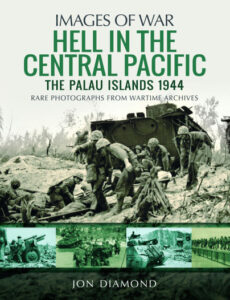
Jon Diamond, Hell in the Central Pacific (Pen & Sword, 2020)
There are many combat tasks that strike me as border-line lunacy. Storming ashore onto an island full of Imperial Japanese soldiers that you know will fight to the death is high on that list. In September 1944, this is what US Marines, supported by American soldiers, did on the Palau Islands, and then fought desperately for every yard against a fanatical enemy. Joe Diamond narrates that story in another of Pen & Sword’s Images of War series.
Diamond begins with the strategic considerations leading to the Palau Islands Campaign. Although a general overview, what it boils down to is that the Japanese had built airfields on the Palau Islands during their rapid expansion in the 1930s from which they bombed the Philippines, and the Americans wanted to neutralize them. Diamond moves onto what awaited the American soldiers tasked with taking the Palau Islands: Japanese defences and weapons, and the hostile environment. That combination provided the hell the Americans had arrived to subdue in September 1944. It would take them two months. Diamond turns to the forces involved and their commanders before narrating the actual assaults and subsequent fighting – the account of the fighting up Umurbrogol Mountain highlights a stunning military achievement. Diamond rounds things off with a summary of a campaign that cost 10,000 American casualties for what turned out to be a strategic waste of lives and resources.
Like all the Images of War books, Hell in the Central Pacific relies on the quality and variety of its images to create its impact. In that regard, this contribution to the series is a hit. The photographs of soldiers on the islands are undeniably dramatic and provide a real sense of what American soldiers endured. For me, the photographs of African-American SBs and two marines with a working dog stood out, but there are many other excellent images to choose from. However, there are also too many ‘context’ photos that have nothing to do with the Palau Islands campaign, and much of the strategic background section could have been pared down to extend the combat narrative, which is barely one-third of the book. Nevertheless, Diamond does a a good job of narrating the campaign and battle, and for those of us in awe of American sacrifice in the island-hopping campaign, that along with the images makes Hell in the Central Pacific a worthwhile addition to our bookshelves.
BUY NOW

by RNS | Feb 20, 2021 | Beating Tsundoku
Ciro Paoletti, Italy, Piedmont, and the War of the Spanish Succession 1701-1712 (Helion, 2021)
The War of the Spanish Succession is known by most of us for the brilliant campaigns of the future Duke of Marlborough. The war was much broader than that; however, little has been written about it in English. That is particularly true for the war in Italy. Until now. Thanks to Helion’s willingness to publish in areas no one else has, Ciro Paoletti takes us into a theatre that proved vitally important to the French and Habsburg Empire.
The book is split into two parts. Part I is the war with the French. Paoletti sets up the convoluted background to the war before describing how wars were fought. The latter includes siege warfare, though Paoletti argues they were not the principal form of warfare in avoidance of battle as is commonly thought – there does seem to be a lot of them though in this theatre. He takes a closer look at the Duke of Savoy’s army and Piedmontese logistics, a vital factor in waging this war. Paoletti moves into the strategy phase and narrative of operations, including the battles of Carpi and Chiari. What follows is a blow by blow account of the war placed in the context of wider European politics. Part II is the War against the French and continues in the same vein as Part I: descriptions of the main events are attached to the broader themes. Logistics again played a major role in these campaigns, especially financing, along with more sieges. That included the siege of Turin in 1706 that led to a climactic battle with Eugene of Savoy emerging victorious in the most exciting passage of the book. The conquest of Lombardy followed Turin and the invasion of France with the ‘failed’ attack on Toulon. The action switches to Naples then the Alps before Paoletti exits via the Treaty of Utrecht. He adds a comprehensive bibliography if your Italian is up to scratch.
Helion strikes again! This is another excellent book on a niche subject, but one that enhances our understanding of the wider picture – Helion are good at that. Paoletti acknowledges that English is not his primary language. That shows in the style and structure, but it also adds a bit of loose enthusiasm to the text, which is quite endearing at times. Exceptional colour artwork of soldiers and flags by Bruno Mugnai and wonderful contemporary illustrations throughout add flavour to the text. The War of the Spanish Succession is undergoing something of a renaissance in interest at the moment and Paoletti’s contribution is therefore very welcome. Military history readers of 18th Century warfare will certainly enjoy this.
BUY NOW
by RNS | Feb 17, 2021 | Beating Tsundoku
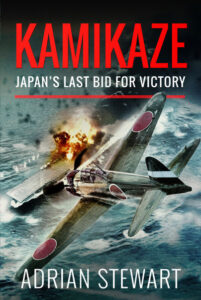
Adrian Stewart, Kamikaze (Pen & Sword, 2020)
There are few more terrifying events for a sailor than coming under air attack. The idea that the pilot intends to crash into you ramps up that fear level exponentially. Yet that is what Allied sailors, mostly Americans, faced as the Pacific War reached its climax in 1944, when Japanese suicide pilots, known as kamikazes, pitched their planes into a dive, heading straight for American ships. This happened day after day, shredding nerves and shattering ships. Adrian Stewart tells the riveting story of a unique but ultimately doomed tactic.
Stewart traces the kamikaze to the code of Bushido, the loyalty code of the pre-modern Samurai warriors. That ethos outlasted the Samurai to become the backbone ideology of the modernized Japanese forces that entered World War II. Death, therefore, held few terrors for Japanese pilots tasked with flying their aircraft into American ships. Stewart points out that such a suicide was not that unusual for pilots who did not carry parachutes: it was the organisation of such men into squadrons for the purpose that was new. This was first tried for the Battle of Leyte Gulf in October 1944 where the tactic proved its worth but was too little, too late to change the outcome. Nevertheless, Vice Admiral Onishi pushed the idea further with solid support from the pilots who would fly the ‘special attacks’ missions. Indeed, Stewart sets great store in the sincerity of those men. The attacks continued around the Philippines and if the Kamikazes made it through the fighter and anti-aircraft screen, they caused considerable damage. The Japanese switched to mass attacks on a single target that proved very effective, and they used a variety of aircraft mixed in with normal bombing operations. But the Americans took the Philippines, which fatally cut the Japanese supply lines.
The threat of unconditional surrender motivated continued kamikaze attacks, including Shinyo boats and Kaiten midget submarines, though they had negligible impact. American counter-measures also reduced the Kamikaze’s effectiveness. Kamikazes still caused serious casualties at Iwo Jima in February 1945 and again at Okinawa when 355 planes in a single attack caused carnage followed by mass attacks on consecutive days. But the Japanese could not sustain their losses. Stewart detours to the desperate ‘banzai’ attack of the battleship Yamato group, which was a disaster but not a suicide mission. Another detour examines the Royal Navy’s dealings with kamikazes around Okinawa. In the end, the kamikazes caused many casualties and great damage, but they could not stop the American advance. Stewart concludes by wrapping up the Pacific War with Japan’s surrender and its aftermath.
Stewart’s Kamikaze is a solid overview of a unique wartime phenomenon. He is careful to place the concept of kamikaze into its historical context and provides detailed descriptions of many kamikaze attacks on Allied ships. Sometimes Stewart adds too much superfluous information for the battles where the attacks took place and he deviates into sideshows such as the firebombing of Tokyo and FDR’s untimely death. Stewart also seems a bit too trusting of his kamikaze pilot sources, though that could be just this reviewer’s Western cynicism. Nevertheless, air warfare and military history enthusiasts will enjoy this account of an important element in Japan’s Pacific War.
BUY NOW
by RNS | Feb 14, 2021 | Beating Tsundoku
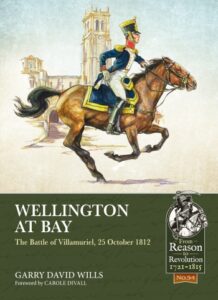
Garry David Wills, Wellington at Bay (Helion, 2020)
The popular perception of Wellington’s Peninsular campaigns is one of strategic manoeuvre interspersed with great battles won by arguably Britain’s greatest general. But Garry Wills’ work on the Battle of Villamuriel on 25 October 1812 highlights something rather different: a stirring rearguard action fought as part of a long, miserable retreat.
Wills begins his narrative at the failed siege of Burgos and Wellington’s retreat back to Portugal. The French maintained a close pursuit of the Anglo-Portuguese army. Protecting river crossings was of prime importance, which was the case for Wellington’s 5th Division at Villamuriel on the River Carrion. Wills sets up the action to come with a detailed overview of the forces involved, including the quality of troops and their commanders, the battlefield, and deployment. The blowing of the bridge over the Carrion heralded the beginning of the combat, but that did not prevent the French cavalry from crossing at a nearby ford. The British withdrew to the high ground, ceding the riverbank and adjacent village to the French, then counter-attacked, driving the French back across the river. The action finished with nightfall, providing cover for Wellington to continue his retreat the next morning. Wills concludes his narrative with calculations of casualties and prisoners, a tricky task but authoritatively handled, and the continued retreat. In his analysis, Wills highlights the complexity of Division level Napoleonic combat, which was far more nuanced than the stereotypical column v line affair. He adds a chapter on wargaming the action, which is very useful, and appendices on French and Allied commanders and officers at the engagement, the story of Ensign George Young, the identity of ‘McK’ – a key source for the battle – and an honour roll of the British and French dead. Wills closes with a comprehensive bibliography that will keep Peninsular War enthusiasts in reading material for a long time.
Wellington at Bay follows the standard structure for a battle narrative, which makes for comfortable if unremarkable reading. That is no bad thing and Wills rises above the commonplace with the quality of his research and rich array of embedded quotes from contemporary sources that illuminate the text. It is also refreshing to read an account of a medium sized Napoleonic battle with its more ground level approach. That will also be very appealing to wargamers who will appreciate Wills’ diligence in digging out the details. Wills’ engagement with other historians that have studied this battle adds a sense of authority to his book, which must surely be considered definitive for the Battle of Villamuriel.
BUY NOW

by RNS | Feb 7, 2021 | Beating Tsundoku
Andrew Bamford ed., Life in the Red Coat The British Soldier 1721-1815 (Helion, 2020)
This book of essays, relating to British soldiers, is compiled from the Proceedings of the 2019 Helion and Company ‘From Reason to Revolution’ conference. The linking theme is the wide range of soldiers’ experiences in their various roles in and out of combat. The eight writers are at various stages of their writing or academic careers, and they are as varied as their subjects. Collectively, under Bamford’s watchful eye, they have produced an entertaining and informative book.
Bamford leads the charge with a chronology and introduction to the essays. Andrew Cormack follows with an analysis of Chelsea Pensioner records between 1715 and 1755. Jonathan Oates considers the rank and file soldiers of the British Army at Culloden, closing a hole in our understanding of that battle. The essays leap forward to Robert Griffith’s survey of foreign soldiers serving under Wellington in the Peninsular War from 1808 to 1814. Alexander Burns returns to the 18th Century to probe the extent and effects of Methodism in the British army from 1739 to 1789. Brendan Morrisey’s topic is the role of the army in suppressing the bloody Gordon Riots in June 1780 and their civic role in general when things went wrong. Robert Tildesley takes us to Minorca in 1756 and how soldiers experienced that losing battle. Zack White also examines soldiers’ reactions to defeat and victory as we return to the Peninsular War, then Carole Divale stays in the 1792 to 1815 period to describe how soldiers experienced battle.
The essays in Life in the Red Coat are of varying quality and originality, but they are uniformly interesting and informative. As an introduction to the experiences of British soldiers in the long 18th Century, this little collection works very well, though sometimes you have to hit the ground running to follow them. To his credit, Bamford acknowledges that these essays are not definitive but doorways to further exploration, and the footnotes and bibliographies will certainly help with that. This is an enjoyable and entertaining read for novices and experts alike.
BUY NOW

by RNS | Jan 31, 2021 | Beating Tsundoku
Dr. Ilkka Syvänne, The Military History of Late Rome AD425-457 (Pen & Sword, 2020)
This is the fourth in a series of seven books by Ilkka Syvänne, presenting the military history of an Empire in deep trouble. And while it seems a short period to cover in a book, this was an action packed and turbulent three decades that Syvänne calls the Age of the Warlords. For Romans it was an era spent on the precipice of disaster.
Syvänne outlines an Empire united but fragile in 425. That integrity could not hold without a strong centralised power, however, and that was tragically missing. The West though was in much greater trouble than the East as becomes obvious when the narrative unfolds. Enemies surrounded Rome’s frontiers, and some were already inside; others, like the Huns, emerged from out of the vast emptiness beyond the frontier to threaten Rome’s existence. Policies of divide and rule against the barbarians and sometimes effective management of resources, along with almost constant firefighting under the brilliant general Aetius, stemmed the tide.
The Eastern Romans helped the West when they could, but they had their own problems, mainly with the Persians but also the Arabs and Huns. The latter threatened both Roman spheres, and led by Attila they invaded Gaul in 451, leading to the Battle of the Catalaunian Fields, which he lost to Aetius. Undaunted, he invaded Italy the following year and lost again. When Aetius was murdered in 454, Attila had been dead for over a year, and the door was open for the Vandals to attack and sack Rome in 455. Marcian, by then Emperor in the East since 450, sent some help, according to Syvänne, but he was also busy in his own backyard. By his death in 457, the East at least was in a stable position. And that is where Syvänne ends this volume.
In telling this often complex story, Syvänne makes the best of patchy sources and is quite happy to lay his analytical steps out for all to see; perhaps too much so at times when he interrupts the flow to dig around in the weeds. He also has an irritating habit of referring to his other published works in lieu of straightforward explanations. Nevertheless, his interpretations are interesting, particularly when he goes against the orthodoxy; for example, on army sizes. He supports his descriptions with frequent maps and illustrations, and the centre section features multiple colour photographs of reenactors, which are visually appealing though it isn’t clear what value they add to the text. I would not say this is a book for beginners studying the late Roman Empire, but for those who have some background, they will find this stimulating and provocative.
BUY NOW