by RNS | Oct 6, 2020 | Beating Tsundoku
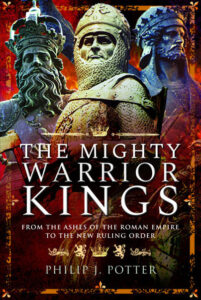
Philip J. Potter, The Mighty Warrior Kings (Pen & Sword, 2020)
The Mighty Warrior Kings takes readers on a journey from the Dark Ages to the early modern era through the lives of nine powerful leaders each of whom changed their part of Europe in significant ways. It also reveals by omission the importance of an introduction to establish connections and propose a thesis. Potter seems to think this is self-evident with this book. It isn’t.
No introduction then, only a prelude from Julius Caesar’s assassination in 44BCE to the 8th Century CE and the reign of Charlemagne where the chapters begin. The nine chapters in this book each follow a separate warrior king: Charlemagne, Alfred of Wessex, Cnut, William I, Frederick I Barbarossa, Richard I, Frederick II, Louis IX, and Robert I the Bruce. Potter narrates their biographies in a straightforward manner, ending each chapter with a selection of sources relating to that warrior king. He ends with a postscript that continues the general narrative into the 16th Century and the end of the period of the warrior kings. His bibliography gives the complete references for the sources cited at the end of each chapter.
The Mighty Warrior Kings is a collection of solid but unremarkable biographies of undoubtedly great men if measured in terms of their military and political power. The assemblage of these warrior kings holds few surprises, though Richard I and Robert the Bruce are placed in higher company than they probably deserve. From that perspective, The Mighty Warrior Kings is a good read, but the jacket claim that “the warrior kings created a new Europe with a centralized power base” is more than a stretch. It is difficult, therefore, to determine the intended audience for this book, particularly in an era when the ‘great’ men school of history is beyond resuscitation.
BUY NOW
by RNS | Oct 1, 2020 | Beating Tsundoku
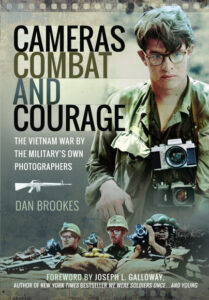
Dan Brookes, Cameras, Combat and Courage (Pen & Sword, 2020)
How do we know what happened during the Vietnam War? The usual written sources, of course, but Vietnam was also the first televised war and it was heavily photographed by a cloud of cameramen from all walks of life – two of the most iconic photographs of the 20th Century were taken during Vietnam. Cameras, Combat and Courage describes the War as experienced by military photographers whose job it was to record the war, but also to fight when necessary. They took millions of pictures; some of them died in combat while doing so.
Cameras, Combat and Courage is episodic for the most part with different photographers taking a chapter to tell their story. And what tales they share: William Muchler spooked while walking through a deserted VC village; Roy McClellan under fire in a paddy field; Christopher Jensen dodging mortar shells at Firebase Ripcord; Marvin Wolf’s encounter with VC snipers. Those were men that survived. Bill Perkins did not; he gave his life saving his comrades from a grenade and was awarded the Medal of Honor. His story is movingly told by his friend. Five others died when their helicopter was shot down near Pleiku. Brooks ends his book with an essay on what photographs meant to the Vietnam War and a eulogy for the men that took them.
As you might expect, Cameras, Combat and Courage is seeded with dozens of photographs covering all aspects of the Vietnam War. Some of them are incredibly poignant like the GI with the classic thousand-yard stare who will die in combat, others seem mundane, pictures of everyday life, but all tell a little part of the remarkable story that casts a long shadow over American history. The pictures, stories, and the men make this a remarkable book worth reading. 8/10
BUY NOW

by RNS | Sep 29, 2020 | Beating Tsundoku
Andy Singleton, Rome’s Northern Enemies (Painting Wargames Figures), (Pen & Sword, 2020)
Andy Singleton can paint model soldiers. In fact, he paints them exceedingly well. If you did not know that, then you are in for a treat with his latest how-to book, this time focusing on the Iron Age barbarians that gave the empire-building Romans such a hard time. For experienced painters of all standards, there is something in this book for you too even if it is just to salivate ever someone else’s inspired work. Singleton aims this book at the ordinary painter, trying to improve their techniques, and he does so by using a simple building block method illuminated by step-by-step photographs. It is a very effective approach.
Singleton dives straight in with a survey of the tools you will need to paint your figures, though helpfully, Singleton also covers the types of figures you can buy. Knives, files, glue, filler, primer, and, of course, brushes, are all part of the painter’s arsenal. Singleton teaches you the basic techniques of painting before getting into the specific challenges the Iron Age barbarians have to offer. He starts with weapons and armour where you learn how to make chainmail shine, or not if that’s how you want it, and then paint wood for spear shafts. Now comes something tricky; the ornate shield designs carried by the barbarians, but don’t worry because you can get shield decals, and Singleton shows you how to add them. Barbarians clothes were also often patterned, including horrible to paint tartan that Singleton makes look easy to do. Some of the barbarians painted their bodies, so we must too. Singleton teaches you how to paint flesh with tattoos and not make them appear like psychedelic rashes! Then he comes to my biggest bugbear: horses. Singleton demonstrates how to paint a variety of horses and their leather straps – this for me was worth the cost of the book. You will need those for the chariot that features next; how to assemble it, though sadly not how to paint it, which is disappointing given the superb chariots Singleton features in his photographs. Once you have mastered the figure, Singleton teaches you how to create realistic bases, which rounds the book off nicely.
Singleton writes in a light, friendly style that makes you feel accompanied rather than lectured to as you work your way through his lessons. The excellent photographs of painted figures are aspirational for most of us, but the great thing about a book is that it is always there in front of you for inspiration with the bonus that you can escape the PC for a while at least. While I would not dare to argue with Singleton’s techniques, it would have been useful to see how they work on smaller scales, especially the popular 15mm scale for the ancient period. That quibble aside, this is a first-rate book on painting figures and complements Singleton’s previous book on painting Imperial Roman soldiers. I recommend you get both. 9/10.
BUY NOW

by RNS | Sep 27, 2020 | Beating Tsundoku
Nic Fields, Britannia AD43 (Osprey, 2020)
We all know the Romans. They were the great conquerors who laid the foundations for western Europe over the course of five centuries and turned the Mediterranean into their lake. But why did the Romans invade Britain in 43CE and how did they do it? Nic Fields explores those questions in Britannia AD43, an Osprey survey book familiar to most military history students. Along the way, he illuminates the main debates that still linger over the events of that year and busts some long-held myths while engaging the reader with a fascinating story.
Fields begins with Julius Caesar’s reconnaissance of Britain in 55 and 54BCE followed by the Contact Period when trade and cultural interchange flourished, but otherwise Rome showed little interest in the island off the edge of the Empire despite the claims of conquest by Caligula in 40CE. That all changed when the notoriously unsuitable Claudius became Emperor the following year. He needed a military victory, Britain was a likely target, a pretext came up, and the Romans were soon planning an invasion and conquest.
Aulius Plautius Silvanus commanded the Roman invasion of Britain in 43CE. Fields introduces him, his legates, and his opposing general on the British side, Caratacus. They commanded very different armies, and the differences between the two is Fields’ next stop. The Roman army was professional in every way; disciplined, organized, and a proper state instrument of war. The British Celts were the opposite; warrior tribes, brave individually but brittle collectively if their initial ferocious charge failed. Their enigmatic use of chariots merits attention too, with their effectiveness open to question. Fields adds a section on the Roman navy that feels a bit forced, but his survey of Roman auxiliaries is very useful.
The strategies of the two sides could not have been more different. The Britons opted to draw the Romans into the country then confuse and disperse them with the hit-and-run tactics they used so successfully against Julius Caesar. These Romans were here to stay, however, and wanted to fight the Britons in a pitched battle and be done with it. Fields moves onto the campaign with a description of the assembled Roman forces, the landing and then the push inland. The Britons opposed them at the Medway River in an unusual two-day battle but could not hold and retired. They tried again at the Thames and lost again. This was in no small part to the tactically adept Batavi auxiliaries that Fields lingers on before introducing Claudius arriving in triumph on his elephant to accept the surrender of the southern tribes. The conquest was not over, however, and Plautius ordered Vespasianus to take the southwest, which he did but not without more hard fighting. Then the Roman advance north began while they consolidated their captured territories. Fields concludes with the question: was all this a Roman vanity project?
There are very few surprises in Osprey survey books like this. The format is familiar with a simple chapter structure and a mid-text break of artistic colour plates. Many maps, colour photographs of various locations, and archaeological discoveries also illuminate the narrative. The text skims the surface for the most part, and Fields engages briefly with the deeper mysteries that the incomplete and sometimes contradictory sources cast up. That is not a bad thing: this is an introductory survey after all. Fields is, however, too opinionated and flippant at times; for example, he disparages Julius Caesar, and Caligula getting “whacked” jars. Putting that to the side, Britannia AD43 engages and entertains its audience very well. For those not already well-versed in the period, they will probably want to read more based on Fields’ book, using his very useful bibliography as a starting point, and that for me makes Britannia AD43 a success.
BUY NOW

by RNS | Sep 25, 2020 | Beating Tsundoku
Andrew Abram, More Like Lions Than Men (Helion, 2020)
Growing up, I understood the English Civil War as a fight between two armies that clashed regularly with the Parliamentarian army of Oliver Cromwell overcoming the Royalist army of Charles I who was doomed to lose his head as a result. Other fighting in the regions was dismissed as not much more than local fisticuffs. Times have changed, of course, along with scholarship and interpretation, and the interconnectedness of the struggle has become steadily more apparent. In that vein, Andrew Abram’s More Like Lions Than Men examines the Cheshire Army of Parliament under Sir William Brereton and establishes it firmly in the broader strategic context of the war.
Abram splits his book into three parts. Part I follows the Cheshire army on campaign from Autumn 1642 to February 1646. Brereton assumed command in a County that showed little interest in the war, but he recruited a sizeable force and cooperated with other Parliamentary forces across England. He also resisted Royalist incursions into Cheshire as the County became increasingly important. Brereton was successful through 1643 aided by a cadre of competent officers and experienced soldiers and that continued through the heavy fighting of 1644 and the siege of Chester that occupied much of 1645.
Parts II and III delve into the nuts and bolts of the Cheshire army. Abram examines how men were recruited, dressed, and organized into the infantry, cavalry, artillery, and other non-fighting branches. He includes an interesting section on religious ministers, which was important particularly in the Parliamentarian armies. Abrams turns his attention to how the army functioned away from the battlefield; how they were fed, paid, and armed, including their ammunition. Part III surveys the units that made up the Cheshire army, beginning with Brereton’s cavalry, highlighting their sub-units, officers and NCOs, and numbers. He does the same for the Infantry regiments and Dragoons. He concludes with an outstanding bibliography
More Like Lions Than Men is excellent value. The opening fast-paced narrative section is followed by an exemplary scholarly analysis of all elements of the Cheshire army. The text is littered with interesting contemporary illustrations and a judicious use of quotes, though some are too long and could have been paraphrased. The colour plate section of soldiers and flags adds to the production values of what is overall a fine book and one that sets the standard for anyone wishing to attempt the same. If diving deep into an English Civil War army appeals to you then this is a must buy; for those just interested in the ECW and how armies fought, Abram has set you up with a thoroughly engrossing read.
BUY NOW

by RNS | Sep 23, 2020 | Beating Tsundoku
John S McHugh, Sejanus Regent of Rome (Pen & Sword, 2020)
His name is synonymous with burning ambition; a man who had enough but wanted it all. At his peak, Sejanus’s power rivalled that of the Roman Emperor, but he overstepped (don’t they always?) and died a traitor’s ignominious death. Along the way, he fundamentally changed Roman history and political culture. John S McHugh brings us Sejanus’s story and attempts to solve the mysteries that still surround him.
Sejanus was born into an influential, though not noble, family during the fiery death of the Roman Republic in 20 BCE. He began his army career as a young man, hoping to follow in his father’s footsteps as one of the Emperor’s Praetorian Prefects, which he duly achieved after climbing the military ladder. He had done so through patronage and exercising his ambition, but Sejanus was also charismatic and energetic and politically astute. Sejanus was now near the centre of power but that only stoked the fires of his ambition. He watched and learned how power worked, becoming the Emperor Tiberius’s right-hand man in the process. When Tiberius removed himself from Rome, Sejanus filled the void as a regent. He now controlled Rome through fear and patronage while keeping Tiberius ill-informed as to events in his capital. Then Sejanus fell, sharply, as tyrants do; Tiberius finally wise to Sejanus’s power-grab. The man who would be Emperor was imprisoned, garrotted, and his corpse defiled, though he suffered his fate bravely. A six-year terror followed against Sejanus’s supporters, real and imagined, fuelled by Tiberius’s vindictiveness and spurred on by his new Praetorian Prefect, Macro. It ended only when Tiberius died. McHugh concludes on a sympathetic note for Sejanus who he sees as little different from those who came after, though Sejanus set the precedent.
The sources for Sejanus are patchy at best, but McHugh picks his way through them with care – his handling of the ‘murder’ of Drusus is an excellent example of this. That might not make for the most enjoyable reading experience at times, but it is necessary and provides great insight into the pitfalls and rewards of studying ancient history. McHugh’s draws the reader in with his clear narrative of events and descriptions of the major players in this extended drama, and his placement of Sejanus’s rise and fall in the context of Roman politics is skilfully exposited. Sejanus’s dramatic rise and fall still serves as a morality tale through the centuries, and it is one that McHugh tells well.
BUY NOW