by RNS | Jul 4, 2025 | Beating Tsundoku
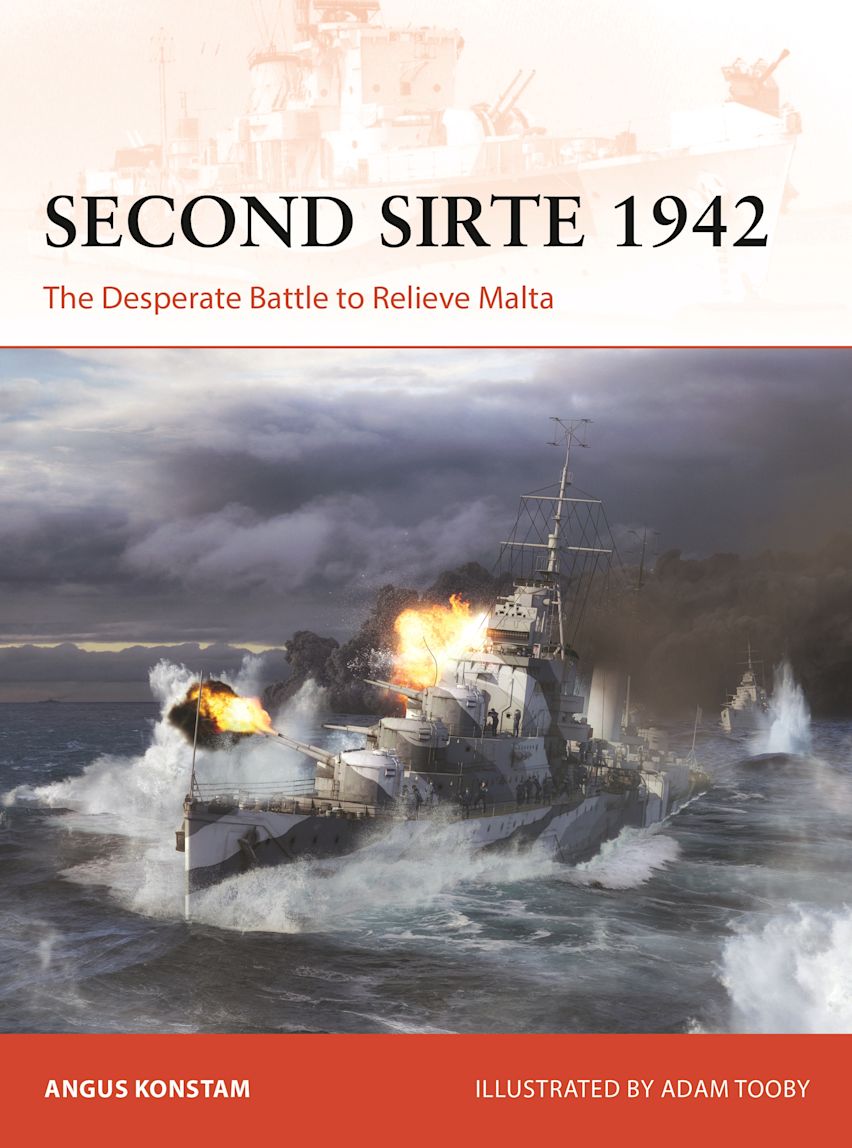
Angus Konstam, Second Sirte 1942 (Osprey, 2025)
The Gulf of Sirte was the north-African terminus for Axis supplies from Italy. The British had to interrupt that supply line, but to do that effectively, they had to protect their bastion of Malta, which they also had to supply. Thus, two supply lines crossed, and whoever controlled them would win the war in the Mediterranean. In his latest book in the Osprey Campaign series, Angus Konstam argues that the British problem was greater because the Axis controlled the skies and operated from home bases. In December 1941, a British convoy got through to Malta, just. In March 1942, they tried again despite being outnumbered and outgunned.
Konstam sets off the Battle of Second Sirte against the backdrop of the continuing struggle for control in the Mediterranean. That had favoured Britian, especially after the victory over the Italians at Matapan in March 1941. Then came the German invasion of Greece and the Allied loss of Crete with significant losses to the Royal Navy. The pendulum had swung, with the German luftwaffe in particular causing the British headaches. The Italian fleet was also still powerful, despite their losses in the raid on Taranto, but the RN held the advantage in radar, deterring the Italian fleet from nighttime engagements. Still, getting convoys through to Malta was imperative however risky that would prove to be, especially during the day.
Admiral Sir Andrew Cunningham commanded the Mediterranean fleet, with Rear Admiral Sir Philip Vian his able subordinate. The Italian Regia Marina was commanded by Admiral Angelo Iachino assisted by Ammiriglio di Divisione Angelo Perona, but both laboured under restrictive orders from their superiors in Rome. Konstam discusses the disparity in the respective fleets, noting that the RN was deficient in carriers, battleships, and heavy cruisers, and what they had was not all that great. But the RN had radar, effective gunnery, and professionalism, whereas the Regia Marina had the resources but not the wherewithal on how to use them effectively
Konstam moves onto the action after describing the respective battle plans, which amounted to the British moving a convoy over 900 miles, and the Italians, with German luftwaffe and U-boat assistance, trying to stop them. The convoy sailed on Friday, 20 March 1942, but did not see serious action before Sunday morning. Then the air attacks and the Italian fleet arrived to which the RN countered with a wall of smokescreen. The fleets exchanged gunfire, broke off, manoeuvred, then engaged again in a sprawling melee fought at times in near gale-force conditions. In the end, the Italian fleet turned for home as night fell. Despite constant air attacks, most of the convoy made it to Malta. However, they were still not safe from the luftwaffe, which sunk or damaged all of the ships.
The story of the Battle of Second Sirte is a confusing one, but Konstam narrates it well, and along with some excellent maps, brings clarity to the combat. Konstam not only coordinates the action but brings out the reasons why the battle transpired as it did, and the reader cannot help but admire the daring and resolve of the outgunned RN ships and their crews. It would have been interesting to know what the latter thought of it all, but the Campaign series format allows for not much more than an operational level overview. Konstam provides a useful further reading list, however, for those wanting to read more. Overall, Second Sirte is a worthwhile addition to the Campaign series, and the prolific Konstam is always worth reading.

by RNS | Jun 30, 2025 | Beating Tsundoku
Matthew Dillon, Christopher Matthew eds., Religion & Classical Warfare: The Roman Republic (Pen & Sword, 2020)
In a secular society, religion is usually separated from the State and paid lip service when it comes to military decision making. It is sometimes difficult, therefore, to understand a society where religion permeated every military act. But that was the case in the Roman Republic. Matthew Dillon continues his explorations into the connections between religion and classical warfare in this book with the help of various expert contributors.
BUY NOW
Matthew Dillon opens with an overview of new perspectives on religion and warfare in the Roman Republic. He notes that recent studies of Roman warfare have ignored the role of religion. He then surveys the topics under consideration by his various contributors before reminding readers that religion and Roman military success were inextricably entwined.
John Serrati surveys the middle republic where religion and warfare affected every aspect of Roman society. The gods were consulted before campaigns and when the army was in the field. Even the Roman calendar was orientated around war, which Serrati covers in some detail. Matthew Dillon returns with an essay on Evocatio, the Roman wartime practice of enticing enemy gods over to their side, which had a long history into the Biblical era. Among the unfortunate victims of this was Rome’s arch-enemy, Carthage. Of course, the boot could be on the other foot if Rome’s gods abandoned them, as happened to Mark Antony in 30 BCE. Brandon Olson examines the religious functions of Roman arms and armament. He notes how the Romans in the western empire emulated the Celts in votive offerings with their weapons. He also considers the role of memory and commemoration in Roman thinking. Christopher Matthew scrutinises the cult of the eagle military standard. He points out that the eagle was connected to Jupiter, but also that it was originally one among many animals used in the Republic. It was Marius’ reforms that standardised the eagle throughout the army, and they became the ‘soul’ of the legion and the focus of the legion’s loyalty. The religious aspect of the eagle was explicit in that devotion.
Lora Holland Goldthwaite considers the role of women at the intersection of religion and warfare, a relatively new field of study. They participated in many religious activities associated with the protection of the state during wartime. That goes wider than the customary emphasis on the Vestals, though Goldthwaite allocates them their prominent place in the religious scene in Rome. She also records the actions of women across all levels of society, including slaves, much of which has been uncovered by recent women historians. The Vestals appear again in Paul Erdkamp’s study of live burials and their connection to Rome’s wars. He begins with three live burials of Roman enemies, the meaning of which baffled even Roman historians. This was also the fate of several of the Vestals, though Erdkamp acknowledges the lack of clarity in the sources. He wrestles with those sources to make the connection between the purity of the Vestals and success in war. Kim Beerden ponders divination and finds it to be a curiously neglected act by other historians. Beerden discusses the methods and processes of divination and how important this was in the context of warfare for physical and moral reasons. Jeremy Armstrong looks at triumphal transgressions. He argues that the triumph ‘broke all the rules’ of the Republican system but paradoxically acted as a stabilising force because the event itself was rules-driven. The triumph was thus more than a victory parade, and it had a distinctly religious component. Armstrong considers the evolution of the event and its socio-economic and political meaning.
The Religion & Classical Warfare series of books invariably provides thought-provoking material, and this one on the Roman Republic succeeds admirably at that too. The range and depth of the essays are impressive, and each contributor is obviously in command of their material. All of the essays include useful bibliographies for further reading and research. The conclusion, after having read the book, is that an understanding of Roman religious practices is essential to understanding Roman warfare. Too many historians are, unfortunately, content to set aside that influence. This collection of essays was informative and entertaining, and it should prove useful for lay-readers as well as experts in Roman Republican warfare.

by RNS | Jun 24, 2025 | Beating Tsundoku
Jim Carter, Hearts of Steel (New Generation Publishing, 2022)
In July 1918, Herbert Leeder, age 17, joined the Royal Navy. He served for over 25 years in peace and war, which was probably the most remarkable thing about him. Like so many sailors before and after him, Leeder merged into the ranks to become one of the crews that kept Royal Navy ships floating and fighting. Leeder’s naval legacy was a four-page record, outlining his service, and a faded photograph of a proud matelot posing in his tropical rig. In Hearts of Steel, Leeder’s great-grandson, Jim Carter, has used that record and a myriad of diverse sources to narrate a gripping account of Leeder’s journey on ship and ashore.
Leeder’s first ship after basic training was the HMS Centurion, but he knocked about between ships, getting married along the way, before joining the cruiser HMS Effingham in 1925. Carter follows that ship as it headed out to the East Indies station, providing a narrative of events with detours into descriptions of naval life, including the ‘crossing the line’ ceremony, burial at sea, time ashore, and the effects of weather and illness. Leeder returned to Portsmouth in 1927, where he became more husband than sailor, before joining the HMS Hawkins in 1932 and returning to the East Indies. Carter provides more details of naval life, including fishing from the decks, watching movies, runs ashore, and hunting hippos! Carter sets all that against the context of the gathering clouds of war over Europe. By the time war broke out, Leeder had joined the HMS Nubian, a Tribal Class destroyer; a ‘lucky ship’ whose luck would run out spectacularly in May 1941.
Nubian first saw action as a convoy escort in the North Sea. Then she took part in the ill-fated Norwegian campaign, where the Luftwaffe ruled the skies and tormented Allied naval and ground forces. This was not the last time, the crew of the Nubian would encounter the dreaded Stuka dive-bomber. Carter describes the adjustments made in the wake of Nubian’s Norwegian experience before she headed into the Eastern Mediterranean in May 1940. Nubian again protected convoys, this time to Malta, and helped provide submarine and air assault screens for capital ships, though she also performed missions outside that remit. Carter describes the Mediterranean theatre and the Royal Navy’s major operations against the Italian fleet and air force and the notorious sinking of the French fleet. HMS Nubian re-enters the scene at the Battle of Calabria in July 1940 as protection for HMS Warspite. She also protected HMS Illustrious for the action against the Italian fleet at Taranto. Leeder resurfaces on charges when in Alexandria for Christmas, but he is soon back at sea in the New Year. Carter narrates the Battles of Matapan and Tarigo then the evacuation of Greece and Crete. The latter brought intense air attacks against Royal Navy ships, and Carter discusses the mental pressures this constant warfare inflicted on the crews. Many RN ships were lost, but Nubian had escaped lightly. Then, on 26 May 1941, her luck ran out when a Stuka creeped in and dropped a bomb on Nubian’s stern, ripping it off and killing 15 sailors. Fortunately, Leeder was not one of them, but Nubian was out of the war for over a year, and that is where Carter concludes his story. Leeder was demobbed in September 1945, living for another twenty years as a family man.
Hearts of Steel is an outstanding account of men and ships in peace and war. Jim Carter knows how to tell a story, weaving aspects of creative non-fiction with more traditional narrative history writing methods. While many, if not most, books on the Royal Navy during this time are driven by operational and technical aspects, Carter’s focuses on the human dimension: the officers and men of the Royal Navy and occasionally the enemies trying to kill them. Leeder was one of those men, and while Carter rarely mentions him by name, Leeder is always present – he could be one of the men manning the pom-poms under Stuka attack or part of a damage control party. The trick in this kind of work is to highlight that the subject is not ‘not there’, and Carter pulls that off very well. Carter also builds in seamlessly lots of context, from the great events to snippets and vignettes of naval life that are rarely included in other books with this range, and he integrates his sources into the narrative without too much intrusion. Carter perhaps digresses too far on occasion, provides a bit too much extraneous detail at times, but that is a mere quibble for a book that rattles along and entertains as much as it informs.

by RNS | Jun 14, 2025 | Beating Tsundoku
Eddie Idrees, Special Forces Interpreter (Pen & Sword, 2021)
Separating friend from foe is a necessary component of modern warfare. Overcoming cultural differences in an alien environment is also crucial for operational efficiency. Even the best armies need local knowledge. In Afghanistan, the British and Americans employed interpreters such as Eddie Idrees. He risked his life in the face of extreme hostility from, not just the Taliban, but from many who he thought might be more supportive. That carried on into his civilian life in the UK, much to his surprise. This book is Idrees’s memoir of his service in and out of combat.
BUY NOW
Idrees begins his story by recounting his time as a child in a Pakistan refugee camp, where he learned English in a UN sponsored school. Even then he knew he wanted to be a soldier like his father. That was reinforced by a visit to Afghanistan where he witnessed Taliban atrocities and cultivated a lifelong hatred of them. He was recruited as an interpreter for the US army that arrived in the wake of the 9/11 attack, but he was suspended for alleged misconduct. Fortunately for Idrees, a chance encounter led him to serving with Britain’s elite SAS force. He took part in many missions, some of which he describes in detail, particularly his hair-raising close escape from an operation that went wrong in Kandahar. Idrees discusses the risks for interpreters, many of whom were killed in combat or executed when captured by the Taliban. Idrees also notes the endemic corruption in the Afghan army. His personal risks, Idrees could handle, but when the threat extended to his family, it was time for him to get out. He sought asylum in the UK, which was not as simple a process as he expected. Also surprising was the hostility he received from the Afghan community in the UK. Idrees has also had to live with his PTSD, but he has no regrets over his service.
This is a riveting but sometimes deeply unsettling account of a man whose service should be honoured by his adopted country. It was his risk to take to become an interpreter, but he undoubtedly saved many coalition, and Afghan, lives through his sacrifice and sense of duty. It is important that those of us on the outside, in a time of anti-immigrant rhetoric and actions, understand what men such as Idrees did for us. This memoir should go some way to helping us and our politicians make better decisions when it comes to those who did so much for us, and it deserves a wide audience.

by RNS | Jun 10, 2025 | Beating Tsundoku
Brendan O’Carroll, The Long Range Desert Group in the Aegean (Pen & Sword, 2020)
What do you do with an elite unit when the war they trained for is over? You retrain them and send them to another war. That is approximately what happened to the British & Commonwealth Long Range Desert Group after the desert war finished in May 1943. Brendan O’Carroll examines the LRDG’s new role in the ill-fated Dodecanese campaign that ended bitterly for so many.
BUY NOW
O’Carroll surveys the activities of the LRDG in the desert before they retrained in the Lebanon as commandos and were ordered to the Aegean. The hub of the plan was to take Kos and Leros as part of a network of Allied controlled islands. It might have worked, but the Germans had other ideas. O’Carroll describes how the LRDG used makeshift motorized sailing vessels, called caiques, to move around the islands, dropping off troops to perform their missions and picking-up them up on completion. That was fine if the LRDG were used in the way they had been trained for covert missions, reconnaissance, establishing observation posts etc, things that elite special forces do, but when used as regular troops, they did not do so well. All too often, the LRDG found themselves outnumbered and outgunned, losing men killed in action and taken prisoner. When Kos fell, the Allies lost their only airfield, and German air superiority rapidly told against the ground forces. This included a swan song for the infamous JU-87 Stuka dive bomber, which O’Carroll devotes a chapter to for its significance. The LRDG also lost men in the disastrous attempt to invade Levitha, prompting New Zealand to withdraw its contingent of soldiers. For the climactic battle for Leros, the LRDG supplied 150 men out of 3,000 defenders, but they made little difference to what O’Carroll calls an ‘avoidable’ outcome.
The individual stories told by the men of the LRDG are the highlight of O’Carroll’s book. Their resilience and courage are undeniable, in combat, on the run from the Germans, and escaping their clutches even as POWs. O’Carroll leans into the vital roles played by Greek civilians in assisting the LRDG at the risk of execution, and the curious role of the Italians, now allies, is well-covered too. The inclusion of the chapters on the JU-87 and a regular soldier’s account of the fighting on Leros, while fascinating, make the book seem a wee bit disjointed, but they add to the overall picture of an ill-conceived campaign that Churchill should probably never have authorized. On the whole, this is a gripping book that WWII readers will enjoy.

by RNS | Jun 3, 2025 | Beating Tsundoku
Nic Fields, The Jugurthine War 112-106 BC (Osprey, 2025)
Most students of ancient warfare will associate the Numidians with their role in the Punic Wars between Rome and Carthage. Indeed, this is the first we hear of Numidia, a north African state, consisting of a few agricultural communities and a vast interior populated by nomadic herdsmen. They had fought with the Carthaginians and then with Rome, becoming something of a vassal state. However, that casual relationship blew up in Rome’s face in 112 BCE when Numidian internal political divisions exploded into a civil war, forcing Rome to intercede against a usurper king, Jugurtha. Nic Fields takes us into the ensuing war that escalated into a level of brutality that even shocked many Romans.
The uncertainties of studying ancient history are immediately apparent in the Jugurthine War for which we have no certain chronology; our main historian, Sallust, having no interest in such matters. Nevertheless, Fields is able to answer most of the how and why questions. The Numidian Jugurtha was in illegitimate prince who had fought alongside Rome in Hispania, where he learned the Roman art of war, which he would use to his advantage against them when the time came for him to usurp the Numidian throne and take on the legions. He fought, or bribed (allegedly), a few Roman generals, but his nemesis would be the infamous Gaius Marius, a provincial aristocrat but also a seasoned general.
Fields examines the opposing forces. The core of the Numidian army was a body of lightly armed foot-soldiers supplemented by some heavier infantry, archers, and elephants. But it was their light cavalry that presented the greatest threat to the legions when operating in a combat environment more conducive to mobile warfare. The Roman manipular legion presented too much of a challenge to the Numidian army in pitched battles, as demonstrated by the Roman general Quintus Metellus at the Muthul river in 109 BCE. Jugurtha withdrew, however, into the mountains and plains where he could wage guerilla warfare, while the Romans ravaged towns and settlements. Metellus could not beat Jugurtha that way. Enter Gaius Marius with a larger Roman army and more brutal tactics, leading to the shocking destruction of the Capsa in 107 BCE. Still Jugurtha fought back, forcing Marius onto the defensive. It would be treachery rather than battlefield victory that brought Jugurtha down when Bocchus, the king of Mauretania, betrayed Jugurtha to the Romans. The war was over. Fields concludes by examining the historical consequences of the Jugurthine War, which was far-reaching militarily and politically.
The Jugurthine War is not one that automatically comes to mind when thinking of Rome’s great campaigns, yet as Fields demonstrates in this slim volume in Osprey’s excellent Campaign series, it highlights many of the problems facing the Romans as their Republic faltered in the late second century BCE. This was not a war that favoured the Roman style, and it required innovations that prompted military reforms and definitively altered Roman politics. Fields works his way through the causes and consequences while narrating the main events in his usual authoritative manner, supported by Osprey’s customary high quality graphics and illustrations. Fields’s The Jugurthine War fills an important gap in Osprey’s coverage of Rome’s wars, and it is an enjoyable and informative read.