by RNS | Sep 2, 2025 | Beating Tsundoku
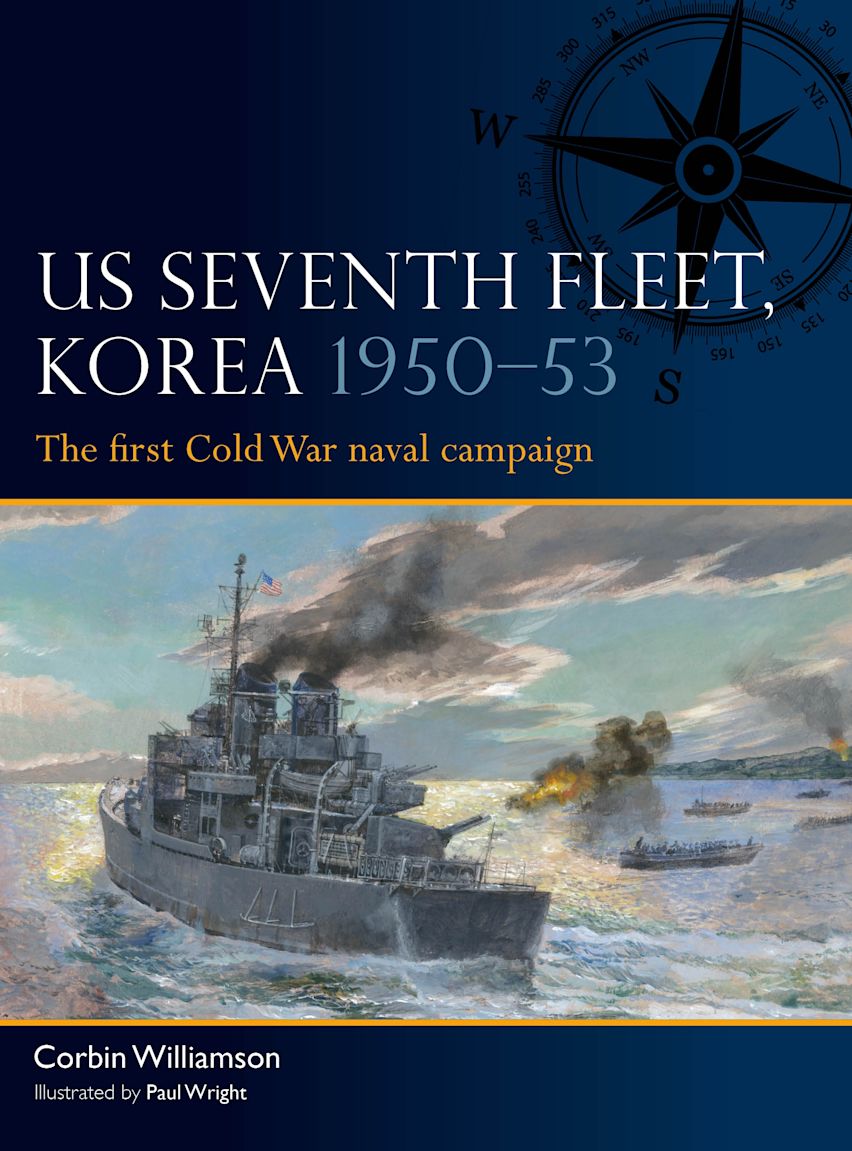
Corbin Williamson, US Seventh Fleet Korea 1950-53 (Osprey, 2025)
Some still refer to the Korean War as the Forgotten War. If it is remembered, it is the ground war that garners most interest followed by the air war in the new jet age. What is too often overlooked is the role of the various navies that made up the UN force at sea. In this book, Corbin Williamson addresses that omission with a particular focus on the most powerful fleet in the world at the time, the US 7th Fleet.
Williamson begins with an overview of the 7th Fleet after World War II. He notes that the fleet remained busy even while US defence cuts took hold and foreign policy focus shifted from the Pacific to Europe. There was also internal dissension between the Air Force and the Navy over how US airpower would function. In the meantime, tensions arose on the Korean peninsula with the threat of a communist takeover. The 7th Fleet held exercises with the Royal Navy in March 1950, but the real action was just around the corner with the communist assault on the Republic of Korea.
An analysis of the 7th Fleet follows the narrative preamble. Williamson surveys the ships, including the carriers, battleships, cruisers, and destroyers, before moving onto the naval warplanes and helicopters. Williamson examines how the fleet operated, focusing on command, control, and communications. Here we find that the Navy was split into two commands in the Pacific then into three groups as the demands became clearer – Williamson helpfully includes an organisational chart to show the various changes. Williamson next describes the problems in communications caused by the increase in wartime radio traffic. The Korean War required a change in US naval doctrine and an increased need for manpower. Williamson also covers naval intelligence and logistics.
Knowing how the navy operated helps us understand what they did in combat. Williamson narrates the defence of the Pusan Perimeter in 1950. Overall naval supremacy was established quickly in the Korean War, but the main naval activity was providing air support for ground troops. Perhaps the most famous incident in the war was the landings at Inchon, facilitated by the Navy and let us not forget the pivotal role of the US Marines. Williamson adds the daring bombardment of Chinnampo to his narrative along with other evacuations of troops when the Chinese flooded over the Yalu River. In 1951 and 1952, the Navy helped interdict Chinese communications with varying degrees of success. Later, to provide an edge in peace negotiations, the Navy increased its attacks on infrastructure.
This is an informative book that adequately supports Williamson’s conclusion that the actions of the 7th Fleet demonstrated the continuing utility of the navy in a time of jets and missiles. Williamson does a good job of explaining how the fleet operated, and he takes care to include the valuable support of other national fleets in this United Nations operation. There is not much in the way of significant events to cover in this war, but Williamson brings out those that were important while describing the fleet’s almost continuous role in supporting the action on the ground. Osprey adds its usual flavourful artwork and graphics to produce a useful survey of this often overlooked aspect of an often overlooked war.
by RNS | Aug 25, 2025 | Beating Tsundoku
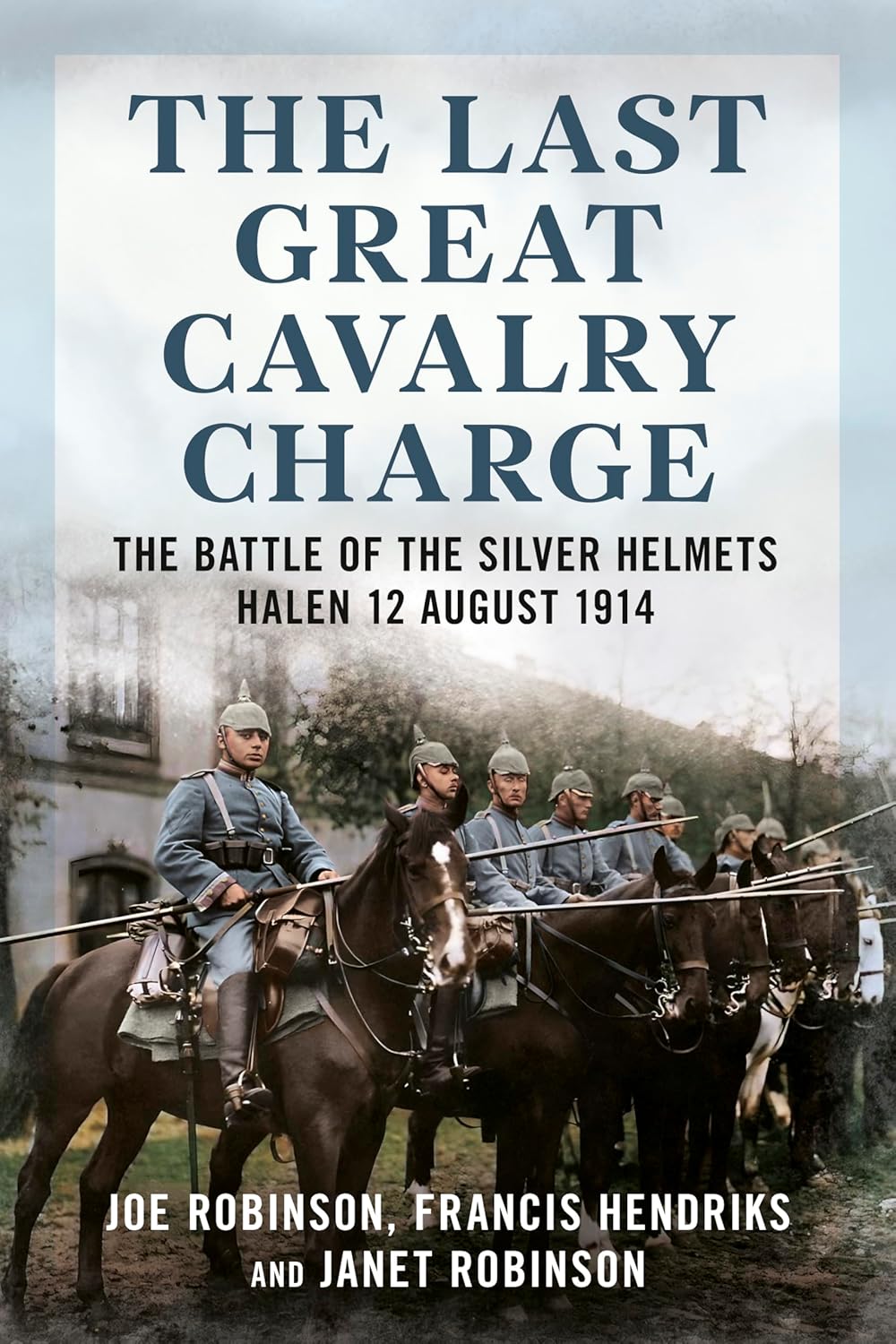
Joe Robinson, Francis Hendriks, Janet Robinson, The Last Great Cavalry Charge (Fonthill, 2025)
It is a truism that the age of cavalry dominance ended in World War I. Those who clung onto the traditions of massed cavalry charges overwhelming helpless defenders were in for a rude awakening when they discovered that horses and industrial warfare do not mix. We can determine the exact day that the Germans found this out thanks to a well-researched and informative book first published in 2015 and now republished by Fonthill books: The Last Great Cavalry Charge. That day was 12 August 1914 at the Battle of Halen.
It seems that the cavalry disaster at Halen was an accident waiting to happen. The authors trace doctrinal problems back to the war against France in 1870 when rifled infantry weapons took their toll on cavalrymen. But the Germans did not learn and reiterated the primacy of the cavalry charge in their 1909 doctrinal manual. This was despite structural, training, communications, and planning problems, all of which would play a part at Halen. The Germans erred at the strategic level too. Their wide swinging wheel on the right-flank of the Schlieffen Plan did not have enough cavalry, and the Belgians delayed their progress, with fatal consequences.
That brings our authors to Halen and its environs, which they describe in detail. They move on to the orders of battle and a description of the competing forces, including the unique Belgian cycling battalion. After some minor skirmishes between German and Belgian cavalry, the Belgians decided to dig-in and create a formidable defensive barrier. But miscommunication left gaps for the Germans to exploit; that and the weight of numbers soon began to tell on the backpedalling Belgians. The Germans took Halen then over-reached, launching eight cavalry charges against the Belgians, who were far from defeated. The authors describe this in gruesome detail with the aid of multiple first-hand accounts. They are as incredulous as the Belgians must have been at cavalry charges launched with ‘pride and tradition’ but no common sense. Confused fighting ensued until the Germans withdrew as darkness fell, having repulsed Belgian counter-attacks. The authors found that the number of human casualties was smaller than suggested at the time, but the great loss in horses badly affected the German cavalry. In their conclusion, the authors argue that this was the last great cavalry charge, noting the superiority of automatic weapons against horses and that the Germans never tried a mounted charge on this scale again.
This book is an informative account of a battle that should probably never have been fought. The authors lay bare the problems, most of them self-inflicted, that awaited the German cavalry in August 1914. Their depiction of the battle is well-researched, and the text is well-supported by first-hand accounts, particularly on the German side. The book reads like a report in places, but the combat sections are well told, as is the authors’ analysis of events. If you are one of those that hold to the myth of Teutonic efficiency, you will be in for a shock when reading this account. In many ways, the Battle of Halen typifies the culture of war shock that rapidly enveloped the armies on all sides when an outmoded form of warfare collided with the reality of the industrial age. Thus, The Last Great Cavalry Charge is well worth reading for military history students and those with an interest in World War I.
by RNS | Aug 4, 2025 | Beating Tsundoku
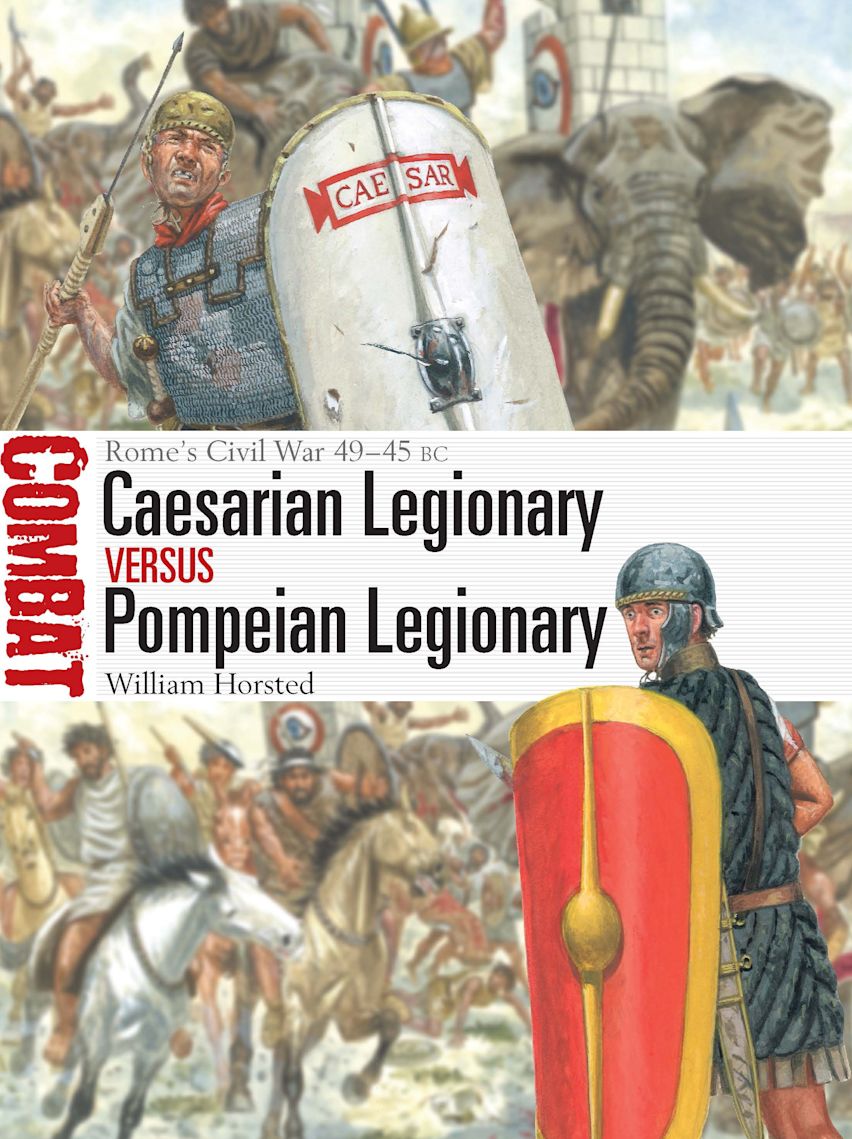
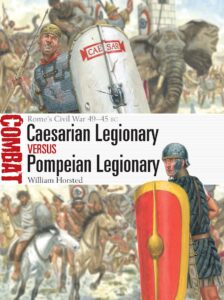
William Horsted, Caesarian Legionary versus Pompeian Legionary (Osprey, 2025)
On a cold January day in 49 BCE, Julius Caesar ‘rolled the dice’ and crossed the Rubicon river into Italy. The result of that shocking decision was a Roman civil war and a clash of two of Rome’s finest generals, the up and coming Caesar and the old warhorse Gnaeus Pompeius Magnus. As is the case for most civil wars, the combatants were very similar in arms and equipment, organisation, and tactics. In this latest book in Osprey’s Combat series, William Horsted surveys the forces on both sides and highlights the factors that led to victory for one side and disastrous defeat for the other.
Horsted weaves much of his descriptive insights into a narrative of events that begin with Caesar crossing the Rubicon, leading an army more loyal to him than Rome. That put the powers in Rome in something of a quandary, and they turned to the great general Pompey to bail them out. Horsted diverts to ask how their armies were recruited and motivated – unsurprisingly, promises of money and land helped with both. Horsted examines how these soldiers were led, how they were organised, and their weapons and equipment. Horsted now comes to his three battles. They do not include Pharsalus, which, perhaps, is surprising. First up is Dyrrachium, one of the opening engagements of the civil war in which Pompey broke Caesar’s siege lines on the Greek mainland. Then we move to another siege, this time in North Africa at Thapsus in 46 BCE. By then, Pompey was dead on a beach in Egypt and Caesar faced Scipio and his ill-behaved elephants. Caesar won that battle, but there was still work to do. The following year, Caesar wrapped things up at Munda in Spain against Pompey’s son Gnaeus. Horsted analyses those three battles, highlighting the often small differences that led to victory and defeat. He closes with a brief reminder of Caesar’s fate and the consequences of that for the doomed Roman Republic. Novices to the period will appreciate Horsted’s annotated bibliography for the ancient sources.
Caesarian Legionary versus Pompeian Legionary is a solid introductory survey of this clash of titans. Horsted comfortably navigates the often complex sequence of events, and he is aided in that by Osprey’s usual quality maps and illustrations. Horsted’s selection of three battles captures the diversity of this civil war, which was empire wide, and the forces involved. It is perhaps ironic that the battles hinged to a great extent on the performances of auxiliaries in a book on the legionaries, but that only highlights the similarities of the principal Roman forces. I also felt that Caesar’s military genius deserved more recognition. Nevertheless, this is an informative survey that will appeal mostly to readers unfamiliar with this Roman Civil War, though more experienced campaigners will still find much to enjoy and muse over.
by RNS | Jul 29, 2025 | Beating Tsundoku
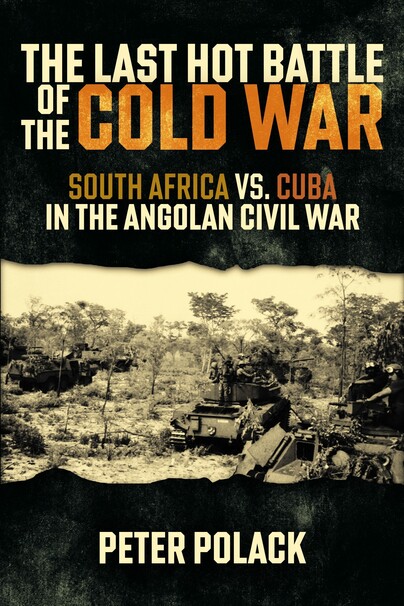
Peter Polack, The Last Hot Battle of the Cold War (Casemate, 2025)
The Battle of Cuito Cuanavale was fought between South African/UNITA and Cuban/FAPLA troops in Angola over a seven month period from August 1987 to March 1988. This was a wide-ranging battle fought over nine-thousand square miles of southern Angola, making it the second largest battle on the African continent after El Alamein. First published in 2013 and now reproduced as a paperback by Casemate, Peter Polack’s The Last Hot Battle of the Cold War tells the gripping story of an intense battle in a crucial phase of the Angolan Civil War.
BUY NOW
Polack outlines the background of the conflict, which erupted from Angola’s independence from Portugal in 1975. The main parties that fought for control were the communist backed MPLA, the US backed UNITA, Cuba, and South Africa. The civil war culminated in the two-part Battle of Cuito Cuanavale. The MPLA’s armed wing was FAPLA, originally led by Soviet advisors who planned the ill-fated attack across the Lomba river. That led to a disastrous retreat followed by a stout defence of Cuito Cuanavale, aided by Cuban forces, against a South African advance. Polack considers the Cuban and South African forces that fought in Angola, including Cuba’s dominance in air power and South African improvisation and innovation. After a brief summary of the Soviet advisors in Angola, Pollack turns to the Angolan FAPLA and UNITA forces and their development. A longer aside follows on the career of General Ben Ben of UNITA before Polack enters the narrative.
In Spring 1987, FAPLA initiated a build-up of forces around Cuito Cuanavale. That is where Polack begins his story. An initial advance of FAPLA, dogged by problems but partially successful, crossed the Lomba river then ran into a South African and UNITA buzzsaw of infantry and artillery fire. In the intense fighting that followed hundreds of FAPLA were killed and wounded. Polack interrupts his narrative with a brief biography of South African Commandant Robbie Hartslief, but he is soon back into the action with the retreating FAPLA pursued by the South Africans. Both sides then settled in for the siege of the town of Cuito Cuanavale. Polack makes it clear that the Soviet advisors to FAPLA had proved disappointing. It would be left to the Cubans to bail them out, which they did through advice, training, effective command, and forces on the ground. Polack provides a blow by blow account of the siege, including chapters on the air war, casualties, and prisoners of war. In December 1988, a ceasefire was signed, which brought about the withdrawal of Cuban and South African forces. But the repercussions continue with Polack highlighting the ongoing process of clearing landmines. Various lists of officers and men involved in the fighting closes out Polack’s book.
Polack has written a book packed with information about a conflict still too few know about. He also captures the spectrum of experience from the top commanders to the soldiers in the field, some of whom paid too high a price for poor decision making by those commanders. There are places where Polack disrupts the flow with digressions that could have been footnoted, and the ratio of narrative to information could have been better weighted, but once Polack gets into the narrative, his descriptions of ground combat are often harrowing, and he provides the reader with a sense of being there; for example, trapped in a South African armoured vehicle with a T-55’s turret slowly turning, or in an FAPLA trench as the artillery rained down, or just being in the sensory-depriving heat of Angola with potential death all around. Some of his selected quotes from the combatants are as authentic as any you will read in military history. Despite the asides and diversions, this book was well worth Casemate’s effort in bringing Angola to a wider readership.
by RNS | Jul 18, 2025 | Beating Tsundoku
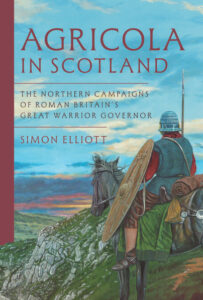
Simon Elliott, Agricola in Scotland (Pen & Sword, 2025)
According to Simon Elliott, Gnaeus Julius Agricola was Roman Britain’s greatest warrior governor. Perhaps. It is a bold statement and one that drives Elliott’s analysis in his latest book, Agricola in Scotland. Elliott sets up the imperial context for Agricola’s governorship of Britain, from 77 to 83 CE, while along the way he describes many of the elements behind that fascinating story of conquest.
Elliott begins with some Roman history 101, providing general context for the empire and the provinces, particularly Britain. This includes a glossary of key terms used in the book. After a chapter with an overview of the Republic and Principate Empire, Elliott digs into the Roman military system, again working from the most basic level. This covers the Legions and Auxiliaries, their weapons and armour, and the regional fleets. He moves onto a general description of Roman Britain in the later First Century CE, including its geography, which would prove so important in Agricola’s campaigns. Elliott also surveys the British tribes’ ways of life and their common way of war. An interesting aside here is a discussion of the weather, where Elliott asserts the Roman view that Britain was ‘wet and cold’, a seemingly obvious statement but one that may have had important military ramifications. Elliott discusses the various Roman campaigns from Caesar’s arrival to Boudicca’s rebellion in 60 CE then pauses to outline Agricola’s early life and his rise to prominence. Elliott returns to Boudicca’s rebellion, where we find Agricola serving with Governor Paulinus in north Wales. Paulinus rushed south and defeated Boudicca then left Britain with Agricola, who subsequently served in Asia, Spain, and Rome. Elliott delves into the year of the four emperors, 69 CE, and its favourable impact on Agricola, who picked the winning side and received a promotion to command a legion in Britain.
BUY NOW
The second half of Elliott’s book follows Agricola into Scotland. Elliott notes the expansionist policy of the Flavian emperors set against the psychological impact of the Varian military disaster in 9 CE. Agricola arrived in Britain, which was in turmoil because of mutinous legions. He helped calm the waters and served under two governors before becoming governor himself, with an intervening consulship in Rome. Elliott then describes the role of a Roman governor. Agricola arrived in Britain in 77 CE and immediately went to work reducing Wales and the north of England. Then he marched into Scotland. Elliott surveys the northern lands and the tribes facing Agricola and his army. Elliott stresses the importance of marching camps for following Agricola’s movements. This he proceeds to do over the course of four campaigns leading to the Battle of Mons Graupius. Along the way, Elliott discusses amphibious operations, the aborted invasion of Ireland, and Roman siege-craft. He describes the battle and its aftermath within the contexts of the Romans in Scotland and the emperor Domitian’s rise and fall.
Elliott does well to place Agricola and his campaigns into the broader imperial context, and his introductory material on the legions and Celtic warfare is useful for novice readers in the period, as is his grasp of the naval aspects of the campaigns. Readers familiar with Agricola’s campaigns in Scotland, however, will find very little new information in this book. Indeed, only about one-third of the text directly relates to Agricola in Scotland, and, in the end, Elliott falls back on a well-trodden narrative path for the campaigns and the Battle of Mons Graupius. But that is a story full of cracks that Elliott papers over, which is disappointing, and he spends little time considering alternative sites. Nevertheless, readers new to the Agricolan campaigns will find Elliott’s book a useful gateway into a fascinating, albeit brief, period in the history of Roman Britain.
by RNS | Jul 6, 2025 | Beating Tsundoku
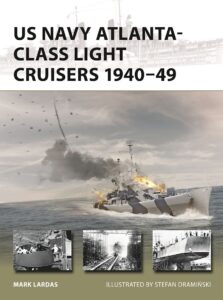
Mark Lardas, US Navy Atlanta Class Light Cruisers 1940-49 (Osprey, 2025)
Imagine being a Japanese pilot in 1943 attempting to sink a US aircraft carrier, but there is a cruiser in the way, and it is throwing an awful lot of lead up at you. If that cruiser was an Atlanta class, you would probably be rethinking your career choice. This was one of the USN’s most effective anti-aircraft ships, and Mark Lardas tells us about them.
So much of the origin stories for warships in World War II lay in the restrictive naval treaties of the inter-war years. This was particularly true for the development of cruisers. For the US, that led to the introduction of the multi-mission Atlanta class, weighing in at about 7,400 tons and festooned with weapons. Lardas highlights the criteria for the new Atlanta class ships: tonnage and speed, with armament a lower priority. He notes that the biggest weakness was instability because of their high smokestacks and stacked gun batteries. The Atlantas carried the most effective dual-purpose guns of WWII, the 5in./38cal DP guns, in eight turrets, supplemented by 1.1in and Oerlikon 20mm close-range guns, Mk15 torpedoes, and twin depth charge racks placed at the stern. The US built four Atlantas then almost immediately ordered four more as the Oakland subclass, which were orientated more towards the anti-aircraft role. The USN then built the Juneau subclass based on lessons gleaned in the Pacific Theatre. These were pure anti-aircraft ships with many changes but still based on the Atlanta design. Lardas also illustrates the changes to the ships throughout the war, which made no two of them quite the same. Eight of the Atlantas served in the Pacific, with two, the Atlanta and Juneau, being sunk off Guadalcanal. Throughout the war, however, they fulfilled their purpose of throwing lots of lead into the air to foil Japanese aircraft. Their post-war service was short-lived in the new jet aircraft generation; one fought in the Korean War while some remained mothballed through the 1950s before being scrapped.
Lardas has written an informative survey on a very useful class of ships, even though they excelled in a role for which they were only partly designed. He is ably supported by Osprey’s usual high quality graphic design and selection of photographs. It is unfortunate that none of these elegant ships survive, but Lardas’s history of them adequately keeps the Atlanta class from being forgotten. Anyone interested in the USN during the Pacific War will appreciate this book.