by RNS | Aug 9, 2021 | Beating Tsundoku
Mark Magreehan, Britain’s Airborne Forces of WWII (Frontline, 2020)
The Paras hold an iconic place in the pantheon of British army regiments. Indeed, it is difficult to imagine allied victory in World War II without them. But, as Mark Magreehan points out, they began their war as an experiment, only achieving their elevated status through hard work and sacrifice. Magreehan follows their development in this fascinating and lavishly illustrated book.
BUY NOW
Magreehan’s numerous small chapters cover the evolution of the Paras and their battle highlights. They were formed in June 1940 as a small and poorly equipped unit, and first saw action in Italy in February 1941. That was a failure, but their next operation at Bruneval the following year was successful. The Paras, having proved their worth, expanded until they formed two divisions by the end of the war. Along the way, they fought in North Africa, Sicily, Italy, Greece, and France where they took part in the D-Day landings. The Paras arguably found their most glorious moment in the defeat at Arnhem in September 1944, though that was not the end of their active service. They took part in the Battle of the Bulge in January 1945 and the crossing of the Rhine two months later. They finished the war in mopping up operations in Norway and the Far East.
The text in Britain’s Airborne Forces of WWII conforms to standard histories of the Paras, but Magreehan tells the story well enough. It is the wonderful collection of photographs accompanying the text that makes this book stand out. Some of them are familiar, but many are not. Magreehan is also adept at highlighting developments in equipment and weaponry through his descriptions of the photographs. In doing so, he also underscores how the Paras rose from being an experiment to an essential component of the British war effort. His inclusion of Polish and Canadian Paras is an important contribution to the history of this force, lest we forget. Anyone with an interest in the Paras will enjoy this book, and modellers and wargamers will be particularly rewarded by adding this to their collection.

by RNS | Aug 1, 2021 | Beating Tsundoku
Andrew Rawson, Balkan Struggles (Pen & Sword, 2020)
The Balkans. Just to say it is to conjure up images of war and devastation with an impact well beyond its borders, as unfair as that might be to the people living there. But the warlike nature of the region in the twentieth century is the focus of Andrew Rawson’s book, and he has a lot of it to narrate in under 200 pages.
BUY NOW
There is a sense of Groundhog Day about the structure of Balkan Struggles. Rawson opens with the war before the War, beginning in October 1912 with wars of independence against the Ottoman Empire. Then came Sarajevo in June 1914 and the world conflagration that followed. With the Great War behind them, you might think a long bout of peace was called for, but not in the Balkans. The Greeks, Albanians, and the Turks all fought wars in the region, and a communist uprising seized Bulgaria, and we’re still in the 1920s. Bulgaria became a right-wing state soon after the new decade started, then a dictatorship, but the major developments were taking place elsewhere on the road to World War II.
Fascist Italy attacked Greece in October 1940, and Nazi Germany invaded Yugoslavia in April 1941; the Balkans was now a significant theatre in that war. Rawson points out that occupation brought its own headaches as the partisan war developed; a multi-faceted campaign that the author does a good job of clarifying. The results of that and changing allegiances in Bulgaria and Romania caused chaos, which ended with post-war communist government across the region and a fascist junta in Greece. Rawson also devotes space to the collaborators in the Balkans and the horrors of the Holocaust, both of which would cast long post-war shadows.
Stalin’s death proved a turning point in the Balkans, according to Rawson. Soviet control over the region faltered and died over the ensuing decades, and the post-war consensus failed with the death of Yugoslavia’s President Tito in 1980. The ethnic tensions released from that loosening of control erupted in internecine warfare through the 1990s, forcing UN and NATO intervention. Peace was restored but at a terrible price. Perhaps fittingly, Rawson leaves the story there without a conclusion to bring the strands together; despite a century of war, several wounds remain open and the future for the region is uncertain.
Rawson’s narrative of the Balkan struggles is a reminder of how far Europe has come in the twentieth century, but also how far it still has to go to guarantee peace and prosperity along its volatile south-eastern flank. The structure of Rawson’s book with its subtitled state by state approach, reflects the fractured political and ethnic landscape that is the Balkans, though it also makes for a disjointed story. Nevertheless, Rawson includes enough detail to produce a satisfying if depressing account of a century of turmoil. Readers of modern European history and warfare will appreciate this survey.

by RNS | Jul 31, 2021 | Beating Tsundoku
Dmitry Ryabushkin & Harold Orenstein, The Sino-Soviet Border War of 1969 v1 (Helion, 2021)
The thought of two nuclear armed superpowers coming to blows is the stuff of nightmares. When it happens over something as paltry as who owns a small island in the middle of a river, the mind boggles. But that is exactly what happened between China and the Soviet Union in 1969. Dmitry Ryabushkin and Harold Orenstein bring us a story shrouded in mystery and propaganda in a magazine-style book from Helion’s excellent Asia@War series.
BUY NOW
Border tensions between China and Russia has deep roots, extending back to the 17th Century when there began a long series of treaties between them. These were discussions over extensive borders, but the fighting that broke out in 1969 centred around a small Island in the middle of the Ussuri River. The authors set that against the wider disagreements between the two communist powers, beginning in the 1950s after Stalin’s death. In the 1960s, the otherwise peaceful coexistence along the border changed to State inspired antagonism; scuffles and brawling followed, and a shooting war was not far behind.
The war began with a Chinese ambush on Damansky Island on 2 March 1969. The authors describe this action in some detail, aided by some remarkable photographs of the event. The Chinese withdrew from the engagement after a few hours, leaving about 20 dead on the battlefield and 31 dead Soviets. The authors add a quite unnecessary section showing photographs of some of the dead Soviets along with descriptions of how they died. The authors include this, they argue, to demonstrate Chinese barbarity driven by their propaganda. The rest of this volume is mostly dedicated to establishing exactly what happened and who was to blame. They follow that with a discussion on the western view of what happened before giving their own thoughts on why this incident occurred. They broaden their inquiry to the geopolitical aspects of the war and the greater clash between Moscow and Peking. While much of that concludes this volume, it also sets the stage for Volume 2 and the much bigger battle sparked by the Damansky Island incident.
The authors had an almost impossible task of seeking the truth from two secretive, totalitarian regimes. That they produced as much as they have is noteworthy, though it is evident that they lean heavily towards the Soviet view of events and sometimes tip into what feels like propaganda. That was hardly avoidable, however, when the Chinese evidence is almost entirely missing. The story of the ambush at Damansky Island is told with admirable clarity, and the maps and illustrations of soldiers and vehicles helps with that. This book will appeal to those interested in modern skirmish warfare and geopolitical issues in the late twentieth century.

by RNS | Jul 29, 2021 | Beating Tsundoku
Martyn Bennett, In the Midst of the Kingdom (Helion, 2021)
Martyn Bennett follows the fortunes of the Royalist army in the five counties of Derbyshire, Leicestershire, Nottinghamshire, Rutland, and Staffordshire, collectively known as the North Midlands, where the effort to establish regional Royalist powerbases and systemic control began in the wake of the inconclusive battle at Edgehill in October 1642. The plan was remarkably successful in the North Midlands, but not decisive, until the crippling defeats in the North in 1644. Bennett examines how the Royalist system worked, and sometimes didn’t.
BUY NOW
The main thread running through Bennett’s work is the command of Henry Hastings, but he casts his net much wider to include the personnel, officers, and commissioners of array who ran the system. He notes that the soldiers and administrators in the region rarely saw eye to eye on a number of issues. As with all academic discourses of this type, Bennett begins with a historiographical overview, including the main sources. He then takes us into the heart of the Royalist administration, comparing that to Parliament’s efforts to do the same. Bennett turns to the Royalist army, and it was a proper army not the bands of piratical raiders as some pro-parliament historians claim. Having laid the groundwork, Bennett puts it all into motion with two narrative chapters that could be labelled as the rise and fall of the Royalists in the North Midlands. His concluding chapter draws all this together so that Bennett can offer his thesis on how the Royalists ran their war and why they lost.
This is a book based on Bennett’s doctoral thesis first produced in 1986 and updated for publication in 2021. As you might expect then, it is a bit of a dry read with lots of analysis rather than storytelling. By the same token, Bennett’s book is well-written and packed with information and insight. This isn’t a book for ECW beginners, but for those who want to dive deeper, In the Midst of the Kingdom will certainly assist with that.
by RNS | Jul 28, 2021 | Beating Tsundoku
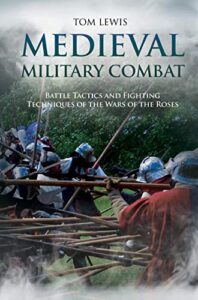
Tom Lewis, Medieval Military Combat (Casemate, 2021)
In this examination of battle in the Wars of the Roses, Tom Lewis deploys various analytical weapons, including modern warfare parallels and re-enactments, to come up with some startling conclusions that if accepted will overturn a few historical apple-carts.
BUY NOW
Lewis sets the scene with an overview of the Wars of the Roses then the development of the infantry combat that dominated the WoR battlefield. He also points out through the next chapter that contemporary accounts of battle are devoid of detail, for which there are a number of reasons, though he sets up a typical battle as a framework for exploration. Lewis examines weapons and armour, arguing that the poleaxe was probably the most lethal weapon used in the WoR. He follows that with a curious chapter on understanding medieval combat through modern books and movies because, Lewis argues, they shape our understanding of medieval combat; thus, he unmasks his intended audience as the most gullible constituency of historical readers. Chapter 5 returns to a discussion of how armour developed and when, and he again singles out movies as his enemy for understanding how armour worked. That brings us to the longbow, another misunderstood aspect of medieval tactics apparently, and back to a more involved look at the poleaxe and how it was used.
Lewis turns his attention to a hypothesis on how medieval battles were fought: he considers ground, weather, battlefield communications, loyalty in battle, aggressive leadership, the aim of the battle, the formation of the battle line, the preliminary to the foot battle, how foot soldiers were arranged, the rhythm of battle, the clash of the front lines, the infantry melee, and the continuation of battle. The Battle of Towton provides Lewis’ example. He relies on logic for the most part in his reconstruction, which looks good but is a doomed exercise for historical understanding of battles. Chapter 10 brings us to Lewis’ mythbusting. The first is the tally of deaths, which focuses solely on Towton, and then the numbers who fought in medieval armies, again based mostly on Towton. Lewis argues that the numbers of both have been exaggerated, though this is pushing at an open door and argues from the absence of evidence, which, as every historian knows, is not evidence of absence. In his short conclusion, Lewis posits a new theory of medieval battle, which is provocative but lacks the hard evidence he needs to force it over the line into an orthodox interpretation.
You have to appreciate a historian pushing the envelope to introduce new ideas to the field. But that historian has to be extra-careful with his methodology and evidence; unfortunately, Lewis falls short of the standard required in this book – when you make a historical error in your first sentence of your introduction, that does not bode well for what is to follow. He is strong on describing tangible things like weapons and armour, and he understands the limitations of his re-enactor evidence, though that does not stop him from drawing conclusions that stretches that evidence too far. Also, much of what Lewis describes, we already know, and it feels like filler. In addition, Lewis’ deployment of modern warfare analogies as evidence might look good, but it simply does not work – there is no universal soldier or timeless combat experience. His use of creative fiction as evidence, we will just file under Straw Man and move on. Lewis is on firmer ground pushing evidence from medieval warfare, but the historian has to be wary here too as with the modern analogies. And his focus on one battle, Towton, as his case-study leaves a lot of other equally important and potentially revealing battles out in the cold. Lewis’s writing is also loose at times and repetitious as if he is struggling to maintain a book-length project rather than an interesting article. His use of bullet-points merely contributes to that weakness. Nevertheless, Medieval Military Combat is thought-provoking and Lewis’s conclusions, however arrived at, are worth considering for those interested in that period of military history.

by RNS | Jul 21, 2021 | Beating Tsundoku
Stephen Turnbull, The Lost Samurai (Frontline, 2021)
You might not think that Stephen Turnbull has anything left to say after having written umpteen books on Japan’s Samurai warriors, but you would be wrong. This book takes us into the world of Japanese mercenaries in Southeast Asia from 1593 to 1688. It is a fascinating but sometimes brutal story of competing powers and factions and the men who fought for them.
BUY NOW
Turnbull acknowledges that he deals in terms of convenience. Southeast Asia is loosely defined but shaped to fit the story. As for the Samurai, they were not Samurai in the classic, romantic sense but most were initially traders turned pirates, the Wakō. Others were left over fighters from the Sengoku Period of almost continual warfare; some were exiled Christians, while more were already resident in Japanese enclaves abroad. Turnbull notes that mercenaries were common in southeast Asia and hired on contracts of various lengths. They included men from many areas, including Europe. It just so happened that the Japanese were rather good at it and developed a fearsome reputation that frightened the enemy but made their masters suspicious.
As you might expect, it was the intrusion of Europeans into the region that created employment for so many of the Japanese mercenaries, though native powers had few qualms in using them too. Many of Turnbull’s sources are European, however, and that perhaps skews the evidence towards greater European emphasis. Fittingly, it was the Spanish in the Philippines who were the first to employ Japanese mercenaries for their schemes to invade China, which came to nothing, but their assault on Cambodia in the 1590s proved more fruitful albeit temporarily so. Japanese mercenaries here also found themselves useful as state executioners on a grand scale against rebellious natives. Turnbull describes the weapons and tactics of the Samurai; while they possessed unmatched bravery, they proved susceptible to European firepower. Nevertheless, the Samurai were used in attack and defence, and as bodyguards. Turnbull visits Siam, a long-standing recruiter of mercenaries through the trade system, then he describes how the Dutch were the most enthusiastic employers of Japanese mercenaries, recruiting directly from Japan. Of note here, is the role of the Japanese in the Dutch wars with the Portuguese, Spanish, and English for the Spice Islands, the Moluccas. But like the other Europeans, the Dutch began to distrust the Japanese, leading to the end of their employment from 1623. Similarly distrustful, the Spanish feared a Samurai invasion of the Philippines. The Dutch had a better case though, when in 1643, ‘native’ Japanese mercenaries helped defend Cambodia against the Dutch, which in reality proved to be a massacre of the Europeans. The Dutch also lost in Taiwan in 1662 with the ‘Iron Men’ playing a leading role. These were probably Japanese mercenaries, according to Turnbull, and they were the last recognised as such in the region.
Turnbull is without peer in bringing the complex world of the Samurai to a public audience yet works like this demonstrate that he is no lightweight historian. This is also a bit of a detour for Turnbull, away from the history of Japan he clearly loves and into southeast Asia with its ancient civilizations and early modern European interlopers. Turnbull follows the sources, sketchy as they might be sometimes, to paint a colourful picture of individual and collective exploits, some of them very gruesome indeed. He also provides the background and context for the use of Japanese mercenaries, which uncovers a familiar but alien world in many respects. The structure of Turnbull’s book is short, self-contained chapters like an edited book of essays on a theme, and it works well, though some chapters are deeper than others. Readers interested in the Samurai and southeast Asian early modern history will no doubt enjoy this book.