by RNS | Jul 20, 2021 | Beating Tsundoku
Ian Baxter, The Warsaw Uprisings 1943-1944 (Pen & Sword, 2021)
In a war full of atrocities, the Warsaw ghetto somehow stands out, perhaps as something tangible instead of the overwhelming numbers and evil of the Holocaust, something symbolic. It is even more so because of the defiance shown by the Jews and other Poles in resisting their fate in what was ultimately a physically hopeless cause but a spiritual and moral victory for good over evil. At first, I thought this was an inappropriate title in the Images of War series, but Ian Baxter shows us something important here, something that goes beyond war into contrasting definitions of humanity and immorality.
BUY NOW
Baxter begins with the background of the German invasion of Poland and the establishment of ghettos for Jews. By October 1940, the Warsaw ghetto housed 400,000 Jews in horrific conditions. In January 1942, the Germans decided to liquidate the Jews in purpose built extermination camps; they called it resettlement and it began in July 1942. Realising their fate, a Jewish resistance movement spread. A short-lived but violent revolt broke out on 18 January 1943, then in April another more serious outbreak of resistance took place against the final resettlement order; 750 lightly armed fighters took on the German troops sent to expel them. Only through complete destruction could the German troops overcome the well prepared bunkers and defensive positions, though they had all but succeeded by 16 May. The surviving Jews were executed or transported to the death camps, the ghetto utterly destroyed, and a concentration camp set up for forced labour to clean the streets. But the resistance was not over.
In June 1944, members of the Warsaw Home Army rose up in anticipation of the Soviet offensive, but the Soviets may have betrayed them, waiting outside the city for the Germans to end Polish resistance, or German defences outside Poland stopped them; Baxter leaves this ambiguous but leans towards the former interpretation. This uprising was a much more organised fight against the Germans, resulting in special ‘pacification’ troops being rushed into the city. They initially slaughtered anyone they encountered but that only led to increased resistance. The battle then became more like a regulation urban engagement, though the poorly armed Poles had little chance. They had to surrender and did so on 2 October. Baxter then counts the cost: 11,000 Germans killed or wounded, 22,000 Polish fighters, and 200,000 civilians. The Germans partially reneged on their surrender agreement to transport 100,000 Poles to the concentration camps then started to raze Warsaw to the ground, but the Soviets finally arrived in January 1945 to seize what was left of the city.
Baxter’s narrative is straightforward and uncontroversial. But, as with all the Images of War series, the quality of the photographs give this book its value. Many are truly harrowing, even just the photos of lines of Jews being escorted out of Warsaw because we know their fate. The photos of often frightened fighters being captured conjure up similar emotions, while photos of laughing German soldiers prompt anger. Yet, looking closely, you can see the dignity and determination of the Jews; men dressed in suits, shirts, and ties, sombre rabbis, defiant women having lost everything yet standing upright in the face of death. The story being told in these photographs is one of true heroism, courage, and hope, and it is one worth telling again and again as Europe continues to face the legacy of the Nazism and hate in the 21st Century.
by RNS | Jul 18, 2021 | Beating Tsundoku
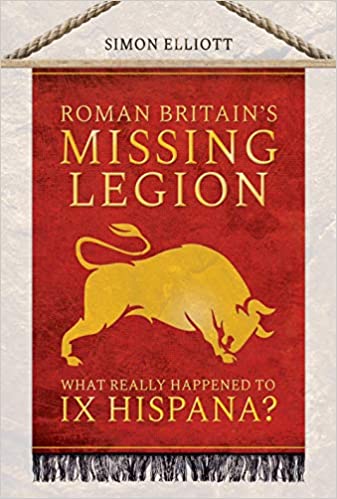
Simon Elliott, Roman Britain’s Missing Legion (Pen and Sword, 2021)
Who doesn’t love a historical mystery? And for military historians, there are fewer mysteries more prominent and perplexing than the sudden ‘disappearance’ from the record of the Roman IX Hispana Legion in 108AD. Was it destroyed in battle or more prosaically by an administrator’s pen? Roman military historian, Simon Elliott, endeavours to find out, analysing the four main theories for what happened to the 9th before delivering his own solution.
BUY NOW
Elliott circles in on the IX Legion through a description of the typical Roman Legion’s organisation and the roles played by the legionaries. A second chapter fills in the background of early Roman Britain and the progress of the Roman Legions into northern Scotland. Elliott then tackles his first theory, and the most popular, that the IX Legion was destroyed fighting in the north. As with all the theories he presents, Elliott works his way through the key evidence for and against the thesis before delivering his verdict. Staying in Britain, Elliott examines the theory that a Hadrianic war in London led to the Legion’s destruction, perhaps in a mutiny that led to the Legions erasure from history. Was the IX Legion transferred to Northern Europe then disappeared in the various wars along the Rhine or Danube? This seems to be the weakest of the theories presented by Elliott. His final search takes Elliott into the east and more wars to consider against extremely dangerous enemies, especially the Parthians. In his conclusion, Elliott brings his theories together and offers his own solution, which is… that would be telling, but this reader was quite surprised, particularly after reading Duncan Campbell’s brilliant, and still very recent, analysis of the problem in The Fate of the Ninth.
Historians of the ancient world are often fickle about their evidence, the paucity of which requires careful handling like fine porcelain. That is as it should be because minor errors can easily undermine or skew historical interpretations. Proofreading is essential. Unfortunately, the lack of proofreading in Roman Britain’s Missing Legion over simple matters creates doubts over the more complex arguments that Elliott presents; for example, Septimius Severus died in 211 not 213. Mistakes relating to some of the seemingly inconsequential background information can also be misleading: Elliott’s claim that the Caledonians attacked the legionary fortress of Inchtuthil during Agricola’s campaigns is baseless but sets up a scenario where the IX Legion could have been operating in the far north of Scotland and therefore more easily lost that way. That is careless writing, as is the resort to bullet points and summaries and introductions within chapters. It all feels a bit perfunctory, which is a shame because Elliott is obviously a knowledgeable Roman military historian, and he works his way through the four theories on the fate of the IX Legion with admirable clarity for the most part. Readers who want to skim through the mystery and gain useful background knowledge will enjoy this book, but it should have been much better.

by RNS | Jul 16, 2021 | Beating Tsundoku
John D. Grainger, Cromwell against the Scots [Revised] (Pen & Sword, 2021)
The subtitle for John Grainger’s Cromwell against the Scots is ‘The Last Anglo-Scottish War 1650-1652’. Followers of the Jacobites might contest that, but Grainger holds his ground. He notes that there has been no narrative military history of this important conflict in modern times. Grainger fixed that in the first edition of this book in 1997 but has now updated it with a revised structure and to incorporate new material.
BUY NOW
Grainger gets off to an unfortunate start when he argues that Scots suffer from “the usual inferiority complex”, thus indicating a subtle bias that underlies his analysis all the way through to his unfortunate conclusion. The military history that forms the bulk of his book tells the story of Cromwell’s invasion of Scotland in 1650, which both sides viewed as inevitable once Charles II arrived in Scotland to claim his thrones. The Scots gathered their army under Leslie and stayed on the defensive, hoping for an opportunity while wearing down the English invaders. He thought he had that at Dunbar in September, but brilliant generalship by Cromwell, argues Grainger, led to a Scottish rout and retreat to Stirling. After various manoeuvres, Cromwell dislodged the Scots who then marched into England to arouse the Royalist supporters into joining a grand army with Charles at its head. But as much as the Scots resented an English invasion, the English equally scorned the Scottish adventure – this is a central point in Grainger’s argument. The English support the Scots required proved significantly reluctant to come forward, though some did, and the army became entrapped by Cromwell in Worcester. A year to the day after Dunbar, Cromwell attacked and routed the Scots again, but this time with no chance of redemption as almost none of the Scots made it home to fight again. In the meantime, Monck, left behind by Cromwell, captured Stirling and pulled off what amounted to something of a bluff with his stretched forces in capturing Scottish towns while fostering political discontent amongst the Scottish hierarchy. Grainger notes that Scottish resistance imploded under English pressure and their incessant squabbling. Their defeat was total, and they remained under the English yoke until 1660 and the Restoration of Charles II.
Grainger’s narrative is engaging and rattles along; his description of the Battle of Dunbar is particularly good. His analysis of the fractured Scottish political scene is also insightful, though he rarely lingers on any similar problems in England with just a few forays into why some in England would not fight the Scots who had backed them in the English Civil War. Grainger’s text is well-supported by maps and monochrome photographs of interesting artefacts and place, and portraits of the main players. It is unfortunate that he concludes with an appeal to the British union that is mired in antiquated thinking, but that aside, the narrative elements are well worth reading for students of warfare in the British Isles in the Early Modern Period.

by RNS | Jul 14, 2021 | Beating Tsundoku
Johann Nobili and Christopher Pringle ed., Hungary 1848, The Winter Campaign (Helion, 2021)
(Guest Review: Mike Huston)
Hungary 1848, The Winter Campaign, is the semi-official Austrian history of the first half of the Hungarian war of Independence. Johann Nobili was tasked with rewriting the history after the initial author’s draft was deemed too negative by the Austrian authorities. It is written almost entirely from the Austrian perspective and certainly takes a more positive view of the winter campaign than the facts would allow. It is crammed full of the strategic plans for the campaign, initial troop locations and their subsequent deployments, numerous orders of battle, discusses Commanders that are unfamiliar, and takes place over a geography where many of the place names have changed. The main historical text is so full of information that it is neither a quick nor an easy read. So why bother?
BUY NOW
The War of Hungarian Independence in 1848/49 is one of the most interesting of the many conflicts that rocked Europe at that time. It is woefully under-represented in the English language and Christopher Pringle’s efforts in translating and editing this work are to be warmly welcomed. The translation flows well, and Pringle does his best to make it an easier read. He has written well over 300 footnotes to the text, providing supplementary information to help the readers understand who’s who and what is actually going on. There is even a table of place names that runs to nearly 20 pages, which details all the names mentioned in the book along with their modern equivalent when they differ to allow the readers to find them on modern maps. When the original place name is used for the first time in the text the modern equivalent appears beside it, which is a service that I wish a few more authors would take the time to provide. Several high level maps have also been provided showing the most important troop movements. To add to the context of Nobili’s account, Pringle also summarises the main events before and after the campaign. The end result is a resource that is an “un”official Austrian military history of the campaign chock full of detail that would not be found elsewhere and supported by a knowledgeable translator who makes it far more accessible to the reader.
Don’t buy this if you want the ladybird book of everything there is to know about the Hungarian War of Independence. However, if like me you have a love for the European conflicts of the mid nineteenth-century and you want to add to your knowledge of a fascinating war, you really should squeeze this one on to your already groaning bookshelves. It is a book that you will be returning to for years.
by RNS | Jul 11, 2021 | Beating Tsundoku
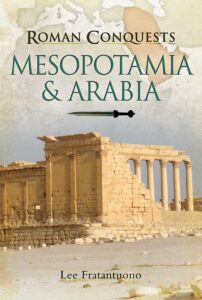
Lee Fratantuono, Mesopotamia & Arabia (Pen & Sword, 2020)
In Mesopotamia & Arabia, Lee Fratantuono embarks on a narrative history of one of the most complex regions of the Roman Empire. It is a story full of drama, treachery, empires rising and falling, and war, lots of war.
BUY NOW
Fratantuono begins with the perennial problem of lack of sources and the geographic problem of identifying the region accurately. He begins his narrative with the expedition of Gallus under Augustus, which provided much of what we know about Arabia in this period. Then it all goes quiet until the Emperor Trajan in the 2nd Century CE who established an Arabian province. It was a peaceful province for the most part, and Fratantuono leaves to describe Roman Mesopotamia, founded by Trajan, that he calls a ‘graveyard of empires’. The region was a bone of contention through the Severan Age when subsequent Roman infighting and the rise of Persia placed Roman power in the east in severe jeopardy. Alexander Severus’s assassination in 235 then plunged the empire into the crisis of the 3rd Century. The great soldier-emperor Aurelian restored the Roman east in the 270s, but as Fratantuono notes, this was against a backdrop of Persian weakness. Another break followed before Diocletian settled the region in 287, for a while anyway. Fratantuono concludes with an overview of the 4th Century with a resurgent Persia and waning Roman Empire. The Emperor Julian came east as another Alexander the Great only to die on campaign in 363. That led to a humiliating defeat for the Romans, more conflict, then a longer peace from 387.
There is no doubt that the history of Rome in the east is a convoluted story, so Fratantuono does a fine job of packing it all into 170 pages. The narrative moves along steadily but Fratantuono sometimes switches back and forward in the story, which can be quite disconcerting. As befits a work of popular scholarly literature, the text contains excellent bibliographical references throughout and Fratantuono has an obvious command of his sources. A small blemish is that we don’t actually find out that much about Roman Arabia or Mesopotamia as the narrative train rushes past. A major annoyance, however, is the lack of a regional map, making it a bit too easy to get lost in the desert as a few Roman armies did. This is probably more than a primer, though it is difficult to see how Fratantuono could have simplified things. Nevertheless, some background on the overall Roman Empire in the east might be an important first step before tackling this. That said, Roman Empire enthusiasts and students will enjoy this book very much.
by RNS | Jul 8, 2021 | Beating Tsundoku
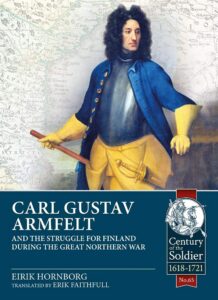
Eirik Hornborg, Erik Faithfull trans., Carl Gustav Armfelt and the struggle for Finland during the Great Northern War (Helion, 2021)
Helion is at it again with another military biography of one of the leading figures in the Great Northern War. This time the not so well known Carl Gustav Armfelt. Eirik Hornborg, one of the key Finnish historians, wrote this account in 1953 and it has been translated by Erik Faithfull who is a descendant of Armfelt. As far as I’m aware this is the first time that detailed information on the defence of Finland by the Swedes in the Great northern War has appeared in English. The original scholarship is impressive, and the translation enhances rather than distracts from the work as can sometimes be the case.
BUY NOW
The book is part biography and part military history. The biographical element covers the usual, birth, early life, marriage, previous military service and death and is interesting in its own way. The main reason for purchasing the book has to be the in depth account of the Finnish Campaigns and the shorter but no less devastating Norwegian Campaign. To give you a sense of the war, the main areas covered are:
The opening phase of the war
The Loss of the Neva Line
The Battle for the Neva Estuary and the Karelian Islands, 1704-1707
The Ingrian Campaign, 1708
The opening phase of the conquest of Finland and the recovery after the fall of Viborg
The Campaign of 1711
The Campaign of 1712
The Summer and Winter Campaigns of 1713
The Campaign around Ostrobothnia in 1714 and the battle of Storkyro.
The Norwegian Campaign 1718-19.
Hornborg’s scholarship just pours from the pages, and he manages to cover all the different aspects on the Campaigns, interweaving the manoeuvres of the land forces, the battles, the sieges, and the importance of controlling the Baltic, into a cohesive story. The book is written primarily from the Swedish perspective, but he remains even handed in his treatment of the subject matter.
The book benefits from excellent maps of the operational areas. The addition of an eight page colour section, which provides pictures of the battlefields today with troop movements superimposed along with pictures of the main protagonists, is a nice touch. The rest of the book is supported by simple battlefield maps, copious historic maps, and illustrations, along with specially commissioned pen and ink drawings of the troops in combat, which helps bring the story to life. There are also appendices on desertion, recruiting, the levy, and reserve regiments, which also add more information to the overall context of the war. Perhaps not for those new to the Great Northern War but highly recommended for anyone who wants to expand their knowledge and delve into the less well known but no less interesting struggle for Finland.