by RNS | Apr 28, 2021 | Beating Tsundoku
Brendan O’Carroll, The Long Range Desert Group in Action 1940-1943 (Pen & Sword, 2020)
The SAS receive much of the plaudits for behind the lines action in the Desert War, but the Long Range Desert Group, created from volunteers from Britain and the Commonwealth, performed a valuable function for the Allied war effort in North Africa and the Mediterranean. Brendan O’Carroll’s photograph laden book takes us inside that force with a general reference to the vehicles, weapons, equipment, uniforms, and men of the LRDG with some background history on how and where they were used.
O’Carroll begins with the formation of the Long Range Patrol Unit (LRP) in the Summer of 1940. New Zealanders mostly made up the first crop of volunteers, and they were so successful that Rhodesian and British troops became involved in the newly named LRDG in December. They were a hardy bunch, driving specially adapted vehicles. Their job was to report from behind enemy lines in the desert, set ambushes, destroy supplies, and in short create mayhem. They also made use of an obsolete Vickers Valentia bomber for recon in the early days.
The LRDG began operations in the Fezzan in Libya in 1941, fighting against the Italians. O’Carroll next surveys the CMP Ford F30 vehicle that came in after nine months to replace the Chevrolets worn out from earlier actions. The Ford was not as popular but still carried the LRDG into further actions alongside the SAS. New Chevrolets replaced the Fords in 1942 and Jeeps were used as command vehicles. By then, the unit had moved to Siwa and began aggressive patrolling, mostly at night, causing chaos behind enemy lines. But recon and intelligence gathering still played a major role for the LRDG. O’Carroll adds a chapter on the LRDG Air Section, which consisted of two sturdy Waco Cabin biplanes. These conducted recon, supply delivery, and casualty evacuation, though one was damaged beyond repair.
One particular LRDG action deserves a chapter from O’Carroll: the Barce Raid in September 1942. This was an assault on a town and airfield in northern Libya that proved successful to the war effort, though the LRDG lost considerable material but few men. By 1943, the British were advancing across North Africa with the LRDG helping to prepare critical outflanking manoeuvres. But, when the Axis forces surrendered in May 1943, there was no operational use for the LRDG, which retired to rest and reorganize in Egypt. Their work was not done, however, and the LRDG took part in the Dodecanese Operations in the Aegean in 1943. They did this mostly on foot, however, operating behind enemy lines as small units, but sometimes grouped together for bigger actions. They had their failures in this theatre but there is no denying their courage. They also fought in Italy and Yugoslavia until the end of the war.
Despite the text being of secondary importance in this book, there is enough action in O’Carroll’s narrative to excite the imagination and admiration for these soldiers. But it is the photographs that the Images of War series is known for and this edition does not disappoint. O’Carroll’s selection covers all aspects of the LRDG’s work and the vehicles and weapons they used in their devastating raids. The final section on their efforts in the Mediterranean illuminates a less familiar area of their deployment. Modellers will find everything they need in this book for their art, and wargamers will find much to chew on to recreate LRDG scenarios. General readers of the Desert War will also find the book informative and entertaining.
BUY NOW
by RNS | Apr 27, 2021 | Beating Tsundoku
Gabriele Esposito, Armies of Ancient Italy 753-218 BC (Pen & Sword, 2020)
It’s sometimes easy to forget that Rome was once a small city state on the fringes of the Greek world. But in the 8th Century BCE, Romans were just bit players on the big stage. Five hundred years later, they stood on the precipice of greatness. To get there involved a lot of hard fighting, especially against the unruly neighbours, but also against interlopers from the north and across the sea. Esposito surveys the various wars Rome fought on the road to Empire with an emphasis on their armies and enemies.
Esposito begins with Rome as a kingdom finding its feet along the Tiber river. They defeated the Sabines and organised themselves as a military society, albeit a small one. Rome, like most city states on the make, and under the influence of the Etruscans whom they would soon fight, adopted the Greek hoplite military system around 570 BCE. More wars followed, which proved dangerous to Rome, particularly when the Romans formed a Republic. By 493, after a series of conquests, they were ascendant. With the Republic came more army changes and campaigns against the Volsci against a backdrop of internal social unrest. But by 446, Rome was ready to take on the Etruscans. Esposito takes us through the sack of Rome in 390 by the Gauls and the subsequent defeat of the Etruscans. As Rome expanded, that brought it into conflict with the warlike Samnites in South Italy. To beat them, the Romans reorganized their military again, some of it along Samnite lines, into the recognizable Manipular Legion system. They lost a major battle at the Caudine Forks in 321, but being Romans, they were quickly back into the fray and winning. It took a while, but they got there. With the Samnites defeated by 290, the growing Roman Empire lapped onto the shores of the Greek world, and a war against a major threat in the Pyrrhic War. Rome now had to fight the Macedonian phalanx system, which proved attritional, but they adapted and again won through. Most of Italy was now in their hands. Sicily was next up on the hit list, which brought Rome into the Punic Wars against Carthage, the major power in the west Mediterranean. Rome’s victory after a second round of warfare replaced that power. The following chapters describe the various peoples that Rome had to fight for supremacy: the Etruscans, Latins, Gauls, Samnites, and Greeks.
Esposito’s Armies of Ancient Italy is a useful introduction to a turbulent period of ancient history. He tells a clean story, untangling a complex web of warfare and diplomacy. He is supported by photographs of reenactors in various uniforms, which is helpful for miniature painters, though not essential to the book. They also highlight the book’s weakness, which is a lack of primary sources and archaeological evidence. Those, for me, are where the energy lies in studying ancient history. For the uninitiated though, this might work as a gateway into the period. If so, job done.
BUY NOW

by RNS | Apr 24, 2021 | Beating Tsundoku
The Latecomers
Nathan N. Prefer, The Conquering 9th (Casemate, 2020)
In The Conquering 9th, Nathan Prefer presents an analytical narrative history of an American field army in World War II. In this case, the Ninth, it is an army strangely neglected by historians, argues Prefer. Perhaps this was because they were late arrivals to the war, but as Prefer makes clear, the Ninth certainly played its part in conquering Germany.
Unit histories, large and small, are shaped like biographies and this is no exception. Prefer describes the accelerated US mobilization for WWII with the Ninth officially born in May 1944. They moved to England then Normandy to reinforce operations after D-Day. In September, they took part in the Battle for Brittany. They also had to tidy up afterwards, an activity you don’t usually read about in books like this. The Ninth was soon saddled up again to continue the fight, despite logistical problems, this time much further north into the area of Maastricht. Once in position, they took part in Operation Queen, where minefields posed a significant threat and German resistance proved very strong. Operation Clipper followed to eliminate the Geilenkirchen salient in conjunction with the British. Besides the Germans, weather and roads proved most problematic. The Ninth also took many casualties, which were becoming harder to replace.
By December 1944, the Ninth was almost ready to cross the Roer, then the Germans attacked in the Ardennes, putting the Ninth on the defensive. With that resolved, the Ninth pushed ahead across the Roer in January with Operation Grenade. Then the race to the Rhine was on as German resistance began to crumble. In March 1945, the Ninth eliminated the Wesel Pocket. As they advanced, the Ninth also had to secure the new rear areas, which they also did effectively. Operation Flashpoint took the Ninth across the Rhine against little serious opposition. Prefer includes a chapter on Operation Varsity, the last great airborne assault of the war. That opened the Ruhr to attack, and the Ninth duly obliged, finishing with the capture of Dortmund. On the Ninth pushed against mostly ad-hoc enemy units with a sprinkling of harder troops. Their last major attack was to capture Magdeburg. The Ninth was deactivated in October 1945 after a short but distinguished career.
Prefer’s The Conquering 9th provides an illuminating insight into all aspects of the Ninth US Army from its introduction to deactivation. He ranges across the operational spectrum from army level planning to the soldier facing the enemy, integrating logistical considerations, commander biographies, and battle narratives. Prefer’s detailed narrative of events sometimes bogs down, and I had the sense he was trying to stuff the cushion a bit too full. Nevertheless, his combat descriptions are tightly written and provide the necessary flavour to keep his book moving. The result is an absorbing story that will appeal to any WWII reader, particularly those with an interest in the US army in Europe from D-Day onwards.
BUY NOW

by RNS | Apr 16, 2021 | Beating Tsundoku
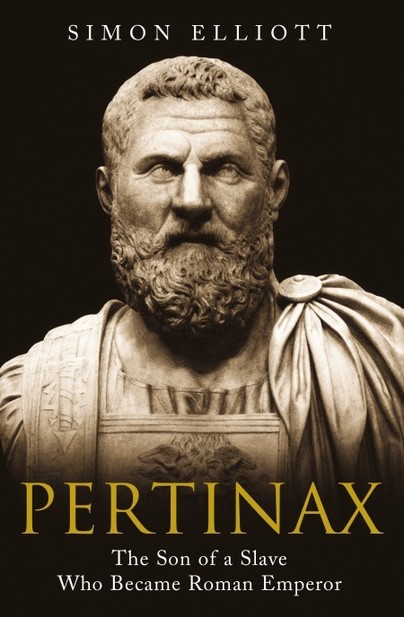
Simon Elliott, Pertinax (Greenhill, 2020)
In Pertinax, Simon Elliott brings us the life and times of arguably the most unique Emperor of Rome. The son of a manumitted slave, Pertinax rose through the ranks into the Roman aristocratic elite, and from there to the pinnacle of power. It is an almost perfect story, but there was a tragic catch at the end.
Elliott wastes no time in outlining Pertinax’s career and establishing his own credentials as Pertinax’s biographer along with the sources he used. After some housekeeping, laying the groundwork for us to understand what is to follow, Elliott sets out on Pertinax’s biography, which is interspersed with informative background details on Roman life, including slavery and patronage. Elliott works two lengthy background chapters in next, the first for the Principate Empire, the second on the Principate military complete with tables of legions and fleets and a section on the Praetorian Guard that would play such a major role in Pertinax’s rise and fall. He then returns to Pertinax’s military career. The rising star saw action in Syria and Britain where Elliott lingers for a while to describe Rome’s difficulties in the region. Moving along, Elliott narrates Pertinax’s meteoric rise through a series of postings, including fighting on the Danube, commanding a legion, then appointed as suffect consul, though not everyone supported his rise. Most of this was achieved under Marcus Aurelius, but when he died, Pertinax’s ascent continued under Commodus. In 185, Pertinax returned to an unruly Britain where he dealt with mutinous legions. A brief sojourn in Rome was followed by a proconsulship in prestigious Africa Proconsularis, then back to Rome where he spent the rest of his life. Elliott establishes the final stage of Pertinax’s career with descriptions of Rome and Commodus’s final descent into madness. When Commodus was assassinated, the Emperorship was offered to the level-headed Pertinax. The catch was that the new reform minded Emperor threatened the privileges of the Praetorian Guard, and a few months later, they killed him. Elliott concludes with the story of the year of the five emperors, 193 CE, Septimius Severus’s emergence as Emperor, and Pertinax’s legacy as an incredible man whose story should be more widely known.
Simon Elliott is correct that Pertinax needs a biographer because he was an extraordinary Roman. And Elliott fulfils that role well, narrating Pertinax’s rise and dramatic fall set against the dramatic backdrop of the 3rd Century Roman Empire. The text suffers from a lack of flow, disrupted by needless chapter introductions, bullet-point lists, and material that should be in footnotes incorporated into the main text. Nevertheless, Elliott includes a lot of pertinent information and his biography fills a hole in the historiography of one of the most turbulent periods in Roman history.
BUY NOW

by RNS | Apr 14, 2021 | Beating Tsundoku
Stephen Manning, Bayonet to Barrage (Pen & Sword, 2020)
In Bayonet to Barrage, Stephen Manning analyses seven Victorian battles to demonstrate how changing technologies enabled the British to build the biggest empire in history. He selects crucial technological and tactical turning points to illustrate his argument and produce a fascinating survey of Victorian warfare.
The Battle of Sobroan in the Anglo-Sikh War of 1846 acts as the datum for his exploration. Here, the bayonet triumphed for the British, but at a fearful cost. Up close and personal was not the way forward against disciplined armies. The percussion rifled musket, specifically the Pattern 1853 Enfield Rifle-Musket and Minie Rifle, featured in the Crimean War, decimating the Russian ranks and furnishing the Allies with the ability to involve snipers. The Enfield also proved its worth in the Indian Mutiny of 1857 and the American Civil War from 1862 to 1865. The Breech Loading Rifle, the Snider Rifle, followed and was used to great effect by the British against the Ashanti at Amoaful in 1874 and again in the Second Afghan War from 1878-1880. The Martini-Henry Rifle’s development overlapped the Snider and was used in various frontier wars, most notably against the Zulus in 1879. Manning makes it clear that rate of fire and accuracy were too much for technologically backward armies, but it was the psychological impact of these weapons as much as their killing power that did for the enemy.
Manning moves onto the Sudan campaigns of 1884-85 where Gardner machine-guns and the Martini-Henry inflicted more fearful damage. Indeed, Manning is keen to point out that despite the romanticised image of this war, the Mahdists did not come close to winning any battles. The British tactical deployment into squares helped achieve that victory. Then at the Battle of Omdurman in 1898, British technological superiority led to slaughter with the Maxim machine-gun and Lee-Metford rifle to the fore. The British would not find it so easy against the South African Boers in 1900. The technological improvement required here was in the British artillery. Smokeless rifle ammunition helped the Boers defeat British assaults, requiring a radical British rethink and rapid development of artillery tactics in support of the infantry. This came to fruition at the attack on Pieter’s Hill in the relief of Ladysmith. Manning concludes with a chapter on ‘Lessons Forgotten’ in which he argues that the offensive spirit re-entered a battlefield where defence through firepower reigned.
In the space of just over 200 pages, Stephen Manning effortlessly traverses the military landscape of Queen Victoria’s reign. A book that begins with bayonets ends in artillery shells fired from miles away and the reader barely notices the transitions until they are complete. Manning achieves that by skilfully weaving technical details of weapons with engrossing battle narratives full of observations from the men that fought in them. Bayonet to Barrage is thus an excellent survey of the Victorian battlefield and should be enjoyed by anyone interested in Britain’s pursuit and maintenance of Empire through military success.
BUY NOW

by RNS | Apr 11, 2021 | Beating Tsundoku
Nicky Nielsen, Egyptomaniacs (Pen & Sword, 2020)
Ancient History is dead, right? What difference does it make? Let it go. Or maybe don’t. In Egyptomaniacs, Nicky Nielson demonstrates the continuing relevance of Ancient Egypt in our world through examining how we came to know what we think we know about a culture that is at once alien and familiar. In doing so, he exposes many continuing myths about Ancient Egypt and presents arguments that will have you thinking about history long after you have closed his book.
Nielsen argues that our perception of Egypt stems from Classical authors, the Bible, and European explorers in more modern times. He begins with how the Greeks and Romans perceived Egypt in their different ways but both with respect for Egypt’s age and mystery. Nielsen notes also that important mediaeval Arab scholarship has been ignored for too long by many Egyptologists. Then we are into the Renaissance and a renewed interest in Egypt in Europe, though they depicted the civilization in European terms. Then we come inevitably to Napoleon’s 1798 expedition and the finding of the Rosetta Stone, indeed, much of the early part of the book focuses on hieroglyphics.
The 19th Century saw a surge in artefact collection for European museums and private investors, and great competition amongst the specialists sent out to get them, though they look like a bunch of vandals to modern eyes. Despite laws to stop it, looting continues to this day, which leads to a discussion of artefact repatriation. More controversial commentary follows when Nielsen delves into past and present tourism. He then uses obelisks as a case study for how ideologues have used Ancient Egypt for their own ends, including the strange pull Nefertiti exercised on Adolf Hitler.
Part 2 is titled ‘Inventing Ancient Egypt’, which begins unsurprisingly with Tutankhamun, or rather his spectacular burial and its discovery. And then, of course, the curse of the Pharoah’s tomb, invented by the Press and lapped up by the public. Neilsen’s discussion of mummies starts with the tons of cat mummies that arrived at Liverpool in 1890, which leads to the story of mummification and the mummy trade. Mummies also mean movies, and Nielsen shows how Hollywood has also shaped our understanding of Egypt. He arrives at the pyramids next; who built them and why? He traces the lineage of some bizarre theories, including pyramidology and links to Atlantis, and, of course, aliens. Nielsen examines belief in such conspiracy theories, which leads to a chapter on who ‘owns’ Ancient Egypt: Nielsen thinks this is a foolish question. He concludes that amongst all the distortions brought to bear on Ancient Egypt their remains a great story, perhaps the greatest ever told.
Egyptomaniacs is an informative and sometimes amusing survey of our fascination with Ancient Egypt. Neilsen confronts numerous tropes that litter modern western thought, dismantling widely-held beliefs while deflating myths and the egos of those who have perpetrated them. The book feels a bit disjoined at times, and more of a sketch than a finished work, but I also think this history of History should be required reading for those inclined to dismiss serious academics in favour of trendy theories based on prejudice and outmoded practices, not just for Ancient Egypt but all fields of history.
BUY NOW