by RNS | Nov 7, 2020 | Beating Tsundoku
Robert C Stern, The Modern Cruiser (Seaforth Publishing, 2020)
In warship designations, what is, or rather was, a Cruiser? Robert Stern is here to tell you, though he too finds them hard to define because there was no one size fits all ship for that classification. Stern’s narrative survey follows the full cycle of the Cruiser’s operational life from the 19th to the 21st Century in a lavishly illustrated, coffee-table sized book that is a must for modern naval history enthusiasts.
Cruisers came from those ships in the 19th Century that performed tasks not assigned to ships of the line. In the later 19th Century, there were three classes of Cruiser based on size. They retained their masts but were iron-hulled and coal-powered. Steel replaced iron and sailing rigs were discarded as they were built for speed and firepower. These Protected Cruisers met in battle during the First Sino-Japanese War at the Yalu River in 1894. A watershed in Cruiser design with two new types, including the light Cruiser, took place in 1897. This generation of Cruisers started to look like modern Cruisers with turret guns and a more elegant streamlined design. But could they fight? World War I would test them as they chased each other all over the oceans. Stern expertly describes the subsequent engagements, including the Battles of Coronel, the Falklands, and of course Jutland. Of all the different Cruiser types, only the light Cruiser emerged with its reputation intact into the 1920s where further developments awaited. Stern describes how the Washington Treaty affected that through its limitation of Capital shipbuilding. Cruisers now had a maximum size, which meant putting as much as possible on them; a designer’s nightmare. Nevertheless. Cruiser construction accelerated, requiring two further treaties to try and slow production, but by the mid-1930s those efforts had been abandoned. By then the Germans were ignoring the rules anyway and a Cruiser arms race followed. That would continue into World War II. Stern examines Cruiser performance in three engagements in that war, including Savo Island in 1942. Cruisers became an anachronism in the post-war world but not immediately. They were transformed into guided-missile Cruisers though some kept their guns. Stern concludes that there is still a role for Cruisers, but sadly none are still afloat.
The Modern Cruiser is a very detailed book covering every aspect of those vessels from drawing board to combat performance. Stern examines individual ships and classes throughout, highlighting improvements but also their problems. The result is a real sense of evolution, befitting the book’s subtitle. Stern’s discussion of the politics of Cruiser building is well-balanced and informative, particularly the chapters on between-the-wars initiatives. A superb collection of photographs illustrates Stern’s thoroughly researched and well-written book. Anyone interested in 20th Century warships will enjoy this book.
BUY NOW
by RNS | Nov 2, 2020 | Beating Tsundoku
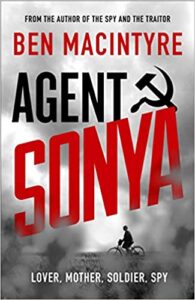
Ben Macintyre, Agent Sonya (Viking Books, 2020)
Oxfordshire, England, late 1940s. There is a lady lives in your village; a Women’s Guild type but keeps herself to herself. She loves her children, a doting mother even. She goes for long rides into the countryside on her bicycle, sometimes for hours. No one in the village is quite sure what she does for her money, though she rarely appears short. Then one day, she disappears without a word to anyone. You find out later that the woman in your midst was a spy for the Soviet Union named Ursula Kuczynski. It’s a scenario straight out of a Le Carre novel, but it was true. In Agent Sonya, Ben Macintyre narrates the extraordinary life of this redoubtable spy.
Kuczynski grew up in a middle-class Jewish German family, her father a prominent left-wing economist. This was not the background of a specialist spy, but Kuczynski had an independent streak and came of age during the rise of fascism. She drifted into communism, an ideology she never eschewed despite some severe tests. Kuczynski travelled to the USA, came home and married, then moved to China in 1930 and had a child. She was recruited as a Soviet agent by master-spy Richard Sorge who gave her the codename Sonya. The Soviets trained her as a radio operator then sent her back to China with another man. She had a child by him too, but while she loved her children that did not interfere with Kuczynski’s espionage. She was recalled to Russia in 1935 then transferred to Poland. Her husband stayed behind in China.
Switzerland was Kuczynski’s next stop where she ran agents into Germany. She divorced her first husband and married a fellow agent who was British. Kuczynski came to England in 1943, as Ruth Werner, moving around before settling in Great Rollright in Oxfordshire. As with everywhere else, she set up an illegal radio in her new house and began transmitting to Moscow. She and another spy infiltrated the American OSS, having double-agents sent to Germany. Kuczynski is most famous for handling the atomic spy Klaus Fuchs whose secrets she sent to Moscow, putting them in the atomic bomb race. She was ineptly interviewed twice by MI5, but when they caught Fuchs the game was up for Kuczynski. She fled England for Berlin on the eve of Fuchs’ trial and before he gave her up. She worked in the new GDR and authored several children’s books and her memoir. Kuczynski died in 2000 her communist beliefs intact.
Ben Macintyre should need no introduction; he is surely the leading writer of spy stories in England. With a Macintyre book, you get a fast-paced, tightly-knit story that reads like a novel. Agent Sonya is no different. Macintyre has a telling eye for detail that breathes life into his characters without becoming bogged down in minutiae, and his sense of the dramatic enlivens the text. Do not be lulled, however, into thinking that Macintyre is anything other than a thorough historian who does his research as his endnotes and bibliography attest. As for Ursula Kuczynski, she lived a charmed life, but she also made her own luck through her skill and fortitude. She was cunning, charming, diligent, and disarming; everything you need in a spy. Macintyre captures all of that expertly, and anyone interested in espionage will enjoy this book.
BUY NOW

by RNS | Oct 31, 2020 | Beating Tsundoku
Marc Burrows, The Magic of Terry Pratchett (Pen & Sword, 2020)
Terry Pratchett was one of England’s most famous writers. His novels sold in their millions and in several languages, and he received a knighthood for his work. Yet for all that, Pratchett’s books never quite received universal acceptance and he remains something of a mystery behind a very controlled public image. Marc Burrows approaches the Pratchett enigma from several angles in a biographical overview that will satisfy his legions of fans but leave others wanting a wee bit more.
The Magic of Terry Pratchett follows the standard biographical structure, beginning in Pratchett’s idyllic childhood where he thrived everywhere except in school. Pratchett was a prodigious reader in his local library, developing a passion for Science-Fiction, Fantasy, and Satire, and he began writing his own stories as a teenager. Pratchett began his apprenticeship as a journalist on leaving school and married in 1968. He also wrote children’s stories for his newspaper, some of which laid the groundwork for later novels. His first novel, The Carpet People, emerged from that work. Pratchett continued his newspaper career through editing, but still wrote columns and reviews while writing his next novel – Pratchett was a prolific writer! Two science-fiction novels followed, along with a daughter. Pratchett moved from newspapers to Public Relations and released The Colour of Magic, his first Discworld novel.
Pratchett’s fame grew with the Discworld novels that appeared regularly through the late 1980s and beyond – he wrote at least one every year, except one, until his death and 17 between 1988 and 1992. But his day job in PR became more stressful until Pratchett’s writing career truly took off with Mort, allowing him to turn full-time. After a few more Discworlds, Pratchett turned to writing children’s books and a fruitful partnership with Neil Gaiman. Burrows describes how Pratchett’s writing polarized critical opinion. Pratchett brushed off negative jibes at his work but supported his fans to the hilt and answered all their letters. By 1996, Pratchett was the best-selling living British author, though he remained grounded in his thriftiness.
The 1990s was the era of Discworld Mania with a wide range of related products, twenty-three new novels, and a crew of artists coalescing around the concept. The first Discworld convention took place in 1995. Pratchett controlled as much of this as he could even while he fostered his author’s brand. The arrival of JK Rowling on the scene relegated Pratchett to second best-selling living British author, but he took that in his stride contrary to many media stories. His later Discworld novels were heavier reads, but he still wrote children’s novels. In 2007, Pratchett announced he had Alzheimer’s Disease. His reaction was to take the fight to the disease, becoming a spokesman for the cause and eventually for euthanasia. Despite his condition, or because of it, Pratchett wrote until the day he died in March 2015.
The Magic of Terry Pratchett falls somewhere between biography and critical review. Burrows did his research, and his analysis of the Discworld concept is excellent, as is his description of the sometimes sketchy world of publishing. His critiques of Pratchett’s books are also well balanced. Burrows presents a moving discussion of Pratchett’s fight with Alzheimers and his eventual defeat. He places Pratchett into the pantheon of modern fantasy writers, while depicting him as a generous, passionate, and independent man. Burrows does not manage to break into Pratchett’s personal shell, however, leaving significant biographical questions unanswered. In addition, Burrows’ obvious veneration for Pratchett shows through, particularly in the footnotes that he claims are homage to Pratchett’s style, but are often just irritating. Burrows never met Terry Pratchett, so he considers his research for this biography as his meeting. That should set off a hagiography alarm. It does not quite reach that level, but this is certainly written for Pratchett fans.
BUY NOW

by RNS | Oct 25, 2020 | Beating Tsundoku
The Curse of Women
Paul Chrystal, Women at War in the Classical World (Pen & Sword, 2017)
Paul Chrystal’s ambition in Women at War in the Classical World is to redress the balance between men and women in ancient warfare by restoring women to their rightful place. He does this by broadening our understanding of war and examining context and background while mining the literary and historical sources. While all Chrystal’s arrows might not hit their targets, he certainly gives military history students something to think about.
Chrystal brings us into the Classical period by way of a tour of women and warfare in the earlier civilisations of Egypt, Assyria, and the Biblical world. He enters Greece through mythology, where we find goddesses heavily involved in war, but the first real Greek women involved in warfare appear in Homer, though still not as warriors – one that tries, Epipole, is stoned to death when discovered. Other seeds are planted, however, such as women as instigators, narrators, advisors, wives of warriors, camp followers, and victims. Spartan women, Chrystal notes, took their role as non-combatant influencers to the extreme. Chrystal makes a brief pitstop for the legendary Amazon women warriors, even if we know very little about them, then works his way through Greek plays. Of the great Greek historians, Thucydides all but ignores women while Herodotus mentions 375, though he had an agenda for doing so. Chrystal reminds us that to the Greeks “women and war simply did not mix”, making his survey a harder sell in the process. Nevertheless, he finds some women who did take part in combat even if many of them were in sieges. Hellenistic women, he adds, had more freedom therefore they took a greater role in military decision making.
A very short but important Part II is an essay on women as victims of war, with rape a particular and horrific consequence of defeat. Part III is reserved for women in Roman warfare. Chrystal begins with the legends but is soon into historical figures and groups. Women, he finds, travelled with the Roman army, donated to the treasury for military purposes, and fought in sieges, but some played prominent roles in decision making. Chrystal also lists some prominent women that Rome fought against, including Cleopatra VII and Boudica. Roman Epic fiction and love poetry also included women, as did the fields of arts and entertainment, including gladiators.
Chrystal concludes his work with the Homeric axiom that war is “the curse of many a woman”. He certainly amasses enough evidence to satisfy that argument. Chrystal’s book is crammed with interesting anecdotes and vignettes gleaned from the sources, perhaps too much so with the inclusion of some women having only a tenuous connection with warfare. Women at War in the Classical World lacks also flow, partly because it gets caught between narrative and thematic structures, and in parts it feels inside-out with probable footnote material incorporated into the main text. This is not helped by listing named women within the chapters. I also question the use of mythology and fiction as useful categories of historical understanding, but I can see why Chrystal included them. Those quibbles aside, Women at War in the Classical World is a thought-provoking book and well worth reading to broaden our understanding of classical warfare.
BUY NOW
by RNS | Oct 20, 2020 | Beating Tsundoku
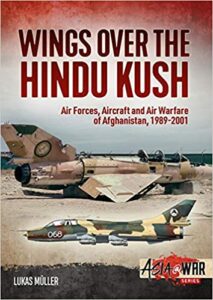
Lukas Müller, Wings Over the Hindu Kush (Helion, 2020)
Like most people, I suspect, I have not given much thought to air warfare in Afghanistan beyond Soviet helicopters strafing hillsides and American bombers raining down their loads onto far away mountains. Otherwise, Afghan wars have always seemed like relentless grinding ground wars. Lukas Müller has changed my perspective on that with his information packed and lavishly illustrated Wings Over the Hindu Kush.
Müller’s remit is the Afghan air forces between 1989, with the communist government on the brink of falling, and 2001 when the Americans entered the fray with their irresistible air power. He begins with an overview of the geography and history of the troubled region, which is useful because once Müller gets into the weeds of the civil wars of the 1990s it all becomes very hard to follow. Suffice to say, when Soviet/Russian funding ended in 1992, Afghanistan fell apart at the seams with faction fighting faction and tribe versus tribe. The Taliban entered the fray in 1994, bringing some semblance of centralised control by 2000 though it was never complete. Their fundamentalist backed terrorism, however, brought them into conflict with the United States of America and there could only be one winner when that happened.
As for air power, it became as fractured as everything else in Afghanistan with lack of parts, fuel, and trained manpower reducing effective combat operations to a rarity despite some factions making the effort to put warplanes and helicopters into the air. The rump government used air power against the Taliban but lost bases through Taliban advances, though this too swung back and forward. To be clear, Müller is not discussing large numbers of aircraft, so each combat loss, pilot defection, and accident had a disproportionate effect on overall airpower. Such attacks that did happen were mostly ineffectual. In October 2001, when Operation Enduring Freedom began, the Taliban found out what an actual air offensive looked like as their air power, including SAM and radar defences, was stripped away in an intensive bombardment. Their air force added to the growing plane graveyards around Afghanistan’s airfields. The Taliban’s overall power in the region also disintegrated under the pressure. In the end, given the circumstances of the civil wars, it was remarkable that there were any warplanes left for the Americans and RAF to destroy, which is in part testament to the men who kept them flying at all.
Wings Over the Hindu Kush is a remarkable little book of just over 60 pages, including some wonderfully rendered colour plates of aircraft and 4 pages of detailed appendices on the organization and plight of individual planes and helicopters. The rest of the book is packed full of text with Müller making the best of the threadbare sources at his disposal. Indeed, it works very well as a potted history of the Afghan civil wars as much as it is a guide to the air war. Müller has certainly plugged a hole in our understanding of the region and its turbulent history while informing and entertaining his readers. That makes Wings Over the Hindu Kush a solid addition to Helion’s Asia at War series.
BUY NOW

by RNS | Oct 18, 2020 | Beating Tsundoku
Lawrence Paterson, Operation Colossus (Greenhill Books, 2020)
When I think of British paratroopers in World War II, D-Day comes to mind, or Arnhem, but in Operation Colossus, Lawrence Paterson takes us to the foundational operation for the Paras in February 1941. This was the small but spectacular assault on the Tragino Aqueduct in Italy. Paterson narrates that operation from the initial plans to its aftermath in an absorbing read.
Paterson begins with the impulse to create small, specialized units that could take the fight to the Germans while Britain repaired its shattered army after Dunkirk. He introduces us to the players in this drama and how the RAF and Army worked out how to pull off airborne operations. Through a rigorous selection process, thirty-eight officers and men were formed into X-Troop and segregated for special training, two were added later, including an Italian interpreter. They took part in a strenuous training programme of practice drops and drills to create an elite force. Their selected target was an aqueduct in Italy that in retrospect, argues Paterson, was ill-chosen. The enthusiastic men of X-Troop were warned that few might return from the mission, which proved prophetic for most of them until the war ended.
The mission’s staging post was Malta from which eight Whitley bombers ascended to fly into Italy where they dropped most of their men more or less on target. Once on the ground, the raiders rounded up the local civilians, laid their guncotton charges, and lit the fuses. They were partially successful, damaging the aqueduct, but now they had to escape across 60 miles of Italian countryside to their waiting submarine. They split up but were all caught and interrogated; their interpreter was executed. The men of X-Troop spent the rest of the war in POW camps, though a few escaped with some hair-raising tales to tell of their adventures. X-Troop’s efforts were originally deemed a failure, but the propaganda effect on morale at home and in Italy was significant for good and bad. The formation of airborne units continued, however, incorporating the lessons learned from this attack.
Operation Colossus is a fascinating story worthy of a book, and Paterson’s diligent research honours the event and the men who took part. He uses sources as close to the action as he could get and that, along with his informative biographical details, personalises what could have been a humdrum operational report about a small action in a great war. Paterson also highlights the logistical and planning difficulties of staging a joint operation without glossing over the many mistakes that were made. Operation Colossus therefore achieves its goals and World War II readers will no doubt enjoy reading it.
BUY NOW