by RNS | Nov 21, 2020 | Beating Tsundoku
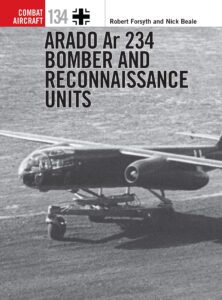
Robert Forsyth and Nick Beale, Arado Ar234 Bomber and Reconnaissance Units (Osprey, 2020)
The German ME262 receives most of the plaudits when it comes to jet warplane development, but Robert Forsyth and Nick Beale tell the story of a different jet aircraft: the Arado Ar234 bomber. It is an interesting tale with an undercurrent of ‘what might have been’ running through it.
Forsyth and Beale begin with the concept and development; testing started in 1943, though the first flew in March 1944. They then follow a detailed narrative of finding pilots and testing this unusual machine, which is perhaps surprisingly interesting given this is often skipped over to get to the operational material. The Ar234 flew its first reconnaissance mission over Normandy in July 1944, but weather, technical issues, and Allied attacks on German airfields disrupted continued missions. Taking photographs was one thing, dropping bombs quite another as far as technical considerations went. But Ar234s dropped bombs on Liege on Christmas Eve 1944, sparking a flurry of missions, some of which took place at night. They did well, working in conjunction with ME262s, and proved a problem for the Allies. Nevertheless, the Germans lacked the resources to maintain more than just a few Ar234s and Allied control of the skies hindered them further with Tempests, Spitfires, and Mustangs shooting down planes the Germans could ill afford to lose. As the war drew to close, the Ar234s performed multiple and sometimes effective missions, and to the credit of their pilots they fought on until the end against hopeless odds.
The story of the Ar234 is told with authority and the depth of the authors’ research clearly shows. The accounts of the Allied pilots tasked with bringing these warplanes down are particularly well handled. As you should expect with Osprey, the text is laced with useful black and white photographs and the usual high quality colour illustrations. Aviation enthusiasts and modelers will appreciate this book, but it is a good read for anyone interested in the latter days of the Third Reich.
BUY NOW

by RNS | Nov 18, 2020 | Beating Tsundoku
Tim Saunders & RobYuill, The Light Division in the Peninsular War 1808-1811 (Pen & Sword, 2020)
The British Light Infantry during the Peninsular campaigns in the Napoleonic Wars were at the heart of the action. They fought toe to toe with the French in the advance and on the retreat. Tim Saunders and RobYuill tell their story and describe the lives of the soldiers on and off the battlefield.
In typical fashion, the British were slow to adopt Light Infantry on more than a nominal scale, with no battalions until 1803, though they had a Rifle Corps from 1800. This became the 95th (Rifle) Regiment under Sir John Moore. Light Infantry served in the Peninsular campaigns of 1808/1809, by which time the Light Division had been formed. The Riflemen that travelled to Portugal were soon in action at Rolica and Vimiero. The unfortunate Moore found himself in command of the Peninsular army in October 1808 and despite his best efforts they found themselves in full retreat by December in the face of the French advance into northern Spain. The Light Infantry were very busy covering that retreat to prevent it becoming a rout. They were hard-pressed all the way to Corunna where with the rest of the army they stood and fought a pitched battle in which Moore was killed but the army escaped by sea. In 1809, the Light Infantry returned to the Peninsula under Sir Arthur Wellesley, the future Duke of Wellington. This was to be a very different campaign with the Light Infantry leading the advance against the retreating French, helping to drive them out of Portugal if only temporarily. In 1810, they took up outpost duties, skirmishing with the French across the lines. They also began working with the Portuguese Cacadores light infantry. The French pushed the British back again, but the Light Infantry proved a consistent thorn in their side with skilled and disciplined skirmishing tactics. In the Winter of 1810-1811, the Light Infantry proved their worth again protecting the lines of Torres Vedras, Wellington’s defensive position in Portugal. In 1811, Wellesley took the offensive again this time for good with the Light Infantry to the front as usual.
Saunders and Yuill cover well-trodden ground in this book as far as the campaigns go, but the focus on the Light Infantry is an interesting angle. The authors deliver solid combat narratives with primary sources incorporated skilfully, particularly the reminiscences of Rifleman Harris of the 95th. They add box-out text sections, covering extraneous information such as weapons, equipment, and uniforms. Reenactor photographs showing loading and basic tactics, including the famous Plunkett Position, and clear maps and modern photographs of terrain illuminate the narrative. Napoleonic wars enthusiasts will enjoy this book very much.
BUY NOW

by RNS | Nov 14, 2020 | Beating Tsundoku
Simon MacDowall, Malplaquet 1709 (Osprey, 2020)
When is a victory not a victory? Perhaps when the price is too high as the Duke of Marlborough discovered at the Battle of Malplaquet in 1709. In this Osprey Campaign series book, Simon MacDowall guides us through the campaign, the battle, and its aftermath. It is a very bloody story.
Malplaquet 1709 follows the standard format for these Osprey books. MacDowall introduces the campaign, sets up a timeline, describes the opposing commanders, forces, and their plans, then brings us into the opening moves before the battle. That takes up half the book with the second half describing the action. And what a battle it was with intense fighting in the woods on both flanks and a concentrated cavalry battle in the centre. For those that hold to the myth of the bloodless 18th Century battle, this will be quite the eye opener. MacDowall is ably assisted by the usual high quality maps and illustrations we have come to expect from Osprey, but this time with the addition of Jean-Antoine Watteau’s brilliant and honest contemporary sketches and paintings.
There are no real surprises in this solid addition to the Campaign series other than it took so long for Osprey to get around to what was a very important and consequential battle. Still, as an introductory book for the battle and the nature of Marlburian warfare, Malplaquet 1709 is a very good place to begin.
BUY NOW

by RNS | Nov 12, 2020 | Beating Tsundoku
Ioulia Kolovou, Anna Komnene and the Alexiad (Pen & Sword, 2020)
If you think you know Anna Komnene, the 12th Century Byzantine princess, as a ruthless and ambitious shrew who plotted to kill her brother and take the throne, then Ioulia Kolovou is here to put you straight. Anna was none of those things. She was a pioneering intellectual, opinionated, strong in character, and a victim of historical misunderstanding and misogyny.
Kolovou sets the scene with the cast of characters inhabiting the opulence of mediaeval Byzantium. Anna Komnene sits in a nunnery in 1147, writing a eulogy to her father, Alexios I Komnenos, called The Alexiad. Kolovou uses that piece of historical fiction to introduce Anna, her history, and its impact on future historians. Kolovou draws back to narrate the rise of the Komnenoi family in Byzantium. It wasn’t pretty, but in his ascendancy Alexios I Komnenos married and united two great families and secured the throne. Anna’s birth consolidated the dynastic marriage. Kolovou follows Anna as she grew up in Byzantium; her family life in the Imperial palace; her betrothal and moving in with her intended in-laws at 7; her return at 12 after all that fell apart; and her education. Then came marriage to a suitable, beautiful, noble match, when she was 14. Her husband, Nikephoros Bryennios, encouraged Anna’s studies, and she was a brilliant student. She also had children, and Kolovou highlights that it is easier to recover Anna’s boys than her girls in the historical record. With that Kolovou takes us on a tour of the Imperial family and the nature of power in Byzantium.
In 1118, Alexios died, setting off a power struggle that Kolovou presents through the various sources, concluding with a discussion of Anna’s role in it against her brother. Kolovou moves on to Anna writing the Alexiad in the nunnery. She takes great pains to point out that Anna was not forced into the convent, or that she lived out her life as a nun; this was just her new home. With her husband’s death in 1138, Anna was free to pursue her intellectual life and writing her famous history. Kolovou analyses Anna’s take on the First Crusade in a lengthy exegesis for what is a relatively short biography. That precedes her account of Anna’s death as a proper nun in 1153 and a discussion of her legacy. Kolovou tidies up her biography with appendices of maps, genealogy, and chronology.
Kolovou’s hope for her biography of Anna Komnene is that you will read The Alexiad with a new understanding of the woman who wrote it. She therefore writes in a looser style for public consumption rather than for academic scrutiny, but still with authority. Kolovou succeeds in penetrating the elite Byzantine world and making it accessible, which is no mean feat. She also rescues Anna from the talons of misogynist historians and places her where she belongs as an extraordinary, but very human, woman, not the monster we have been led to expect. In doing so, Kolovou has performed a useful service to Anna Komnene and history.
BUY NOW
by RNS | Nov 10, 2020 | Beating Tsundoku
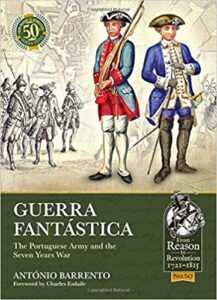
António Barrento, Guerra Fantástica The Portuguese Army in the Seven Years War (Helion, 2020)
In this slim but informative monograph, António Barrento narrates a most peculiar war between Portugal and Spain in 1762. In doing so, he brings what is usually considered a mere sideshow of the major war going on elsewhere in Europe onto a bigger stage.
Barrento begins with a repetitious introduction that should have been strangled in the draft stage, but the book picks up after that with a brief but useful overview of Europe in the mid-Eighteenth Century. He follows that with a description of warfare and the use of military force, ending in a synopsis of the Seven Years War. Most of us are familiar with the major players in that War – Britain, France, Russia, Prussia, and Austria – but my guess is that Spain and Portugal probably do not make that list. Barrento describes the Portuguese army in the years before the War in Europe as ‘nominal’ and in need of a rapid overhaul. Tensions with Spain and France added to the sense of urgency. An ultimatum was issued to Portugal in March 1762 for the Portuguese to break with the British, which they refused, promising to defend Portugal’s borders. If only they had an army to do that. Barrento dismantles what little army the Portuguese did have, which was not much particularly compared to the Franco-Spanish army on the eve of their invasion on 24 February 1762. In the end, despite some successes, the Spanish first effort met greater than expected resistance from irregular forces. In the meantime, British forces arrived to bolster the Portuguese, but the initiative remained with the Spanish. Yet local opposition, disease, desertion, and effective Anglo-Portuguese manoeuvring under the command of the excellent Count of Lippe, wore down the Spanish, forcing them to retreat and ultimately seek peace. The war was over by the end of November 1762.
For the most part, Barrento tells an interesting tale of strategic marches and counter-marches with the Spanish implementing a seemingly confused war plan and the Anglo-Portuguese stymying them at just about every turn. His narrative of operations effectively untangles the flow of events, revealing a much more serious affair than is sometimes accredited elsewhere in the history books. He is ably supported by Helion’s usual high quality illustrations of soldiers and contemporary prints and maps. Barrento’s rather polemical conclusion, however, based on a 250 years old lesson, puts a puzzling cap on his otherwise balanced account of a significant moment in Portugal’s history. Eighteenth Century warfare enthusiasts will enjoy this book as will anyone interested in the Iberian Peninsula’s history of long running conflicts.
BUY NOW
by RNS | Nov 8, 2020 | Beating Tsundoku
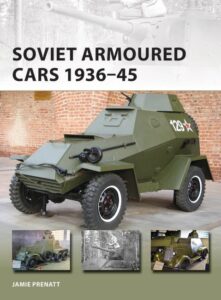
Jamie Prenatt, Soviet Armoured Cars 1936-45 (Osprey, 2020)
In this slim volume in Osprey’s New Vanguard series, Jamie Prenatt surveys a weapon not usually associated with Soviet armies: the armoured car. It is perhaps more surprising that they had been in Russian service since before the 1917 Revolution and during the Russian Civil War.
The first Red Army mechanized brigade was formed in 1929, consisting of 17 armoured cars, and a deal with Ford (!) the same year boosted design and production. Soviet armoured vehicles were heavy when equipped with cannons and light if armed only with machine guns. And with that, Prenatt works his way through the various models assisted by black and white photographs and colour illustrations. He follows up with an overview of Soviet armoured cars in action, including the Spanish Civil War, the Khalkin Gol campaign in Mongolia, the Invasion of Poland, the Winter War, and, of course, World War II. The final batch of World War II Armoured cars continued in service until the 1950s.
Soviet Armoured Cars 1936-45 is a neat and tidy little book on a weapon that proved effective in the right tactical circumstances. Prenatt does not get too bogged down in the technical details and his narrative accounts of the vehicles in action are basic but informative. All in all, this is a useful addition to the series.
BUY NOW