
by RNS | Dec 14, 2020 | Beating Tsundoku
Leonard Low, Scotland’s Untold Stories (Guardbridge Books, 2020)
Imagine sitting in front of a roaring fire on a cold winter’s night in Scotland. The wind howls around the house, rain batters the windows, and your favourite uncle, sitting beside the fire, the light sparkling through his whisky glass, says “I have a story for you”. That should set the scene to read Leonard Low’s Scotland’s Untold Stories, a collection of dark tales from Scotland’s murky past gleaned from sources long since forgotten.
Low tells stories of a warrior with an iron hand, an expensive dram of whisky, cannibals, executions by drowning, duels, witch hunters, seers, a curious jail cell in a bridge, a botched execution, pirates, the white slave trade, John Paul Jones, early balloon flights, early lighthouses, a curling disaster, a brave death at Waterloo, graverobbers, wife selling, a church disaster and one in a quarry, a riot in a church, dream evidence in a murder investigation, German U-Boats, an outbreak of St. Vitus Dance in Leuchars, a lucky escape from the Moors Murderers, and Jack the Ripper in the East Neuk of Fife? Surely not!
It is customary to highlight the best and weakest stories in a compendium, but in this book Low’s selection is of consistently high quality, though credit must be given to the way he tells them. And that is also how they should be read; with an ear for cadence and rhythm as if listening to the storytellers of old. This is no accident, however, because Low has done his homework in the archives and on the ground, and he helpfully lists his sources and books for further reading where available. You can also visit many of the sites where these stories happened. Low may lean towards the romantic at times, but this is Scotland after all where we treat the darkness then with more of a weather eye now. Anyone interested in Scotland’s history will appreciate and enjoy Low’s stories and ask when volume 2 is coming out.
BUY NOW

by RNS | Dec 12, 2020 | Beating Tsundoku
Michael Graham, On Operations with C Squadron SAS (Pen & Sword, 2020)
In this, the third book on Michael Graham’s exploits in the SAS, the author takes us into the African bush to fight communist terrorists during the late 1960s and 1970s. His stories are sometimes hair-raising, sometimes amusing, but always interesting and worth reading.
The book opens by profiling the men we are about to meet and share their experiences, from General Peter George Walls down through the ranks. Next comes some maps and a brief history of the unit and its reorganisation into an effective fighting force. Then we are off and running, literally, on an account of an evasion training exercise. Active missions followed: recovering evidence, training Portuguese troops in Angola, assaulting an MPLA base, and hunting terrorists in Mozambique. In 1980, after 12 years of almost constant fighting and with defeat looming in Rhodesia, the unit disbanded with many going on to serve with the South African army. Graham also describes South African efforts to destabilize Zimbabwe and the possible assassination of guerrilla leader Samora Michel, though Graham was not involved in the latter. Graham concludes with a brief family and personal biography, culminating in his facing the reality that at the time of writing he had lung cancer and not long to live.
Graham is a terrific storyteller, writing in a journalistic style. His tales of combat are those of an authentic cold warrior fighting on the front lines of a proxy war. His perspective is personal and focused on his work, though he detours into an extended opinion of how the British let down Rhodesia after Margaret Thatcher was asked to help and refused. Fighting communists was Graham’s life for twelve years, so it is unsurprising how much he hates them, but he shows little understanding of the conflict beyond the stark realities of war. For those interested in small unit combat operations in Africa, this is a very good read.
BUY NOW
by RNS | Dec 7, 2020 | Beating Tsundoku
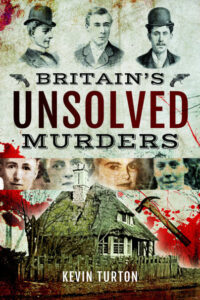
Kevin Turton, Britain’s Unsolved Murders (Pen & Sword, 2019)
In Britain’s Unsolved Murders, Kevin Turton presents a selection of thirteen crimes committed between 1857 and 1957. Turton sets the scene, provides a narrative of the murder and trial if there was one, then gives his verdict.
Some of the unsolved murders in Turton’s book are more famous than others; for example, the infamous Scottish verdict of ‘Not Proven’ delivered to Madeleine Smith in 1857 and the atrocious desecration of the young Bradford boy John Gill in 1888. While all of the murders contain a central mystery – who did it – a couple are truly baffling, namely the murders of Florence Nightingale Shore in 1920 and Evelyn Foster on a lonely moor in 1931. Others appear to have a more ready explanation to hand and only an investigative or trial error prevented the murderer being unmasked. In one case a jury member refused to convict the apparent murderer through his own conviction against Capital Punishment.
Turton narrates these stories in an engaging style, laying out the events in a straightforward manner. They are a good jumping off point for further reading, but some of the murders already have their own historian, most notably Diane Janes’ Death at Wolf’s Nick which is a brilliant forensic examination of an unsolved murder. A frustrating lack of footnotes and references, however, blunt further investigation by the reader into other cases. Turton also does not make it clear why he chose these murders across that particular century while leaving out many others and not including more modern cases. Given his personal edge to his verdicts, perhaps the title might be better read as Kevin Turton’s Casebook of Unsolved Crimes? Nevertheless, this works as a true crime book within that genre, but as an appetizer rather than a main course.
BUY NOW
by RNS | Dec 1, 2020 | Beating Tsundoku
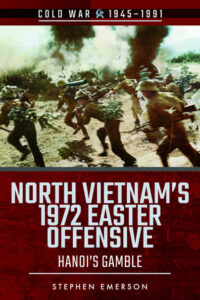
Stephen Emerson, North Vietnam’s 1972 Easter Offensive (Pen & Sword, 2020)
On paper, South Vietnamese prospects for winning the Vietnam War in 1972 looked as good as they ever had. Although the US was pulling out, its funding enabled South Vietnam to field one of the world’s biggest and best armed military forces. The policy of Vietnamization was going well apparently, but all was not as it seemed. Stephen Emerson narrates what happened next in an engaging little book.
Across the borders of South Vietnam, 225,000 North Vietnamese soldiers were massing, waiting for the order to strike. This was no peasant army, but a well-armed Soviet and Chinese backed force, whose commanders were willing to gamble on maintaining supply lines while overcoming the South Vietnamese resistance. On 30 March, NVA tanks rolled across the DMZ supported by a massive artillery barrage and 30,000 troops. More fighting broke out in April at the Cambodian border just north of Saigon, along the coast, and through the Central Highlands. ARVN defences collapsed in front of all this despite continuous air-strikes and American naval support. Then the NVA paused, allowing the Americans to escalate their air support for South Vietnam. Massive air-strikes followed, but the NVA pressed ahead with their offensive. The ARVN suffered great losses but held on where they could, particularly around Hue and the besieged An Loc. At Kontum, meanwhile, the NVA lost up to 40,000 troops in a losing effort. A lull followed again with both sides licking their considerable wounds, but the NVA had won ground. Only now they had to defend their gains.
In retaliation, President Nixon unleashed the full power of America’s Air Force on North Vietnam, hitting transportation and supply links the hardest. The North Vietnamese air defences had improved, causing some losses for the Americans though not enough to stop the pounding. While this was ongoing, the ARVN counter-attacked on the ground. After initial success, that offensive stalled too through attrition. Nevertheless, the ARVN crawled its way forward to regain much of what they had lost in the Easter Offensive and by September the NVA’s Easter gamble had failed. North Vietnam’s reluctance to negotiate saw the B-52s return in December, which changed minds if not hearts, and peace talks resumed. Emerson concludes with his analysis of the campaign that he regards mostly in terms of North Vietnamese miscalculations, though Hanoi’s gamble had exposed fatal flaws in South Vietnam’s ability to defend itself, which would end with defeat three years after the Easter Offensive.
North Vietnam’s 1972 Easter Offensive is a solid if unremarkable addition to Pen & Sword’s Cold War 1945-1991 series. Emerson teases out the main themes of the fighting that he reveals as much more intense than the textbook dismissal of the Offensive, as little more than strategic manoeuvring before peace talks, suggests. He is aided by informative maps and many colour and black and white photographs to tell a deeper story and one that deserves our attention if we are to understand the closing stages of the Vietnam War.
BUY NOW

by RNS | Nov 30, 2020 | Beating Tsundoku
Phil Carradice, The Battle of Tsushima (Pen & Sword, 2020)
In 1904, a Russian Imperial fleet sailed on an 18,000 mile voyage into disaster at the hands of a Japanese fleet under the command of a master admiral. What could go wrong for the Russians did go wrong, but the seeds of their destruction lay in Moscow. Nevertheless, the Japanese made full use of all their considerable advantages to win the ensuing battle. In The Battle of Tsushima, prolific writer Phil Carradice narrates the story of one of the most decisive battles in naval history, and one with world changing consequences.
The battle’s origins were laid in 1891 through an assassination attempt on a Russian prince while on a visit to Japan. Czar Nicholas, as the prince became, swore revenge. With his accession in 1894 and Russian expansion into the Far East, he thought he had it. But it was Japan that declared war on Russia in February 1904. To win they had to defeat the Russian fleet and chose the brilliant Admiral Togo Heihachiro to do it. He almost achieved his objective with a surprise attack on Port Arthur. When the repaired Russian fleet sailed out in August, Admiral Togo crushed them. The Czar despatched his Baltic Fleet with “Mad Dog” Zinovi Rozhestvensky in command. They had to sail 18,000 miles while taking on coal, conducting repairs, which would be many, and with mostly conscript crews.
The voyage was as bad as could be feared. False reports of Japanese torpedo boats in the North Sea were British trawlers and fired upon, which nearly resulted in war. The Russian fleet split in two at Tangiers, one to go through the Suez Canal and the other around Cape of Good Hope. Morale fell and class division appeared in the heat of Africa and toil of being at sea. Mechanical problems slowed the fleet too. The fleet reunited at Madagascar only to hear that Port Arthur had fallen and there would be no joint Russian fleet operations from that direction. Politics also intervened to make the situation worse. Morale plummeted further and fear spread, leading to mutinies. Defeat seemed certain, but the fleet sailed on.
Meanwhile, the Japanese prepared for combat. They had technical superiority and battle-hardened crews. In May, the Russian fleet, bolstered by reinforcements, moved towards Tsushima, hoping to make it to Vladivostok. On 27 May, the Japanese spotted them. Togo ‘crossed the T’ placing him at an advantage to the Russian’s battleships. Soon, Japanese shells poured into the Russians, and what they missed torpedoes hit. The battle was a catastrophe for the Russians; two-thirds of her ships went to the bottom, 4,380 sailors died. Carradice concludes with apportioning blame, the battle’s cultural legacy, and a curious epilogue describing the assassination of Czar Nicholas II.
The Battle of Tsushima is an absorbing read, though the battle itself takes up little room. Carradice writes history with a novelist’s touch, perhaps too much so at times, and highlights the farcical nature of the Russian voyage halfway round the world to inevitable defeat. The plight of that fleet is an extraordinary story that deserves its place on your naval history shelves.
BUY NOW

by RNS | Nov 23, 2020 | Beating Tsundoku
Javier Garcia de Gabiola, The Paulista War Volume 1 (Helion, 2020)
Almost every nation has suffered a Civil War at one time its history. Brazil is no exception. In fact, Brazil went through a series of civil wars, beginning around 1889 and ending in its biggest challenge in 1932. For three months, 100,000 Government troops took on 32,000 rebels from Sao Paulo, known as Paulistas, who wanted a new constitution. Javier Garcia de Gabiola brings us that story in an entertaining magazine-style book in Helion’s Latin America @ War series.
Gabiola narrates the causes of the Paulista rebellion that began in civil unrest and ended in full-scale war. He describes the Federal army that outnumbered and outgunned the opposing Paulista forces by a considerable margin. Though both sides used much the same weapons, the Paulistas never had enough, nor did they have an adequate supply of ammunition. The apportionment of heavy weapons also favoured the Government forces, as did aircraft. The Paulistas had to improvise, therefore, just to stay in the field. Gabiola continues his narrative, bringing the Paulistas into open conflict and the first operations, although their hoped for allies in neighbouring provinces failed to turn up. This was a war fought on a number of fronts, all covered well by Gabiola, who makes particular mention of the air war. He leaves this volume with the Paulista collapse along the coast.
Helion is onto something with this series of books, opening a continent of historical wars that are rarely covered in English. Gabiola’s contribution is an excellent addition to that library. Nor have the production values been spared: The Paulista War contains black and white photos, propaganda posters, and high quality, full colour illustrations of warplanes and uniforms; although Gabiola has a thing about who wore what helmets for some reason. He also includes good, clear maps, which makes events easier to follow. The result is an engaging read and I look forward to Volume II.
BUY NOW