by RNS | Mar 8, 2021 | Beating Tsundoku
Michael Livingston & Kelly DeVries, 1066 A Guide to the Battles and the Campaigns (Pen & Sword, 2020)
Who hasn’t heard of 1066 and the Battle of Hastings, the foundational battle in English history? And do we really need another book on it? Well, if two notable medieval historians are writing that book, then perhaps we do need to take notice. This is also an unusual little pocket-sized book designed for you to carry around on the five guided tours contained within, all of them relating to this most famous medieval campaign.
A colourful description of the end of Hastings draws us into this book before the authors fill in the background to William of Normandy’s invasion of England to secure the throne he claimed was rightfully his. With the stage set, they embark on their first tour: the origins of the conqueror. The tours in the book are preceded by the relevant background story, then the authors list all the best stops to complete their story, describing architectural, geographic, and cultural points of interest along the way. The other tours follow the Norwegian invasion that sapped much of the Anglo-Saxon strength over two battles; William’s landing and his road to Hastings; the fateful Battle of Hastings; and the victorious William’s march on London. The authors provide a helpful further reading list for when the reader is not on one of their tours.
1066 A Guide to the Battles and the Campaigns presents a straightforward narrative of these pivotal events in English history. That includes, however, vignettes on sources, some of the main players, archaeological artefacts, feudalism, aspects of medieval warfare, and other cultural notes that flesh out the context for the campaigns and battle. The book is also lavishly illustrated with colour photographs of locations, and it almost goes without saying that scenes from the Bayeux Tapestry are sprinkled throughout the text. All in all, this is an excellent little primer on 1066 and a first-class resource for those that want to follow in the footsteps of the victor and the vanquished.
BUY NOW
by RNS | Mar 1, 2021 | Beating Tsundoku
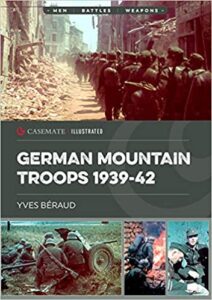
Yves Beraud, German Mountain Troops 1939-42 (Casemate, 2020)
For the German war effort in World War II, a clear bell curve emerges, illustrating their military rise and fall. The peak seems to occur sometime in 1942 when German expansion ground to a halt and defence and withdrawal became the dominant strategy. In German Mountain Troops 1939-42, Yves Beraud surveys a select branch of the Wehrmacht that fought at the cutting edge of the German advance across its European borders.
Beraud opens with a timeline of the development and operations of the Gebirgsdivision from 1935 to 1942. He gets into the details over the next series of chapters, starting with troop development before September 1939. The mountain troops first saw action in the invasion of Poland. They performed well, but it was not long before they displayed some disturbing practices in treatment of civilians and prisoners, which Beraud is a bit quick to excuse. From Poland, they helped attack Norway in 1940 and fought in some proper mountains in some proper winter weather. Afterwards, some mountain troops remained as the occupying force, while others took part in the invasion of France. The French offered stiff resistance at first, causing many casualties, but the advance was irresistible. With the French defeated, the Gebirgsdivision troops embarked for the Balkans and Crete in 1941. In Greece, they helped break through the Metaxas Line in difficult terrain but with considerable losses. The fighting in Yugoslavia was no picnic either but again they succeeded. In Crete, the Gebirgsdivision all but saved the combined air and sea operation from disaster, according to Beraud. Then came the Eastern Front. The mountain troops fought with Army Group South and breached the hastily constructed Stalin Line with relative ease, but the further they pushed, the greater the Soviet resistance, and then the weather started closing in. Spring 1942 brought more Soviet counterattacks and a thaw, bringing movement almost a halt until May. Some mountain troops fought with Army Group North that faced many of the same problems as their counterparts in the south. Beraud returns to Norway and Finland to review the mountain troops and their failed attempt to take Murmansk along with other operations in hostile conditions. Beraud concludes his work with appendices on organization, tactical symbols, and some useful abbreviations.
German Mountain Troops 1939-42 is a narrative operational history interspersed with vignettes on uniforms, commanders, and foreign recruits fighting for the Germans. Beraud’s text, structured somewhat repetitively in ‘clipped’ paragraphs with little extraneous detail, is supported by a great collection of colour and monochrome photographs – one with the men wearing patterned tablecloths to stave off the cold in Norway is my favourite. These were undoubtedly resourceful soldiers, marching thousands of miles across Europe, sometimes fighting on skis, often using mules in mountainous terrain to carry supplies, almost always taking on the hardest tasks at the cutting edge of German assaults. Beraud’s description of their hard-earned reputation as fierce soldiers, however, occasionally masks their more brutal methods, and his evident sympathy for them is sometimes unsettling. There is not much depth of analysis in this book, but it will appeal to readers interested in the German army in the early phases of World War II.
BUY NOW

by RNS | Feb 27, 2021 | Beating Tsundoku
Simon and Jonathan Forty, Tank Warfare 1939–1945 (Pen & Sword, 2020)
Is it possible to cover the entirety of tank warfare in World War II in just over 200 pages, including photographs? You might not think so, but Simon and Jonathan Forty set out to do just that by emphasizing the theatres of combat you need to know about while seeding their text with technical aspects of tanks and tactical vignettes on tactics and other useful pieces of information. The result is an engaging introductory survey that will appeal to general readers.
Forty provides tank-related abbreviations and Glossary to get the ball rolling, which is handy for the uninitiated. A potted history of tanks follows by way of an introduction, narrating the evolution of the machines and tactics by many nations through World War I and the inter-war years. Forty lingers on Nazi Germany and Heinz Guderian’s influence, which is fitting because the Nazis were ahead of the game when it came to tanks. That brings in the next chapter on the Blitzkrieg that showed what tanks could do, though Forty points out the Germans did not have things all their own way and had to evolve their tactics on the hoof. North Africa is next on this survey where the Allies persevered to overcome the Germans despite inferior tanks. The introduction of American designed tanks helped with that. The other major tank battlefield was the Eastern Front where a war of relentless attrition ensued that the Germans could not win. With the war turning in favour of the Allies, Sicily and Italy then Normandy became crucial battlegrounds for tanks and are given their due consideration. The most difficult battlefields were in the Far East where the environment often caused the problem for the Allies rather than the inadequate Japanese tanks. That concludes the narrative. Along the way, Forty injects many useful vignettes and sub-topics, including tank crews, concepts of armoured warfare and tactics, an extensive section on how tank battles were fought, and infantry cooperation with tanks. Forty closes with various appendices on Tank Guns, Gunnery, and Ammunition, Antitank Warfare, Tank Maintenance and Recovery, Tank Radios, Bridging and Bridgelayers, Amphibious Tanks, a survey of Allied Tank casualties in WWII, and Tank and SP Gun Production numbers.
The tracks could easily have come off this book because there is so much to cram into relatively few pages. Yet Simon and Jonathan Forty succeed in producing an engaging survey using elements of narrative mixed with description and analysis. They also avoid a dry and dusty text through an informal writing style that may not be to everyone’s taste but largely works. They are assisted by many interesting contemporary photographs and the vignettes sprinkled throughout. Their book is not for specialists and does not cover every aspect of WWII tanks, but for those with a general interest in the period, Tank Warfare does that job quite nicely.
BUY NOW

by RNS | Feb 25, 2021 | Beating Tsundoku
Gabriele Esposito, Armies of Ancient Greece (Pen & Sword, 2020)
The long 5th Century BCE can rightfully be called the Greek Century. This was a time when many western ideas we take for granted came into effect, for better or worse. But in addition to their contributions to culture and politics, the Greeks brought in a system of warfare that to varying degrees formed the basis of all western armies into the pre-modern era. In this book, Gabriele Esposito surveys the Greek period from 500 to 338 BCE from the military perspective.
Esposito embarks on a trip through Greek history from their beginnings down to the Polis and Hoplite era. This is where he slows down for a better look at five Greek city states: Athens, Sparta, Thebes, Argos, and Corinth. Esposito gives the background to each but opts to focus his next full chapter on Sparta, which is fitting given their martial reputation. Athens receives attention next with a similar narrative history of events. With the two main players receiving their due consideration, Esposito turns to the major Greco-Persian Wars and tells that story. That leads almost seamlessly into the Peloponnesian War then into the wars of the 4th Century and the rise of Macedonia. That is where Esposito’s narrative ends and his survey of the armies and soldiers begins. He covers hoplites, of course, Peltasts, and the Ekdromoi, Psiloi, and Hamippoi light infantry. These included slingers and archers, some of whom were mercenaries. Esposito notes that cavalry was not a main component of Greek armies except on the flat plains of Thessaly and Boeotia. He describes the Athenians as his ‘perfect’ organization for a Greek army, and adds descriptions of the Spartan army, the Theban army, and the Argive army. Esposito concludes with a chapter on the Greek panoply and tactics.
Armies of Ancient Greece is boilerplate narrative military history for the most part. The standout feature is the sprinkling of colour photographs of reenactors in Greek and their Allies’ military attire along with their replica equipment. Not all the photographs match their adjacent text, however, which might be a bit misleading, particularly when it comes to the Spartans. And that is all there is by way of illustration, which is disappointing from a culture rich in military imagery and artefacts. The text is functional, telling the history adequately, but it lacks depth of analysis – the weak bibliography gives this away before we even get to the text. The lack of referencing is also irritating, especially on contentious issues such as the Spartan treatment of their Helots, or that Marathon demonstrated that “the balance of power was changing in Greece”, which is again unsatisfactory for a culture with an abundance of military texts. Ultimately, it is difficult to determine who the audience is for this book, but if you are looking for a straightforward and lightweight military history of the period with photos of reenactors then this will do the job.
BUY NOW

by RNS | Feb 24, 2021 | Beating Tsundoku
Michal Paradowski, Despite Destruction, Misery and Privations… (Helion, 2020)
Between 1626 and 1629, the Swedish and Polish fought a bitter territorial war in Prussia. This was another in a series of wars beginning in 1600. Two great commanders led the armies: Gustav II Adolf and Hetman Stanislaw Koniecpolski. The Swedes are more familiar to English-speaking audience, but in this book, Michal Paradowski examines the Polish army, including the famous Winged Hussars.
Paradowski begins with a general oversight of the complex Polish military system with all its different contingents and allies, mainly from the Austrian Habsburg Imperial forces. Then comes a discussion of the commanders where we find that Koniecpolski was not only a militarily capable Hetman (Commander), he kept a cadre of experienced officers around him for this war. Paradowski also considers recruitment and the size of the army in Prussia. How that army was formed, organized, and equipped comes next with an emphasis on the Polish cavalry. Paradowski highlights the role of mercenaries that formed the backbone of the Polish infantry, all of which were apparently musketeers, which was highly unusual for the period. They also had very little artillery and a deficient navy, a clear problem against the Swedes who were not short of both. Paradowski moves on to logistics and finds the Poles administratively ill-equipped there too, lacking resources in all areas, including food and weapons. Nevertheless, it says something about the Poles that they fought hard for three years. Battles were small affairs and sieges were more common: Paradowski provides a very good account of those actions and how the Poles fought. In his conclusion, Paradowski notes that the 1626-1629 war was transitional for the Polish, at least tactically, but logistical and financial problems continued to haunt them for the rest of the century. His book concludes with nine short appendices, consisting of various pieces of primary evidence, and a deep bibliography, though almost all of it in Polish.
I came to Paradowski’s book through my curiosity about Winged Hussars, but I found there was much more to this Polish army than meets the eye. Paradowski presents a clear analysis of the Poles at all levels of their professional competency, or otherwise. He is supported by a series of excellent colour plates by Sergey Shamenkov and many monochrome illustrations, especially of those fabulous Winged Hussars but also other colourful units. This is certainly a niche subject, but anyone interested in 17th Century warfare, and other aspects of the Polish world illuminated by the military system and processes, will enjoy this book.
BUY NOW