Lawrence Paterson, Kriegsmarine Norway Command 1940-45 (Osprey, 2026)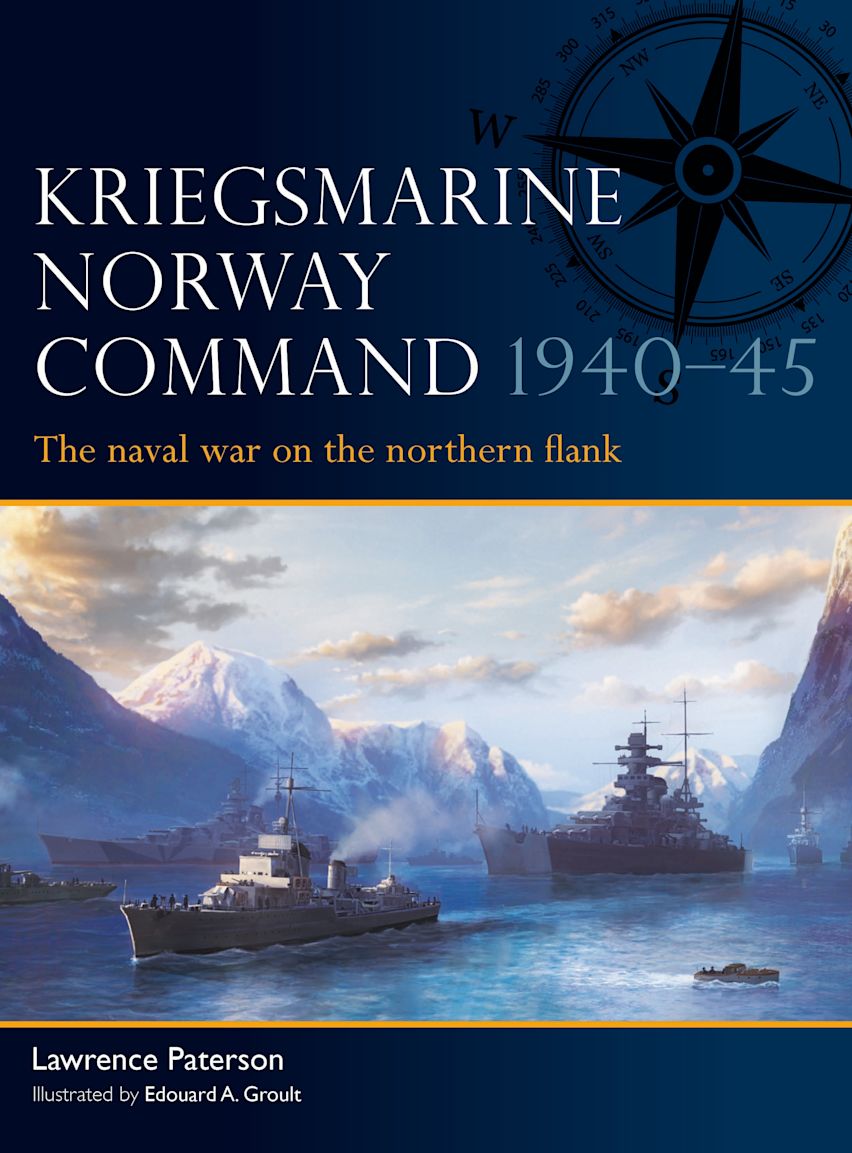
In this edition of Osprey’s Fleet series, we revisit the Kriegsmarine in Norway. Rather than the separate commands, however, Lawrence Paterson examines the totality of the German fleet operations in this theatre. That includes offensive operations into the North Atlantic and against the Soviet Union but also the layered and stretched defensive curtain the Kreigsmarine attempted to place along the extensive Norwegian coastline. To do all that, Paterson highlights the absence of a single fleet but an overall command that served Germany’s naval requirements.
Paterson relates how the German high command was persuaded that invading Norway was vital to protect Germany’s iron ore supply while providing a base of operations into the North Atlantic. He notes that the Royal Navy was initially unprepared to deal with the Germans as the coastline quickly became Fortress Norway. After providing that context, Paterson conducts a survey of ships, including Tirpitz as the standout heavy warship, many destroyers, flak ships, gunboats, torpedo boats captured from the Norwegians and repurposed, minelayers, and the ubiquitous Vorpostenboote or patrol boats, generally converted whalers and trawlers, and of course U-boats, though they surprisingly under-performed in action. Command and control proved cumbersome and in need of regular tinkering, Paterson notes, before working his way through the command structure and geographic and operational responsibilities. The war in Norway started with a bang, with Narvik the focus of fierce combat. Norwegian capitulation on 10 June 1940 resulted in a year of German consolidation. Fending off Royal Navy attacks occupied much of the German time along the long, crenulated coastline, but they also carried out offensive operations against Allied convoys in the North Atlantic and against Soviet bases. Along the way, they lost the battleships Scharnhorst and Tirpitz, one to naval combat and the other to increasingly effective FAA and RAF raids. In his analysis, Paterson argues that the invasion of Norway ‘taxed the Kreigsmarine to the maximum’ and that they failed in their mission to stop the Allied convoys. The Norwegian theatre, he concludes, promised much but delivered little.
Kriegsmarine Norway Command is a useful survey of German naval operations in a complex theatre. Paterson ranges across the wide scale of operations from big ship actions to the smallest coastal defence vessels. Along the way, he offers deeper dives into actions through informative ‘boxouts’. Osprey’s graphics, illustrations, and photographs complement Paterson’s text. Anyone interested in the Kriegsmarine or World War II naval actions in general will appreciate this book.