Pier Paolo Battistelli, Florence 1944 (Osprey, 2026)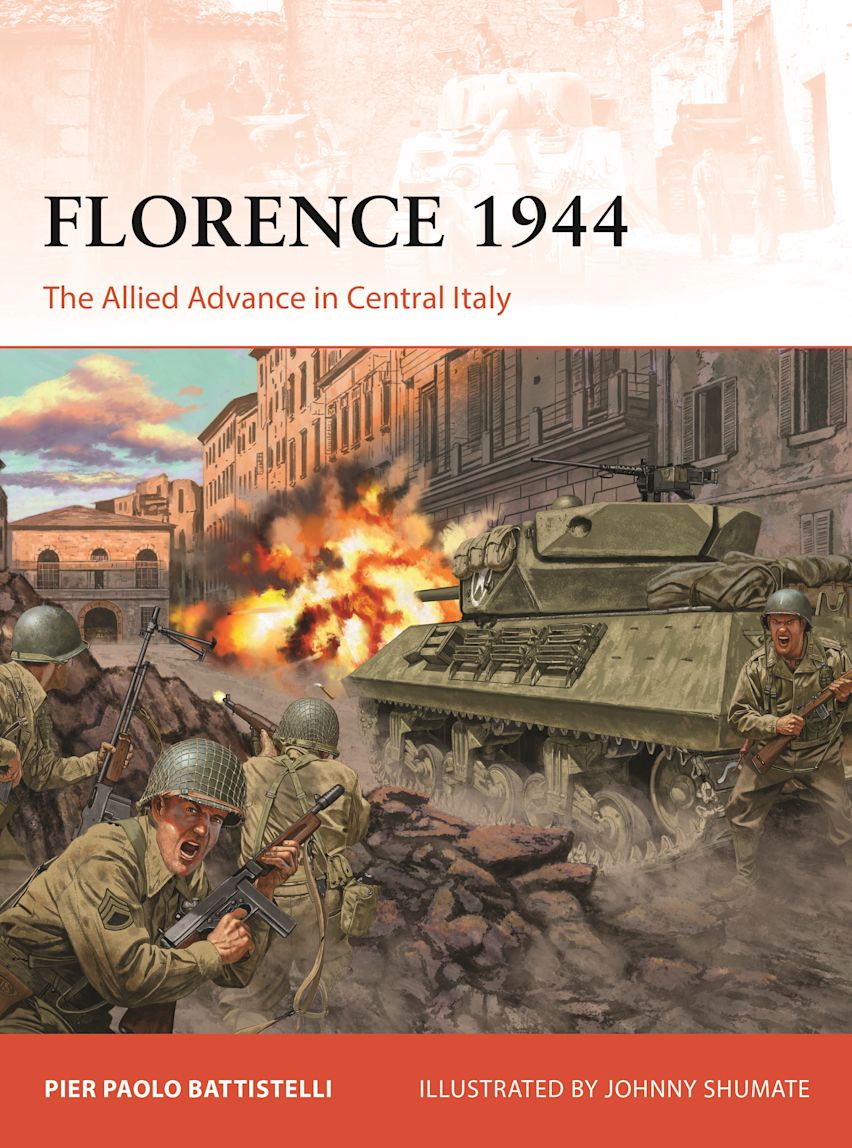
According to Pier Paolo Battistelli, in Florence 1944, the Florence campaign in Italy was one of missed opportunities for the Allies. They held the advantages of speed and manoeuvre, but they chose to conquer territory rather than go for the jugular of the German army. The Germans, meanwhile, pulled off a textbook fighting withdrawal. In this book in Osprey’s Campaign series, Battistelli tells that story.
The stand-out Allied commander, argues Battistelli, was the American Mark Wayne Clark, though he was ably supported by a cadre of talented US and Allied Corps commanders. Battistelli notes that for the Germans, army and corps commanders took the strain as they battled the Allied tide. For the forces they commanded, Battistelli again begins with the Allies. They were ascendant and superior in all military factors on the ground and in the air. However, the need for troops to invade southern France depleted the armies in Italy. Chaos and confusion, Battistelli contends, characterised the German forces, which makes it hard to determine who did what, where and when. They had been worn down but fought on while badly understrength.
The Allies lacked a plan for advancing north of Rome beyond moving fast and hitting the Germans hard. The Allied armies were allowed to use their initiative on how to proceed. The broader idea was to drive the Germans back to the Gothic Line, where they could then be defeated. The Germans had to fall back to the Gothic Line, while delaying the Allies as much as possible. And with that overview, Battistelli takes us into the campaign narrative. The long streaming northward pointing arrows on Osprey’s accompanying map do not do justice to the intensity of the fighting narrated by Battistelli.
He opens with the Allied march on Rome, leading to German confusion as they attempted to defend the Dora Line north of Rome. Nevertheless, localised German resistance strengthened as the Allies advanced. Battistelli covers the capture of Elba Island, something of a sideshow to the main thrust of Allied operations. He then surveys the British 8th Army that pushed the Germans backwards but at a pace often dictated by the Germans. The action moves on to the next German defensive line, the Albert Line, which could not resist the Allied armour and artillery superiority. Battistelli notes, however, that the Allies focused on capturing territory rather than destroying the German armies. Fierce fighting continued all the way to the gates of Florence and beyond. Battistelli concludes that the Allies missed opportunities to inflict the maximum damage on the withdrawing Germans, which made the next phase of the campaign harder than necessary. He closes with the curious absence of memorials in Italy for this campaign.
Pier Paolo Battistelli’s Florence 1944 is an informative and entertaining survey of an important but under-emphasised campaign. The relentless advance of the Allied armies against the professionally managed withdrawals of the Germans is a complex story, but Battistelli highlights the main events. And while most of his narrative is at the operational level, he does not neglect the common soldier, and he includes the considerable contributions of the Commonwealth, French, and Polish troops who did so much to bring about the Allied success. Battistelli is aided by Osprey’s excellent maps and photographs of the combatants. World War II enthusiasts will appreciate Battistelli’s book as will any reader of military history.