Brian Lane Herder, Westport 1864 (Osprey, 2026)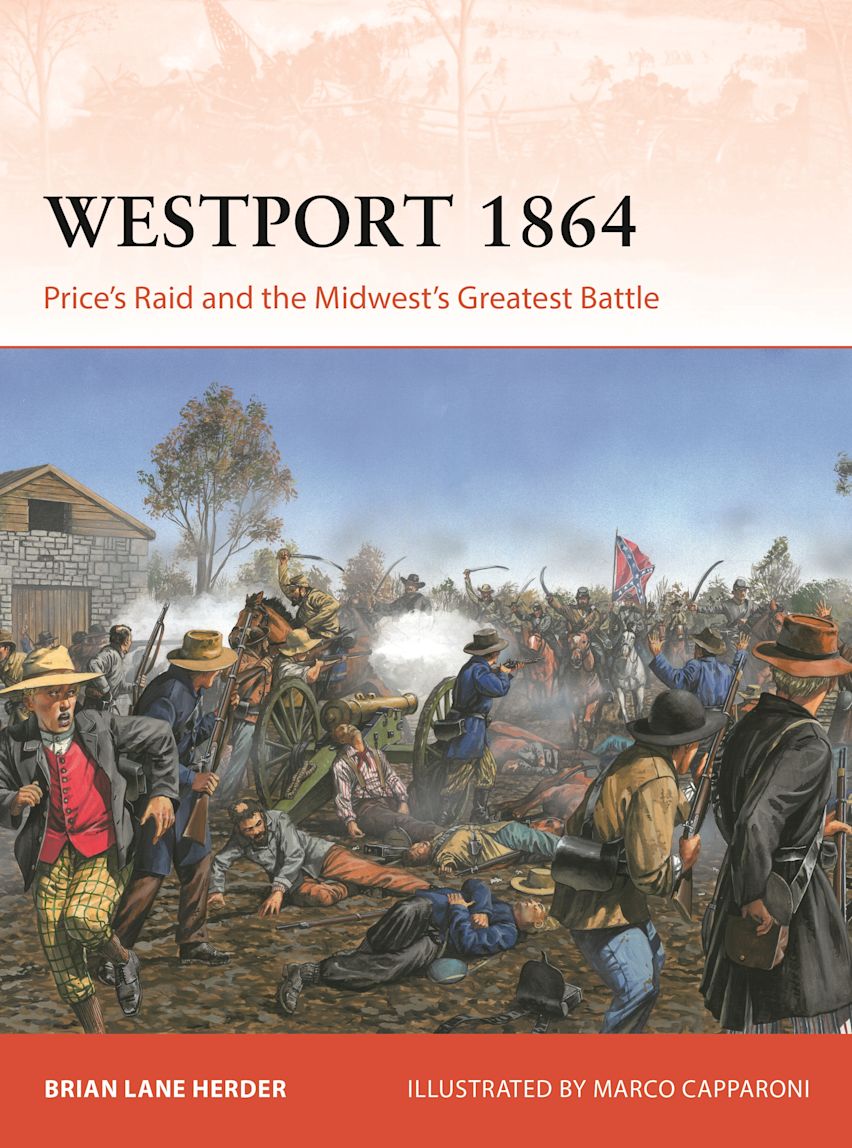
By late 1864, the fortunes of the American Civil War had firmly shifted in favour of the Union. But the fighting was far from over. While the concentration of forces remained in the East, the Western theatre had not been completely neglected, though the Federal forces in Kansas felt more threatened by Indian raids than Confederate ones. That would change in September with a Confederate invasion that threatened St. Louis. It would end in the second largest cavalry battle of the war. In this Osprey Campaign series edition, Brian Lane Herder brings us that story.
The neighbouring States of Kansas and Missouri were hotbeds of violence before the hostilities opened that became a national conflagration in 1861. The central issue was slavery against free labour, with Kansas opting for the latter when it came to picking sides in the Civil War. Herder highlights Missouri as a more contested space with considerable military activity in the early phases of the war. That included along the Kansas-Missouri border, which became anarchic. Herder assesses the strategic situation in 1864. That reveals a Confederacy firmly on the back foot and split in two along the Mississippi river. To bolster the west, the Confederates pushed a cavalry force into Missouri, traditionally known as ‘Price’s Raid’, but it was much bigger than that.
Herder reviews the various commanders on both sides, a cast of atypical characters but typical of the Civil War. The men Confederate general Sterling Price commanded consisted of three undersized cavalry divisions with some light artillery, the quality of which left much to be desired. The Federal force was of a similar size, around fourteen-thousand, consisting of regular and militia troops from across the Union. They were superior to the Confederates in almost every metric. Sterling Price’s mission was to capture St. Louis, and if forced out, to ravage Kansas; the Federals, under Major-General Samuel Curtis, just had to hold, but they were unprepared for a major Confederate invasion.
The campaign narrative follows. Herder begins in late August 1864, with the Confederate army bypassing the Federal line and moving into Arkansas before invading Missouri on 19 September. The first serious resistance came at Fort Davidson, which fell but so did 1,000 Confederates. Then, as he approached St. Louis, Price abandoned efforts to carry the town, described as ‘one of the Confederacy’s great lost opportunities’ by Herder. Jefferson City became the new target. But here too, Price opted out, rendering the overall mission a failure. Herder switches to review the anarchic bushwhacker actions along the border. Returning to the main operations, Herder describes the ‘race to Kansas’ and the clashes between the Confederates and Federals at Glasgow, Sedalia, and Little Blue River. On 22 October, the sides met at Westport in the largest battle fought west the Mississippi river. This was in reality two almost synchronous battles followed by two more the following morning. Across the battlefields, the Federals wore down their opposition before sending them flying. Rearguard actions followed until the Federals over-ran the Confederates at Mine Creek on 25 October in a stunning cavalry charge. Despite his later braggadocio, Price’s army had been destroyed almost wholesale, and the Confederate effort west of the Mississippi river was effectively ended.
The Western theatre of the American Civil War rarely grabs the attention of readers and students. That’s probably rightly so, given the scale of operations east of the Mississippi. But Brian Herder, a Kansas native, has written an action-packed narrative of war set against a fractious political background. The Westport campaign has everything that makes the Civil War interesting, and in some ways, unique, and there is the added dimension of a large cavalry battle to enjoy. It’s a fascinating story. Herder is ably supported by excellent maps, graphic illustrations, and contemporary photographs. Readers of the Civil War will appreciate this book.