by RNS | Nov 21, 2021 | Beating Tsundoku
Jack Devine, Spymaster’s Prism (Potomac Books, 2021)
When a former senior official in the CIA writes a book warning of the dangers posed to the West by Putin’s Russia, you have to take notice. That is precisely Jack Devine’s stated motive in Spymaster’s Prism. He surveys the Cold War history of competitive espionage between the USA and Soviet Union and how that has carried forward to the present day. All of that was carried out under a set of unwritten codes known as “Moscow Rules”. They helped keep the Cold War cool; but Devine notes that under Putin, those rules have been abrogated. We are therefore in a very dangerous situation.
Devine organises his book into thirteen intelligence lessons circling a central premise: “never trust the Russians”. It follows that Devine sees complacency towards Russia where there should be vigilance; Russian interference in the 2016 US Presidential election should have tipped us off to that. His evaluation of Putin and his strategic vision is scathing, but not surprising. This takes Devine into his survey of espionage from World War II when the Soviet Union’s KGB held most of the cards. The CIA was formed in response, but Devine points out that since 9/11 their efforts have been focused on the problems associated with that event with Russia left behind as almost an afterthought. And that chapter structure of looking back to look forward, typifies this book, which makes for an engaging and stimulating read. Along the way, we meet the notorious spies on both sides and the techniques used then and now to create leverage against the ‘enemy’. In the end, Devine pleads the case for renewed attention to Russia and a renegotiation for Moscow Rules.
As with all polemics, Spymaster’s Prism has to be treated carefully, and there is no doubt that Devine’s position in the CIA encourages a level of suspicion that his book might not deserve. From a historical perspective, Devine provides a fascinating insight into some of the great espionage cases of the 20th Century. His clear exposition of the current Russian threat is also well grounded in his sources, particularly the Mueller Investigation that should have, and maybe did, set all the alarm bells ringing. And there’s the rub; we don’t know what we don’t know, and we’re probably not supposed to, that’s how intelligence works. So, who is the audience for this public appeal? The politicians, American voters, the intelligence community, all of the above? I’m not sure, but I do know that as a student of espionage I enjoyed this book even if I’m not completely sold on Devine’s fearful thesis.

by RNS | Nov 17, 2021 | Beating Tsundoku
Conor Whately, A Sensory History of Ancient Warfare (Pen & Sword, 2021)
Conor Whately follows in the footsteps of John Keegan’s Face of Battle approach to military history that has been around for a while now, but he digs deeper into the more encompassing sensory immersion of combat. However, Whately structures his book not around the five senses, as I expected, but in three sections: the Greek World, the Roman World, and Late Antiquity. Those are further sub-divided into prominent battles of the period. That allows Whately to consider the five senses collectively for each engagement. The chapters follow a similar pattern: context and sources, then Whately moves into the sensory experience.
BUY NOW
Part I, the Greek World, takes us to the Battle of Cunaxa in 401 BCE. Whately’s main sources for this chapter are Xenophon’s Anabasis with help from Diodorus Siculus and general archaeological finds. He describes the sights and sounds of two armies advancing to contact then in battle. This is reasonably well-covered ground, but Whately continues with the other senses: touch, smell, and taste. Some of this falls outside the battlefield but still affects the battle experience. Whately’s description of the Battle of Issus (333 BCE) emphasizes the role of sight. He again takes us through the background and sources before analysing the peculiar visual aspects of this battle.
We’re into the Roman world in Part II, following the pattern set for the Greek battles. Whately picks Cannae (216 BCE) as his first battle to study; a bold choice given how much has been written about it. But Whately again approaches from the sensory perspective, picking three senses to highlight: sight, sound, and touch. Given the massacre that befell the Romans, that makes for some unpleasant reading. Two sieges come next: Jerusalem (70 CE) and Masada (72-74 CE). Of course, food and water, or lack thereof, was an essential item for the besieged. Then there were the sights, smells, and sounds of the horrors that accompanied the sack of a city. At Masada, that was different with the alleged mass suicide of the defenders. Whately ends this section with the fascinating story of a woman trapped in a cave with other rebels during the Bar Kokhba revolt.
Late Antiquity occupies Part III, beginning with the Battle of Strasbourg (357 CE). Here Whately deploys all five senses to make sense of the battle: the sight of banners through the dust clouds, the sounds of horns and trumpets, the push of battle lines, and the role of food, the taste and smell of it, for well-fed soldiers. The Siege of Edessa (544 CE) concludes Whately’s survey with the by now customary overview of the sensual experience with particular emphasis on the ordeal of the besieged. Whately sums all this up by arguing that studying the sensory approach to ancient warfare, we can open up new insights into how wars were fought and the lives of those who fought them.
Whately promises much with this book, and for the most part he delivers. He is correct that his approach provides an extension of the Face of Battle approach to warfare, though his strengths are in the audio-visual aspects that are reasonably familiar to military history students. Much of his background and narrative sections tread common ground too. But none of that should detract from an engaging book written in an entertaining style by a historian whose work is embedded in the primary sources. It says something when you read a historian and want to read more of his work. I look forward to doing that. Other students of ancient military history will also undoubtedly lap this up.

by RNS | Nov 9, 2021 | Beating Tsundoku
Wolfgang Schneider, Panzer tactics. German small unit armor tactics in World War II (Stackpole Books, 2020)
Panzer Tactics is a translation of a German work first published in 2000, containing 372 pages and a claimed 400 illustrations, though that seems on the low side to me. Schneider served as an armour officer in the German army and his knowledge of his subject shines through at all times. He has written a number of books on German tanks in WW2 and has a mastery of his subject, and he has clearly spent a lot of time in and around tanks, both modern and WW2.
Sometimes you can judge a book by its cover, but not in this case. Here we have one that is far more than it claims and quite simply an essential source for anyone with an interest in the period or amour in general. Schneider has taken military training manuals, unit histories, after action reports, and a myriad of other documents and extracted and collated a wealth of information from them. These are backed up by hundreds of photos from a large variety of sources and are mostly previously unpublished. Add sketch maps and schematic diagrams and this becomes a primer for all things Panzerwaffe. Throughout, Schneider gives the German terms as well as the English, so if you are ever unclear about Hauptkauptkampfentfernung he spells it out for you, or his translator does at any rate.
Schneider sets out the various chapters thematically, starting with offensive operations, then defensive operations, unit movement, reconnaissance etc. They don’t all relate to tactics but also include logistics and maintenance, life in a panzer, and training and tank gunnery. These add to the completeness of the book, so while not strictly covered by the title they are more than welcome inclusions. There is a short chapter on tactics today and in the future, which seems a bit tagged on and unnecessary, but that is a very minor complaint for what is otherwise an excellent book. The illustrations are chosen to best illustrate the text so do not flow chronologically but thematically and show a huge variety of vehicles from a VW saloon to a Tiger II and everything in between. There are a number of oddities, like a Panzer I command tank in a combat unit in summer 1944, which as Schneider says, shouldn’t be there.
This is an excellent book on the German panzer arm and will appeal to anyone with an interest in the topic, be they a modeller, historian or wargamer. This should be the first item on their Xmas list.
Reviewed by Jim Graham

by RNS | Oct 31, 2021 | Beating Tsundoku
Waldemar Goralski, USS Stevens (Kagero, 2020)
The United States of America built 175 Fletcher Class destroyers, some of which were notable for their aircraft carrying capability. One of those was the USS Stevens, commissioned in February 1943, though the airplane function was removed that December. She is the subject of this illustration heavy book by Waldemar Goralski. The USS Stevens served as an Atlantic convoy escort and in the Pacific as a carrier and convoy escort. She also helped with shore bombardment, fire support, and air defence as the American net closed in on Japan. She was decommissioned in July 1946 but stayed in reserve until 1972. The rest of this oddly satisfying book is made up of beautifully rendered colour graphic illustrations of the visible structure of the USS Stevens. A series of monochrome scale drawings is included as a fold-out supplement. I can’t imagine a casual reader picking this book up, but certainly a modelmaker or WWII US Navy enthusiast will enjoy poring over the artwork.

by RNS | Oct 29, 2021 | Beating Tsundoku
Christopher Brice ed., Forgotten Victorian Generals (Helion, 2021)
Say what you like about the Victorian period and the British Empire, but there’s no doubting the range of colourful characters that inhabited the era. Nowhere is this truer than in the British Army. In this collection of essays, Christopher Brice has drawn together essays from various historians on seven of Queen Victoria’s lesser lights.
Anyone doubting the relevance of this work need only turn to the first general on the list, Sir George White, who made his reputation as a young major in Afghanistan in the 1878 campaign as described by Rodney Atwood. He went on to command in Burma during a particularly volatile period, then in Balochistan. He was also the hero of the Ladysmith siege during the Boer War. Ian Beckett narrates the career of Sir William Lockhart. He served in the Indian Mutiny and the Far East then back to the North-West Frontier. Indeed, he would become the army’s foremost frontier expert. His signal moment came when he commanded the Tirah Campaign in the winter of 1897. Unfortunately, Lockhart’s career ended with his premature death from malaria in March 1900.
Christopher Brice takes up the baton with his account of Sir Robert Cornelis Napier. Napier, Brice points out, is now largely forgotten but was once Britain’s ‘go-to’ general in the event of war. He arrived in India in 1829 to command the 1st Bengal Sappers but greater things lay ahead. He served in the Anglo-Sikh Wars and the Indian Mutiny. He also commanded in China and led the stunning 1867 Abyssinian expedition. From there, he returned to become the Commander-in-Chief of India then took up the same position in Gibraltar. That was his last command as new leaders were rising in the British army. Edward Gosling looks at the career of Sir John Charles Ardagh, a Royal Engineer from 1859 who made his reputation as an intelligence officer, beginning in 1875. Much of his valuable work lay in engineering, surveying, and diplomacy, though he saw action in the Sudan. Gosling argues that Ardagh was an important general through the modernization period for Victoria’s army.
Notable historian John Laband’s contribution is an analysis of the aristocratic Sir Arthur Cunynghame in South Africa from 1873 to 1878. He was a veteran of the First Opium War and the Crimean War before landing in India in 1862. He commanded his first true colonial expedition in 1877 in the Ninth Cape Frontier War in South Africa, though he saw no action. Politics rather than military failure did him in and he was recalled to Britain. Paul Ramsay continues the essays with his review of Sir William Nicholson, the ‘leading staff officer of his generation’. He spent thirty years in India, Afghanistan, Egypt, and South African honing his skills as an engineer and staff officer, and played a significant role in preparing the British army for World War I. Finally, Roger Stearn considers Lord Wantage VC. He joined the Scots Fusilier Guards in 1850 and was one of the earliest VC winners, earning his in the Crimean War. However, he never commanded a formation in battle, according to Stearn. Indeed, he did not see much action at all after Crimea, but he played a role from the side lines as one of the benevolent aristocracy that populated Late Victorian England.
While all that might seem like an extensive summary of contents, I’ve barely scratched the surface of this enthralling and information packed book: Victoria’s generals were an extremely industrious lot. The seven essays are uniformly well-written by historians who know their material, though there is some inevitable overlap between essays. As for the generals, what comes across are universal attributes, such as courage, administrative expertise, political awareness, and logistical and planning skills that kept an extensive empire running through Victoria’s long reign. That these were the ‘forgotten’ generals speaks volumes for those who are still household names. If you have an interest in the Victorian empire or the 19th Century British army, you will want to read this book.
by RNS | Oct 26, 2021 | Beating Tsundoku
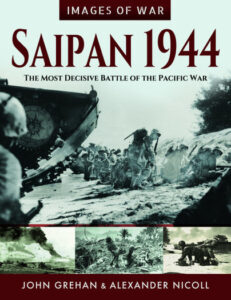
John Grehan & Alexander Nicoll, Saipan 1944 (Frontline, 2021)
Spring 1944, and the war in the Pacific had turned against Japan. But as long as their homeland remained free from threat, argue Grehan and Nicoll in Saipan 1944, then war’s end looked no closer. If the Americans could take the Mariana Islands, that would change because the new B-29s could hit Japan. The most heavily defended was Saipan; this book in the Images of War series tells the story of the American assault and the bitter fighting that followed.
BUY NOW
The authors take us through the whole of Operation Forager intended to capture Saipan. The Americans underestimated Japanese strength on the 12.5 mile long misshapen island where 32,000 Japanese defenders waited, not the expected 17,000. D-Day was 15 June 1944, supported by naval gunfire and aerial bombardment, but that didn’t prevent the Marines deploying onto the beaches under a storm of Japanese fire. Nevertheless, the Marines pushed inland and onto the high ground, winkling the Japanese out of their caves and bunkers one by one in intense combat that lasted for several days before entrapping the Japanese remnants on the north of the island. Grehan and Nicoll detour to cover the massive but one-sided naval battle of the Philippine Sea that took place during the conquest of Saipan. Returning to the island, the authors describe the last desperate banzai attack of the defenders on 7 July: over 4,300 Japanese died. All that was left was to mop up holdouts and survivors, but the horror was not over as hundreds of civilians committed suicide by jumping from cliffs. With Saipan taken, the authors conclude with photographs of B-29s taking off to bomb Japan, mission accomplished.
As with all Images of War books, Saipan 1944’s success lies in the range and quality of its photographs. On the whole, these are informative and sometimes thought provoking. There are perhaps too many naval photographs, but the modern pictures of where the action took place are interesting, and the combat photographs of US Marines graphically portray what they endured. The accompanying text is concise, and the authors make good use of quotes from those involved. They also include some very useful maps so that readers can follow the action. Overall, this is a solid addition to the series.